Reflected XSS in the shared note view on https://evernote.com
A reflected XSS vulnerability exists in the shared note view because the ionUrl parameter is only checked for containing the Evernote base URL, not starting with it. An attacker can craft a link that executes JavaScript in the victim's browser, potentially stealing cookies and taking over accounts.

- Disclosed after 30 days
Summary:
There is a reflected XSS vulnerability on https://evernote.com, in the shared web note view, triggered through the view and ionUrl parameters of the /shard/s[SHARD_NUMBER]/client/snv endpoint.
Description:
When a user creates a note and shares it, it is stored in the following endpoint, being accessible by its GUID and generated KEY: https://www.evernote.com/shard/s[SHARD_NUMBER]/sh/[NOTE_GUID]/[NOTE_KEY].
The above link redirects to another generated link this is going to be used to access the ressource in the web note viewer, and has the following format: https://www.evernote.com/shard/s[SHARD_NUMBER]/client/snv?noteGuid=[NOTE_GUID]¬eKey=[NOTE_KEY]&sn=[PREVIOUS_LINK]&title=[NOTE_TITLE]
When accessing from this web note viewer link, a script named main.68d4af6d45d9dcaab6e6.js is fetched from https://dashboard.svc.www.evernote.com/app/nv/, used to format and display the note properly.
After analyzing this file, we can observe at line 3353 of this script (beautify the script first) a function named renderWithContext() that handles different ways of rendering the note:
renderWithContext() {
    switch (this.view) {
		case "content-unavailable":
			return this.renderContentUnavailable({
				header: this.state.i18n.t("SharedNote.contentUnavailable.info"),
				body: this.state.i18n.t("SharedNote.contentUnavailable.downloadInfo")
			});
		case "saved":
			return this.renderContentUnavailable({
				header: this.state.i18n.t("SharedNote.contentUnavailable.savedOnMobile.info"),
				body: this.state.i18n.t("SharedNote.contentUnavailable.savedOnMobile.downloadInfo")
			});
		case "notelink":
			return this.renderNoteLinkView();
		case "after-save-note":
			return this.renderAfterSaveNoteView()
	}
	const { embedMode: e } = this.state;
	return e ? this.renderContent() : o.createElement("div", {
		className: Gn.appContainer
	}, this.renderHeader(), this.renderContent())
}
Since the this object represent the current URL parameters, the switch statement switch (this.view) gives away that we can reach this function by adding a view parameter in the URL.
The vulnerable case here is after-save-note. Here is what the renderAfterSaveNoteView() function looks like:
renderAfterSaveNoteView() {
	if (W())
		if (R.isMobile) {
			const e = oe(R.isMobile);
			e && (window.location.href = e)
		} else {
			const e = function () {
				const e = W();
				let n = e && e.ionUrl;
				return n && -1 === n.indexOf(J.baseUrl) ? null : n
			}();
			e && (window.location.href = e)
		}
	return null
}
We can observe line 12 that this script sets the window.location.href attribute to the variable e. As line 9 shows, we also control this variable e as it represents an additional parameter we have to add in the URL: ionUrl.
However, we can see at line 10 a security measure that will try to prevent attacker from setting the window.location.href attribute to anything outside evernote.com: J.baseUrl contains the value "https://www.evernote.com/". This line basically checks if the substring "https://www.evernote.com/" is present in the provided ionUrl URL parameter.
That's where the vulnerability resides; it only checks if the substring "https://www.evernote.com/" is in the provided ionUrl URL parameter, but not that it starts by it.
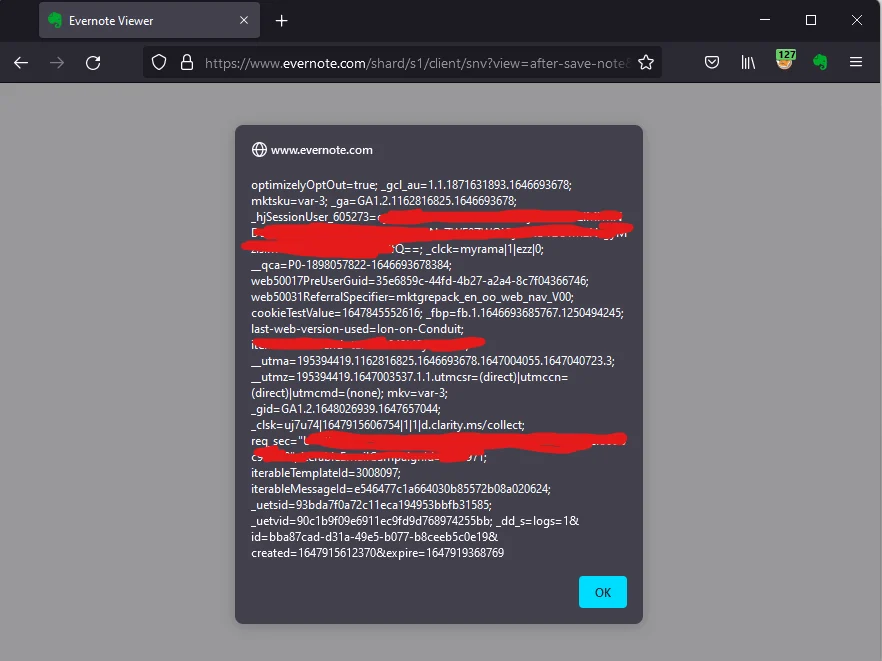
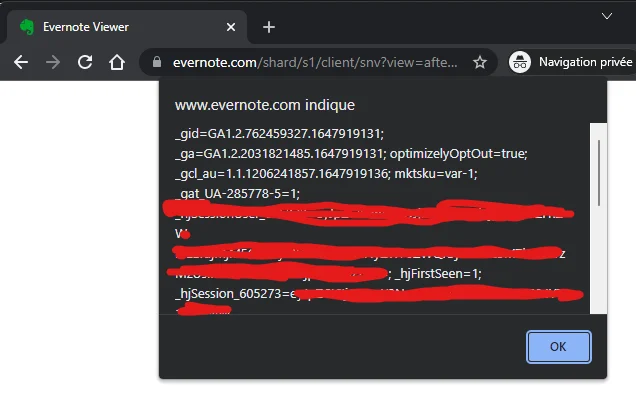
I was then able to execute javascript by passing the following payload to ionUrl : javascript:alert(document.cookie)//https://www.evernote.com/, using javascript comments to comment-out the evernote link (and setting view to after-save-note in order to reach this function).
Here is the POC that will display current cookies in an alert box: https://www.evernote.com/shard/s1/client/snv?view=after-save-note&ionUrl=javascript:alert(document.cookie)//https://www.evernote.com/
The link to the note doesn't have to valid, only the view and ionUrl parameters matter. An attacker could also have a valid note link that is properly displayed, and still execute the javascript silently. He can also force the user to sign-in beforehand to make sure to get his cookies.
This has been tested and working on up-to-date Firefox and up-to-date Chrome. This exploit works on the latest version of Evernote.
Steps To Reproduce:
- Click on the following link: https://www.evernote.com/shard/s1/client/snv?view=after-save-note&ionUrl=javascript:alert(document.cookie)//https://www.evernote.com/
Supporting Material/References:
Impact
An attacker can execute script in a victim's browser, making him able to take over accounts of victims, make victims perform action without their consent, steal their private data, install malware, and so on.
Not written yet. The AI write-up for this report has not been written yet. The Original tab links to the source.
How it worked
Impact
An attacker can execute script in a victim's browser, making him able to take over accounts of victims, make victims perform action without their consent, steal their private data, install malware, and so on.
What the attacker needed
Victim clicks a link
Explained by bugbounty.wiki with AI from the original and checked against quotes from it; it can still be wrong. Read the original before relying on a detail.
Not written yet. The AI write-up for this report has not been written yet. The Original tab links to the source.
This is a cross-site scripting (XSS) bug. The website takes a value from the link (ionUrl) and uses it to redirect the browser, but it only checks that the value contains the site's address, not that it starts with it. So an attacker can put JavaScript code in the link, and when a victim clicks it, the code runs on the real site and can steal the victim's login cookies.
What is XSS?
Script an attacker supplies runs in another user's browser, on the target's origin, with that user's session.




