SSRF in graphQL query (pwapi.ex2b.com)
The GraphQL query for allTicks allowed the source parameter to be set to an arbitrary URL, causing the server to make GET requests to that URL. An attacker could use this to perform blind SSRF, scanning internal ports and sending requests to internal services, though HTTP responses were not returned.

- Triaged in 7 days
- Fixed in 5 months
- Paid in 8 days
- Disclosed after 6 months
Summary by the program
SSRF in one of the graphQL parameters.
The report
Summary:
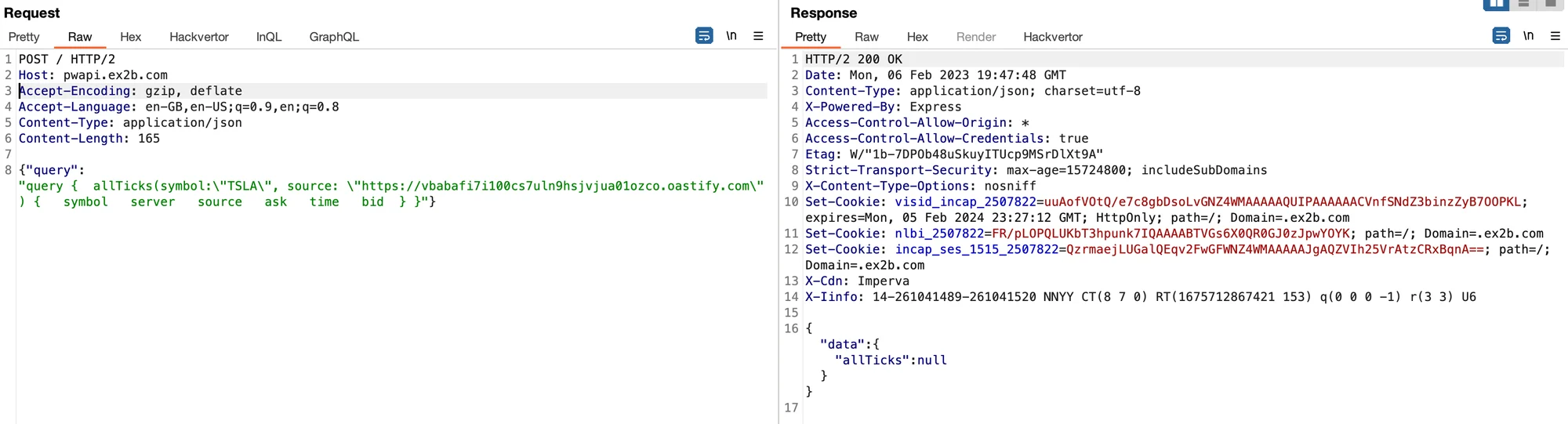
The query for allTicks allows setting the parameter source that is used to do GET requests, this can be set arbitrarily .
Steps to Reproduce:
- Use a service like burp collaborator to observer incoming requests.
- Replace my domain with your burp collaborator domain and execute the graphQL request.
- Observer incoming DNS and HTTP requests.


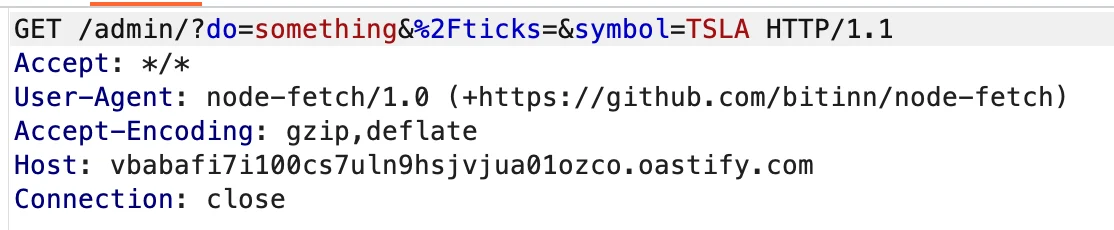
Please note that the source parameter in the graphQL request can be a full URL so that any GET request is possible.

Impact
The SSRF vulnerability can be used to potentially compromise internal services that are exposed to internal network requests. Unfortunately, HTTP responses are not returned, but an attacker can still gather information about open ports and perform blind HTTP GET requests against internal services, potentially help in finding more severe vulnerabilities on internal network services.
Mitigation
The application must only accept servers on an explicit allow list. This will mitigate SSRF attacks.
Impact
The SSRF vulnerability can be used to potentially compromise internal services that are exposed to internal network requests. Unfortunately, HTTP responses are not returned, but an attacker can still gather information about open ports and perform blind HTTP get-reqeusts against services that are running on these ports, potentially help in finding more severe vulnerabilities on internal network services.
Context
EXNESS runs a GraphQL API on the host pwapi.ex2b.com. Among the queries it exposes is allTicks, which returns tick data. That query accepts a parameter called source, and the server uses the value of source to perform a GET request. The researcher found that the parameter can be set arbitrarily, which turns the query into a server-side request forgery primitive.
The program's own summary of the issue is short: SSRF in one of the GraphQL parameters. The report was rated medium severity and paid a bounty of 3000 USD, and it was disclosed on 2023-07-24.
Setup
No account, role or special privilege is described. The only tooling the report relies on is a service that records incoming requests, such as Burp Collaborator, used to observe DNS and HTTP traffic generated by the target server. The precondition is simply the ability to send a GraphQL request to the allTicks query with a source value under the attacker's control.
Finding it
The researcher noticed that the allTicks query takes a source parameter and that the backend uses that parameter to issue a GET request. The value can be set arbitrarily. That is the whole of the finding: a user-controlled value that the server feeds into an outbound HTTP request.
Exploitation
Step 1: Prepare a request listener
Use a service like Burp Collaborator to observe incoming requests. The collaborator domain acts as the destination that the target server will contact, and it records both DNS lookups and HTTP requests that arrive.
Step 2: Point source at the listener and run the query
Replace the researcher's own domain with your Burp Collaborator domain and execute the GraphQL request. The request as shown in the report is below; the domain in it is the researcher's and must be swapped for your own listener.
The relevant part is the source parameter inside the GraphQL query. Whatever host is placed there is the host the server will try to reach with a GET request.
Step 3: Observe DNS and HTTP requests
After the query is executed, the collaborator records incoming DNS and HTTP requests originating from the target.
A DNS lookup alone already proves that the server resolved the attacker-supplied hostname; an HTTP request arriving at the listener proves that the server went further and actually issued the GET.
Step 4: Use a full URL
The source parameter in the GraphQL request can be a full URL, so that any GET request is possible. The screenshots below show the parameter carrying a full URL rather than a bare host.
The report notes that the source parameter can be a full URL, so that any GET request is possible.
Root cause
The source parameter of the allTicks GraphQL query is passed through to the code that performs the outbound GET without being constrained to an allow list of servers. The report does not describe the server-side implementation, so the exact validation gap is not shown; what is established is that an arbitrary value, including a full URL, reaches the request logic. No existing control stopped the request from leaving for an attacker-controlled destination, which is why the collaborator received traffic.
Impact
The SSRF can potentially be used to compromise internal services that are exposed to internal network requests. There is an important limit: HTTP responses are not returned to the attacker. The issue is therefore blind. Even so, an attacker can gather information about open ports and perform blind HTTP GET requests against internal services, which can help in finding more severe vulnerabilities on internal network services. The report does not claim any specific internal service was reached; the impact is stated in terms of what the primitive potentially enables.
Fix
The mitigation given in the report is that the application must only accept servers on an explicit allow list. That is the recommended change; the report does not say what was actually changed on the target.
Variants to test
- Other GraphQL arguments that name a host or URL. Look for parameters whose names suggest a remote source (source, url, host, endpoint, callback, webhook) on any query or mutation. A positive result is a collaborator hit (DNS or HTTP) after you substitute your own domain.
- Full URL versus bare host. Try both forms. If a bare host is accepted, the server is building the URL itself; if a full URL is accepted, you control scheme, port and path, which widens what you can probe. A positive result is a request arriving at a non-standard port or path on your listener.
- Scheme handling. Where a full URL is accepted, try other schemes and observe whether the server attempts them. A positive result is any out-of-band interaction triggered by a scheme other than plain HTTP.
- Internal address probing. Because responses are not returned here, use timing and out-of-band side effects to distinguish open from closed ports. A positive result is a measurable difference in response time or a callback that only fires when a port is reachable.
Hunting notes
GraphQL APIs are a good place to look for this class of bug because a single schema often exposes many parameters that map to backend fetches, and those parameters are less visible than REST query strings during casual testing. During recon, the signal is a query or mutation whose arguments describe a remote location rather than a local filter. The cheapest confirmation is out-of-band: point the parameter at a listener you control and watch for DNS and HTTP. The researcher demonstrated both the DNS lookup and the HTTP request arriving at the collaborator, and showed that the parameter accepts a full URL, so that any GET request is possible.
What happened, in plain words
EXNESS runs a service on the internet at pwapi.ex2b.com. That service is an API, which is a way for one computer program to ask another computer program for data. Think of it like a restaurant: you (the client) order from a menu, and the kitchen (the server) prepares the dish and sends it back. You never walk into the kitchen yourself; you just send an order and receive a result.
This particular API speaks a language called GraphQL. In GraphQL, the client sends a request that names exactly which piece of data it wants, and the server answers with just that piece. One of the things you can ask for is allTicks, which returns tick data (small price updates that a trading platform produces constantly).
The allTicks query accepts a parameter called source. A parameter is an extra piece of information you attach to a request, like telling a waiter "no onions". The researcher found that the server takes whatever value you put in source and uses it to make a GET request. A GET request is the simplest kind of web request: it is what your browser does when you type an address and ask for a page. So the server, not you, goes off and fetches something from the address you supplied.
That is the whole problem. If you can make a server fetch an address of your choosing, you can make it fetch addresses that you yourself cannot reach. Servers often sit inside private networks, behind firewalls, next to databases and admin panels that are not exposed to the public internet. This class of bug is called Server-Side Request Forgery, or SSRF: the server is tricked into forging a request on your behalf.
The program summarised the issue in one line: SSRF in one of the GraphQL parameters. The report was rated medium severity, paid a bounty of 3000 USD, and was disclosed on 2023-07-24.
The setup
The report does not describe any account, role or special privilege being needed. The only tool it relies on is a service that records incoming requests, such as Burp Collaborator. Burp Collaborator is a free service that gives you a unique domain name and then logs every DNS lookup and every HTTP request that arrives at that domain. Think of it as a mailbox with a glass back: anyone can post a letter to it, and you can see exactly who posted what and when.
The precondition is simply being able to send a GraphQL request to the allTicks query with a source value you control.
Finding it
The researcher noticed two things. First, the allTicks query takes a source parameter. Second, the backend uses that parameter to issue a GET request. The value can be set arbitrarily. That is the whole finding: a value the user controls is fed by the server into an outbound HTTP request.
Exploitation
Step 1: Prepare a request listener
Use a service like Burp Collaborator to observe incoming requests. The collaborator domain acts as the destination the target server will contact, and it records both DNS lookups and HTTP requests that arrive.
Why this step matters: you need somewhere to send the server that you can watch. If you pointed source at a random website, you would have no way of knowing whether the server actually contacted it. The collaborator gives you a domain you own for this purpose, and a log of everything that hits it.
Step 2: Point source at the listener and run the query
Replace the researcher's own domain with your Burp Collaborator domain and execute the GraphQL request. The request as shown in the report is below; the domain in it is the researcher's and must be swapped for your own listener.
The relevant part is the source parameter inside the GraphQL query. Whatever host is placed there is the host the server will try to reach with a GET request.
Why this step matters: this is the actual attack. You are not sending a request to the internal service yourself; you are asking the EXNESS server to send it for you. The server is the one making the outbound connection, which is why this is called server-side.
Step 3: Observe DNS and HTTP requests
After the query is executed, the collaborator records incoming DNS and HTTP requests originating from the target.
A DNS lookup alone already proves that the server resolved the attacker-supplied hostname. DNS is the internet's phone book: before a computer can connect to a name like example.com, it asks a DNS server what numeric address that name corresponds to. If your collaborator logs a DNS lookup, the target server asked the phone book about your domain. An HTTP request arriving at the listener proves the server went further and actually issued the GET.
Why this step matters: the two records tell you different things. A DNS hit means the server tried to find your host. An HTTP hit means it found it and spoke to it. The second is stronger evidence, but the first is still useful because it shows the server is willing to look up names you supply.
Step 4: Use a full URL
The source parameter in the GraphQL request can be a full URL, so that any GET request is possible. The screenshots below show the parameter carrying a full URL rather than a bare host.
A URL is the full address of something on the web, made of several parts: the scheme (such as http or https), the host (the name of the machine), an optional port (a numbered door on that machine), and a path (which page or resource on that machine). A bare host is just the name, with no scheme, port or path.
Why this step matters: the report notes that the source parameter can be a full URL, so that any GET request is possible. That widens what you can probe considerably, because you can aim at specific ports and specific paths on internal machines.
Root cause
The source parameter of the allTicks GraphQL query is passed through to the code that performs the outbound GET without being constrained to an allow list of servers. An allow list is a list of things that are explicitly permitted; anything not on the list is refused. The report does not describe the server-side implementation, so the exact validation gap is not shown. What is established is that an arbitrary value, including a full URL, reaches the request logic. No existing control stopped the request from leaving for an attacker-controlled destination, which is why the collaborator received traffic.
Impact
The SSRF can potentially be used to compromise internal services that are exposed to internal network requests. There is an important limit: HTTP responses are not returned to the attacker. The issue is therefore blind. Blind means you can make the server send a request, but you do not get to read the reply. It is like posting a letter and never receiving an answer, only being able to watch whether the envelope was delivered.
Even so, an attacker can gather information about open ports and perform blind HTTP GET requests against internal services, which can help in finding more severe vulnerabilities on internal network services. A port is a numbered channel on a machine; different services listen on different ports, and a port that answers is a port where something is running. The report does not claim any specific internal service was reached; the impact is stated in terms of what the primitive potentially enables.
Fix
The mitigation given in the report is that the application must only accept servers on an explicit allow list. In other words, the server should keep a short list of approved destinations for source, and refuse anything else.
Variants to test
- Other GraphQL arguments that name a host or URL. Look for parameters whose names suggest a remote source (source, url, host, endpoint, callback, webhook) on any query or mutation. A mutation is the GraphQL term for a request that changes data rather than just reading it. A positive result is a collaborator hit (DNS or HTTP) after you substitute your own domain.
- Full URL versus bare host. Try both forms. If a bare host is accepted, the server is building the URL itself; if a full URL is accepted, you control scheme, port and path, which widens what you can probe. A positive result is a request arriving at a non-standard port or path on your listener.
- Scheme handling. Where a full URL is accepted, try other schemes and observe whether the server attempts them. A positive result is any out-of-band interaction triggered by a scheme other than plain HTTP. Out-of-band means the evidence arrives somewhere other than the normal response, such as at your collaborator.
- Internal address probing. Because responses are not returned here, use timing and out-of-band side effects to distinguish open from closed ports. A positive result is a measurable difference in response time or a callback that only fires when a port is reachable.
Hunting notes
GraphQL APIs are a good place to look for this class of bug because a single schema often exposes many parameters that map to backend fetches, and those parameters are less visible than REST query strings during casual testing. A schema is the description a GraphQL server publishes of everything you can ask it for. REST is the older style of API where each URL is a separate endpoint. During recon, the signal is a query or mutation whose arguments describe a remote location rather than a local filter. The cheapest confirmation is out-of-band: point the parameter at a listener you control and watch for DNS and HTTP. The researcher demonstrated both the DNS lookup and the HTTP request arriving at the collaborator, and showed that the parameter accepts a full URL, so that any GET request is possible.
Glossary
- API: a way for one program to ask another program for data or actions, without either side needing to know how the other is built.
- GraphQL: a query language for APIs where the client names exactly which fields it wants and the server returns just those.
- Query: in GraphQL, a request that reads data without changing it.
- Mutation: in GraphQL, a request that changes data on the server.
- Schema: the published description of everything a GraphQL API can be asked for.
- Parameter (argument): an extra value attached to a request to tell the server what you want.
GETrequest: the basic web request used to fetch something, such as a page or a file.- SSRF (Server-Side Request Forgery): a bug where an attacker makes a server send a request to an address the attacker chooses.
- Blind SSRF: SSRF where the attacker cannot read the response, only observe side effects such as callbacks or timing.
- Burp Collaborator: a service that gives you a domain and logs DNS lookups and HTTP requests that arrive at it, used to detect out-of-band interactions.
- DNS: the internet's naming system that translates a name like
example.cominto a numeric address. - DNS lookup: a request to a DNS server asking for the address behind a name.
- HTTP: the protocol browsers and servers use to exchange requests and responses on the web.
- URL: a full web address, made of scheme, host, optional port and path.
- Scheme: the first part of a URL, such as
httporhttps, that says which protocol to use. - Host: the machine name in a URL, such as
example.com. - Port: a numbered channel on a machine where a particular service listens.
- Path: the part of a URL after the host that identifies a specific resource.
- Allow list: a list of things explicitly permitted, with everything else refused.
- Out-of-band: evidence that arrives through a different channel than the normal response, such as a callback to your own listener.
- REST: an older style of API where each URL represents a separate resource or action.
- Recon: the information-gathering phase before testing, where you map out what a target exposes.
- Bounty: a payment made by a program to a researcher who reports a valid security issue.





