Security Vulnerability in Google Chat's Absolute Poll Allows Unauthorized Poll Closure
The Absolute Poll app in Google Chat allowed any user to close a poll they did not create by modifying the close schedule time and replacing the poll ID with the victim's poll ID. An attacker could prematurely close other users' polls without authorisation.
 Published on medium.com
Bug Bounty
The full write-up lives on its author's site
It belongs to its author, so we link to it rather than copy it. The other two tabs are our own rewrites, checked against it.
Context
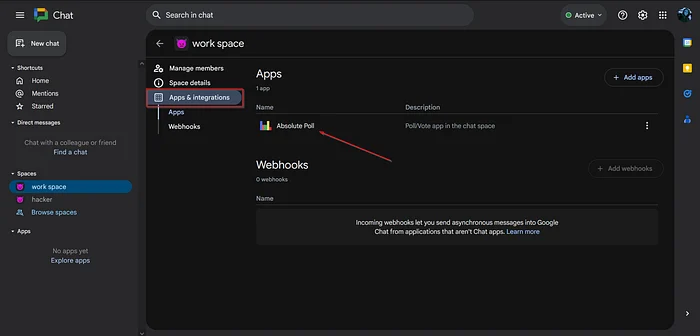
Google Chat supports a voting feature that becomes available by adding the Absolute Poll app to a space. The integration lets users create and manage polls directly inside the chat. When a poll is created, only its creator is supposed to be able to close it. If any other user tries to close the poll, the system returns an error saying they are not authorised to perform that action.
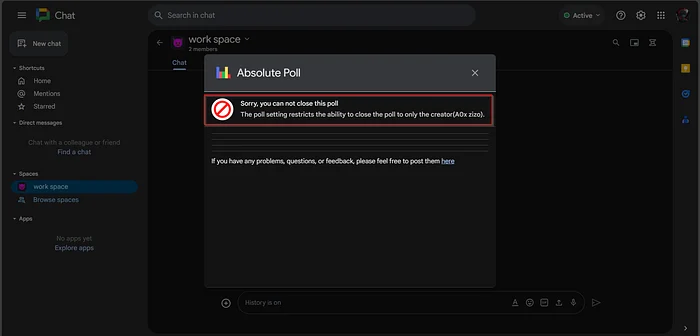
The researcher describes the class of issue as an Improper Access Control vulnerability: the application fails to properly restrict user actions based on their permissions, so a user can perform an action they should not be allowed to, in this case closing a poll they did not create. The write-up was published on 4 June 2025 and describes a finding made about two months earlier.
Setup
The report does not describe any special accounts, roles, versions or preconditions beyond the following: the tester uses Google Chat with the Absolute Poll app added to a space, and uses Burp Suite to intercept and modify the request that closes a poll. The tester also uses the browser's developer tools to inspect page elements and read the voting ID. No specific Google Chat version, app version or account configuration is given.
Finding it
While using Google Chat, the researcher came across the voting feature and observed the intended rule: only the poll creator can close a poll, and any other user attempting to close it receives an authorisation error. That rule is enforced somewhere in the flow that closes a poll, and the question the researcher pursued was whether the request that performs the close actually checks who owns the poll.
Exploitation
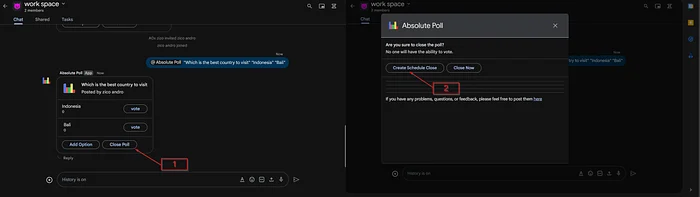
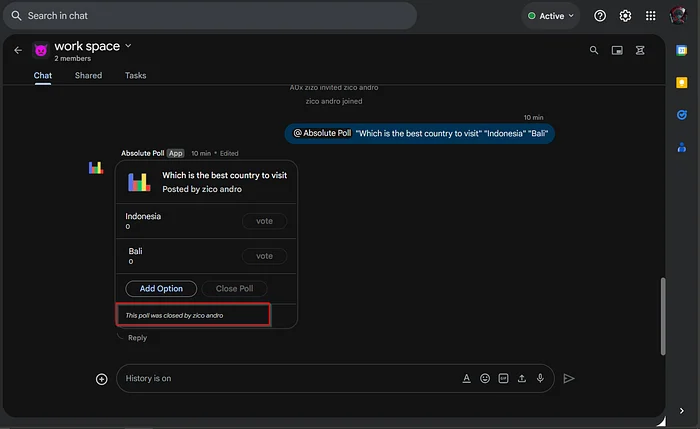
Step 1: create a poll and try to close it
The hacker creates a poll and tries to shut it down.
Step 2: capture the close request in Burp Suite
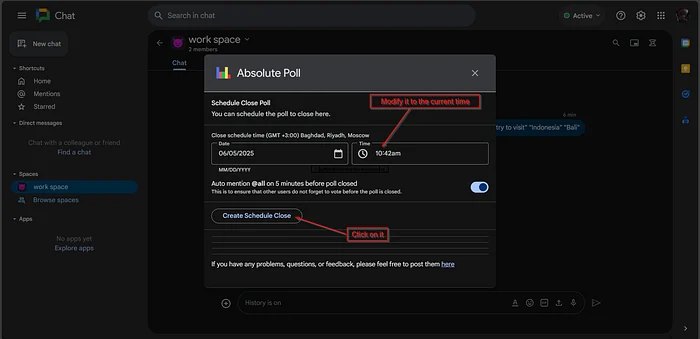
The close action is performed with the request intercepted in Burp Suite. The key modification is to the close schedule time, which is set to the current time.
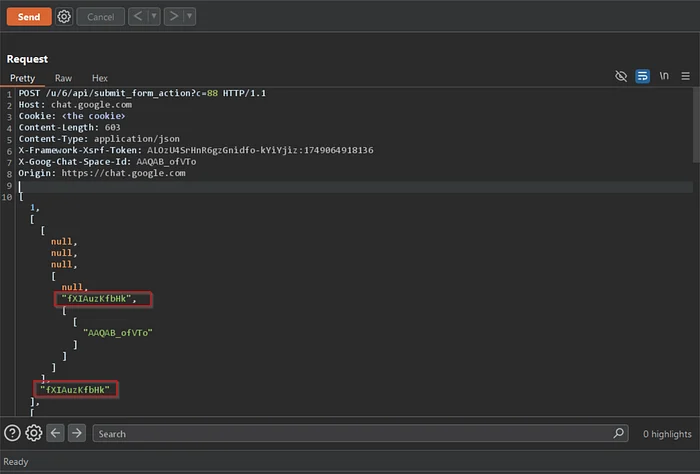
Step 3: understand the request format
The request format should resemble the following. The two matching words in the box serve as the unique voting ID.
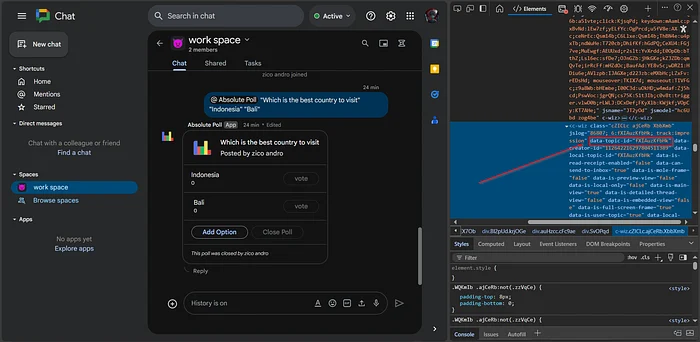
Step 4: obtain the voting ID
The voting ID can be obtained by inspecting the page elements using the browser's developer tools.
Step 5: swap in the victim's voting ID
If you obtain the victim's voting ID and replace your own voting ID with theirs in Burp Suite, the poll will be successfully closed.
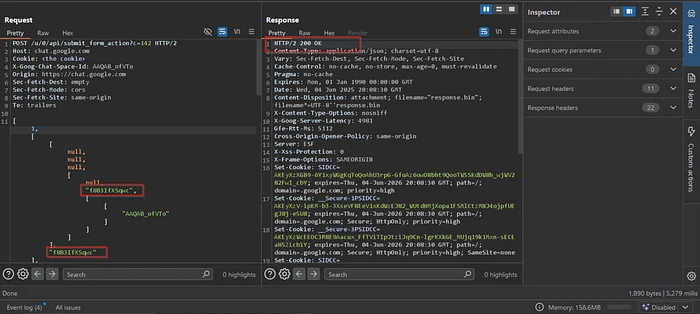
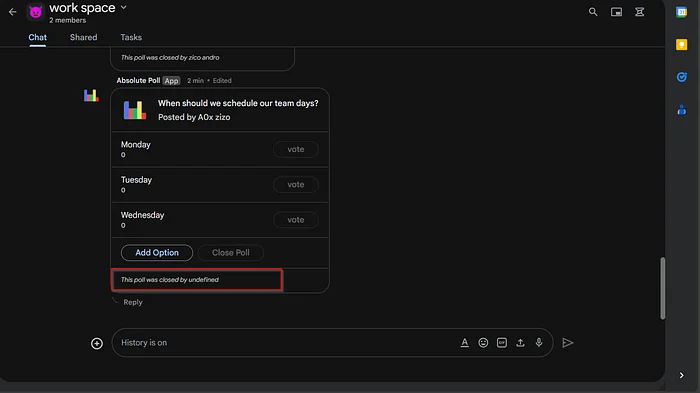
Voting has been successfully closed.
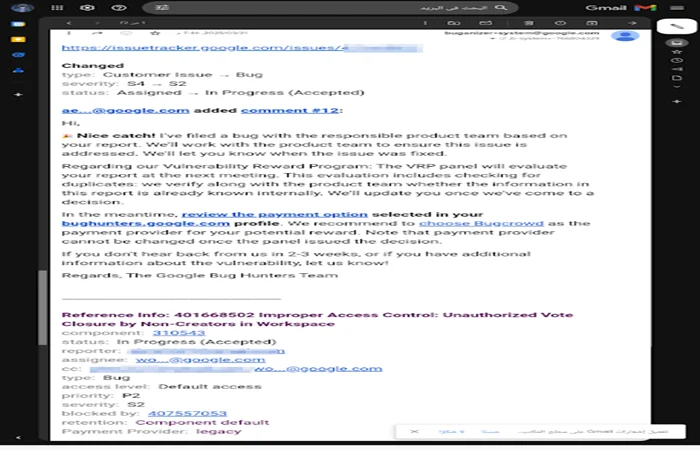
The report also mentions a video PoC.
Root cause
The close request carries the voting ID, and the report shows that swapping it closes the victim's poll. The report shows that replacing the tester's own voting ID with the victim's voting ID in the intercepted request causes the victim's poll to be closed. In other words, the server does not verify that the caller is the creator of the poll identified by the voting ID before performing the close. The report does not show where the check is made, so the exact cause is not stated.
Impact
An attacker who knows the voting ID of a poll they did not create can close that poll prematurely. The report frames this as an unauthorised user being able to close polls, something only the poll creator should be able to do. The attack requires the attacker to obtain the victim's voting ID, which the report says can be read from page elements via the browser's developer tools.
Fix
The change implied by the finding is that the server should verify, on the close request, that the caller is the creator of the poll identified by the voting ID, rather than trusting the voting ID supplied in the request.
Variants to test
- Other poll actions keyed by an identifier. Try voting, deleting, editing or extending a poll while substituting another user's poll identifier. A positive result is the action succeeding on a poll the tester does not own.
- Identifier formats. The report notes that the voting ID consists of two matching words. Try identifiers belonging to other users and check whether the server validates ownership or merely looks the poll up. A positive result is any response that acts on the other user's poll instead of returning an authorisation error.
- Timing fields in the same request. The report modifies the close schedule time to the current time. Try other values in that field on a poll you own and on a poll you do not own, and compare the responses. A positive result is the server accepting a schedule change on a poll you do not own.
- Chat app integrations generally. The same pattern can be tested on other chat-integrated apps that create objects with identifiers, such as polls, reminders or approvals. A positive result is an action on another user's object succeeding when the identifier is swapped.
What happened, in plain words
Google Chat is Google's messaging app, the same kind of tool as Slack or WhatsApp, but built for teams. Inside a chat space you can add small helper apps, called integrations, that add extra features to the conversation. One of these is called Absolute Poll, and it lets people create polls (a question with several answers that everyone can vote on) directly inside the chat.
When someone creates a poll, the normal rule is simple: only the person who created it can close it. If anyone else tries to close it, the app refuses and shows an error saying they are not allowed to do that.
The researcher, Ahmed Nasr, found that this rule only holds in the normal screen. Behind the screen, the app talks to Google's servers using small messages called requests. The researcher captured one of those requests with a tool called Burp Suite (a program that sits between your browser and the internet and lets you read and change what is sent), changed values inside it, and closed a poll that belonged to someone else. The write-up was published on 4 June 2025 and describes a finding made about two months earlier.
This kind of bug is called Improper Access Control. In everyday terms: a hotel gives every guest a key card for their own room, and the door checks the card. If the door instead just checked that you had a card, without checking which room it was for, any guest could open any door. The app did not stop the request from closing a poll that was not yours.
The pieces you need to understand first
Before walking through the steps, here are the few ideas the whole report rests on. None of them require any security background.
- A request is a message your browser sends to a server. When you click a button, your browser packages up what you did ("close poll number 123") and sends it off. The server reads it and replies.
- An API is the set of these request addresses a service offers. Think of a restaurant menu: the menu lists what you can order and how to ask for it. The API is the menu of things the app can ask the server to do.
- An identifier (ID) is a name or code that points at one specific thing. Your passport number identifies you among millions of people; a voting ID identifies one poll among millions of polls. If you know someone else's identifier, you can refer to their object, and the question is whether the server lets you act on it.
- Burp Suite is a tool that lets you pause a request on its way out, edit it, and then send it. It is the equivalent of intercepting a letter, changing a word, and posting it on.
- Browser developer tools are built into every browser (usually opened with F12). They let you look at the page's underlying structure, called the elements, which is where the voting ID can be read.
Setup
The report does not describe any special accounts, roles, versions or preconditions beyond the following: the tester uses Google Chat with the Absolute Poll app added to a space, and uses Burp Suite to intercept and modify the request that closes a poll. The tester also uses the browser's developer tools to inspect page elements and read the voting ID. No specific Google Chat version, app version or account configuration is given.
Finding it
While using Google Chat, the researcher came across the voting feature and observed the intended rule: only the poll creator can close a poll, and any other user attempting to close it receives an authorisation error. That rule is enforced somewhere in the flow that closes a poll, and the question the researcher pursued was whether the request that performs the close actually checks who owns the poll.
In plain terms: the screen says no, but the screen is not the server. The screen is just a page drawn by your browser. The real decision is made by the server when it receives the request. If the screen hides the button but the server still accepts the request, the rule is only decoration.
Exploitation
Step 1: create a poll and try to close it
The hacker creates a poll and tries to shut it down.
Why this step: you need a poll of your own to study. By creating one and closing it, you produce a normal, legitimate close request. That request is your template. You are not attacking anything yet; you are learning what a correct request looks like so you can compare it with a tampered one later.
Step 2: capture the close request in Burp Suite
The close action is performed with the request intercepted in Burp Suite. The key modification is to the close schedule time, which is set to the current time.
Why this step: a poll can be set to close automatically at a future date and time. That future time is a field inside the request. The report says to change the close schedule time to the current time. This is a practical trick: it lets you see the result of the close straight away rather than scheduling it and waiting.
Step 3: understand the request format
The request format should resemble the following. The two matching words in the box serve as the unique voting ID.
Why this step: before changing anything, you need to know which part of the request says which poll to close. That part is the voting ID. The report notes that the two matching words in the box serve as the unique voting ID.
Step 4: obtain the voting ID
The voting ID can be obtained by inspecting the page elements using the browser's developer tools.
Why this step: the voting ID is not printed on the screen as visible text. It lives in the page's underlying structure, the elements, which the browser uses to draw the page. Developer tools let you read that structure. This is the same idea as reading the small print on a ticket rather than the big title: the information is there, just not in the part meant for casual reading.
Step 5: swap in the victim's voting ID
If you obtain the victim's voting ID and replace your own voting ID with theirs in Burp Suite, the poll will be successfully closed.
Voting has been successfully closed.
Why this step: this is the actual test. You take the legitimate close request you captured in step 2, and you change exactly one thing: the voting ID. Everything else stays as it was, including the fact that the request comes from your account. If the poll is closed, it means the request closed a poll that was not yours. That is the bug.
The report also mentions a video PoC.
Root cause
The close request carries the voting ID, and the report shows that swapping it closes the victim's poll. The report shows that replacing the tester's own voting ID with the victim's voting ID in the intercepted request causes the victim's poll to be closed. In other words, the server does not verify that the caller is the creator of the poll identified by the voting ID before performing the close. The report does not show where the check is made, so the exact cause is not stated.
A useful comparison: a cloakroom that hands out a numbered ticket for each coat. If the attendant gives back whatever coat matches the number you say, without checking that the ticket is really yours, then anyone who reads a number off someone else's ticket can walk away with their coat. The missing check is the problem.
Impact
An attacker who knows the voting ID of a poll they did not create can close that poll prematurely. The report frames this as an unauthorised user being able to close polls, something only the poll creator should be able to do. The attack requires the attacker to obtain the victim's voting ID, which the report says can be read from page elements via the browser's developer tools.
Fix
The change implied by the finding is that the server should verify, on the close request, that the caller is the creator of the poll identified by the voting ID, rather than trusting the voting ID supplied in the request.
In everyday terms: the door should check not only that you have a key card, but that the card is for this room.
Variants to test
If you want to look for the same pattern elsewhere, these are directions to try. Each one follows the same logic: find an action that names an object by an identifier, then try naming someone else's object.
- Other poll actions keyed by an identifier. Try voting, deleting, editing or extending a poll while substituting another user's poll identifier. A positive result is the action succeeding on a poll the tester does not own.
- Identifier formats. The report notes that the voting ID consists of two matching words. Try identifiers belonging to other users and check whether the server validates ownership or merely looks the poll up. A positive result is any response that acts on the other user's poll instead of returning an authorisation error.
- Timing fields in the same request. The report modifies the close schedule time to the current time. Try other values in that field on a poll you own and on a poll you do not own, and compare the responses. A positive result is the server accepting a schedule change on a poll you do not own.
- Chat app integrations generally. The same pattern can be tested on other chat-integrated apps that create objects with identifiers, such as polls, reminders or approvals. A positive result is an action on another user's object succeeding when the identifier is swapped.
Glossary
- Absolute Poll: a helper app that can be added to a Google Chat space to create and manage polls inside the chat.
- API: the set of request addresses a service offers, like a menu of things you can ask the server to do.
- Authorisation error: a refusal from the server saying you are not allowed to perform the action you asked for.
- Browser developer tools: a panel built into browsers (often opened with F12) that lets you inspect the page's elements and the requests it makes.
- Burp Suite: a tool that intercepts requests between your browser and a server so you can read and modify them before they are sent.
- Close schedule time: the date and time at which a poll is set to close automatically; a field inside the close request.
- Elements: the underlying structure of a web page, which the browser uses to draw what you see and which can contain values not shown on screen.
- Identifier (ID): a name or code that points at one specific object, such as one poll among many.
- Improper Access Control: a vulnerability where an application fails to restrict actions based on who the user is, so someone can do something they should not be allowed to do.
- Integration: a small app added to a chat space to provide an extra feature.
- Poll: a question with several answers that people in a chat can vote on.
- Request: a message your browser sends to a server describing an action you want performed.
- Server: the computer that stores the data and decides whether to carry out the actions requested by browsers.
- Video PoC: a proof of concept recorded as a video, showing the attack being carried out.
- Voting ID: the identifier that points at one specific poll; the report says it is made of two matching words.

