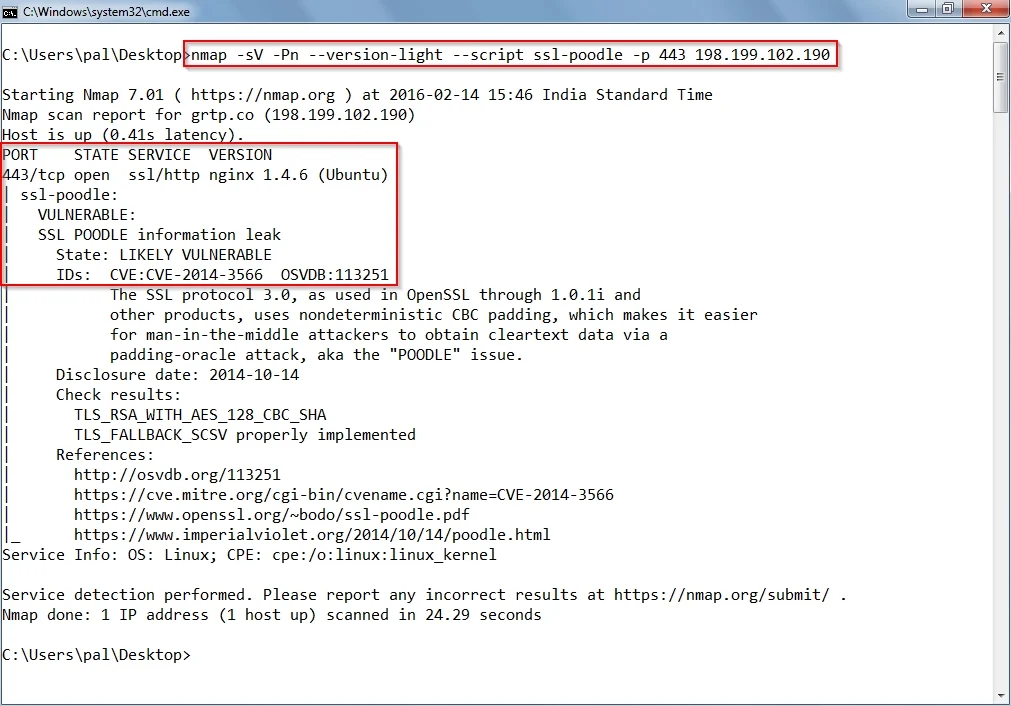
The POODLE attack (SSLv3 supported) for https://grtp.co/
The site accepted SSLv3 connections with CBC-mode ciphers, which makes it open to the POODLE attack. A network attacker in the middle could decrypt targeted parts of the connection, usually cookie data.
 Originally disclosed on HackerOne
- Fixed in 30 hours
- Paid in 30 hours
- Disclosed after 31 days
Websites that support SSLv3 and CBC-mode ciphers are potentially vulnerable to an active MITM (Man-in-the-middle) attack. This attack, called POODLE, is similar to the BEAST attack and also allows a network attacker to extract the plaintext of targeted parts of an SSL connection, usually cookie data. Unlike the BEAST attack, it doesn't require such extensive control of the format of the plaintext and thus is more practical.
The impact of this vulnerability An attacker may be able to exploit this problem to conduct man-in-the-middle attacks and decrypt communications between the affected service and clients.
How to fix this vulnerability It's recommended to disable SSLv3 and replace it with TLSv1.0 as soon as compatibility with legacy clients is no longer required. (The only browser that does not support TLSv1.0 is Internet Explorer 6).
To disable SSLv2 and SSLv3: For Nginx: ssl_protocols TLSv1 TLSv1.1 TLSv1.2;
Screenshots attached for the reference.
Attachments
Not written yet. The AI write-up for this report has not been written yet. The Original tab links to the source.
How it worked
Root cause
Likely the server was configured to still accept SSLv3 with CBC-mode ciphers instead of restricting it to TLS.
Impact
An attacker in the middle of the network could decrypt targeted parts of the connection, such as cookie data.
What the attacker needed
Attacker on the network path; victim connects to the site
Explained by bugbounty.wiki with AI from the original and checked against quotes from it; it can still be wrong. Read the original before relying on a detail.
Not written yet. The AI write-up for this report has not been written yet. The Original tab links to the source.
SSLv3 is an old encryption protocol for HTTPS. It has a flaw that lets someone on the network between you and the site recover small pieces of secret data, such as your session cookie. The fix is to turn SSLv3 off and allow newer TLS versions.
What is Crypto?
Encryption, signatures, randomness or certificate checks that do not protect what they claim to.




