HTTP Request Smuggling
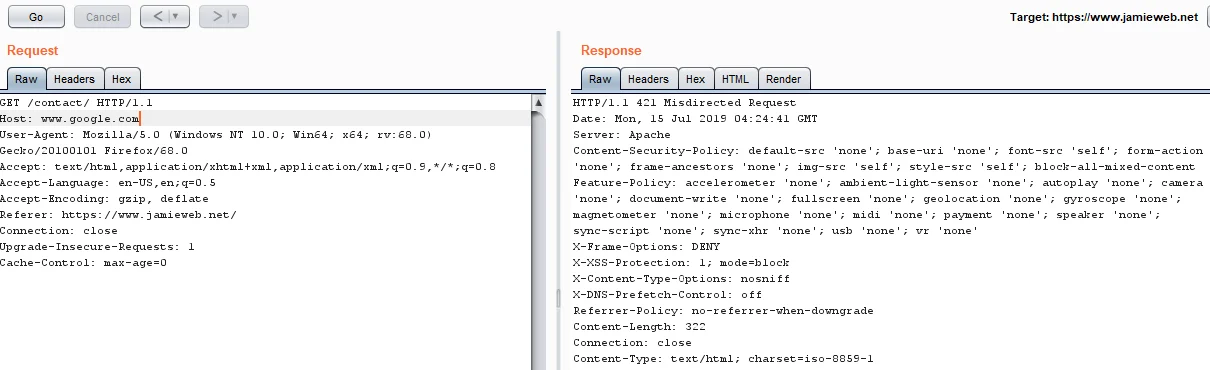
The application accepted a modified Host header, returning a 421 Misdirected Request. An attacker could use this to poison password reset emails or cache entries, potentially leading to account takeover or access to internal hosts.

- Triaged in 18 hours
- Disclosed after 8 months
is vulnerable to host header injection because the host header can be changed to something outside the target domain.
Attack vectors are somewhat limited but depends on how the host header is used by the back-end application code. If code references the hostname used in the URL such as password reset pages, an attacker could spoof the host header of the request in order to trick the application to forwarding the password reset email to the attackers domain instead, etc. Other attack vectors may also be possible through manipulation of hyperlinks or other misc. code that relies on the host/domain of the request.
Steps To Reproduce:
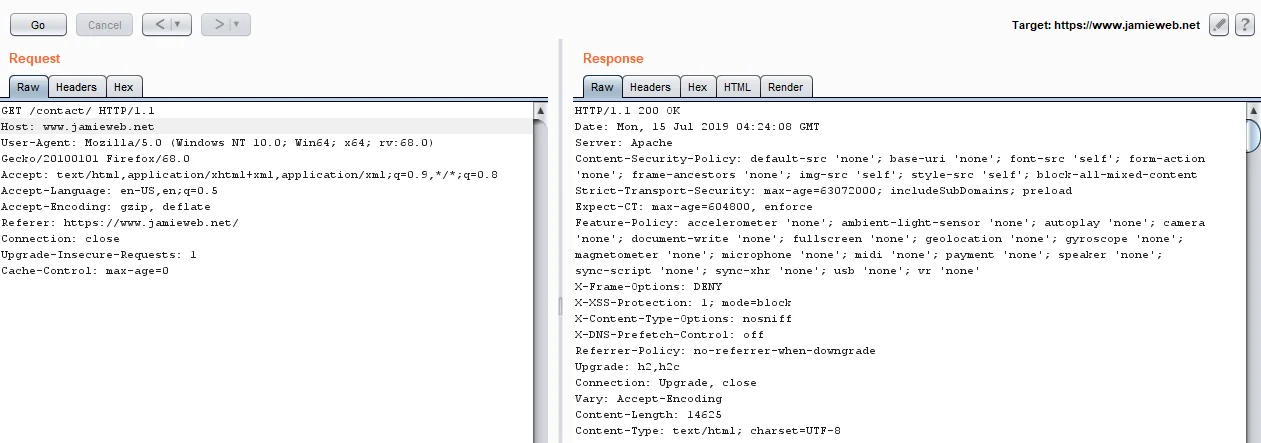
request:-- GET /contact/ HTTP/1.1 Host: www.google.com User-Agent: Mozilla/5.0 (Windows NT 10.0; Win64; x64; rv:68.0) Gecko/20100101 Firefox/68.0 Accept: text/html,application/xhtml+xml,application/xml;q=0.9,/;q=0.8 Accept-Language: en-US,en;q=0.5 Accept-Encoding: gzip, deflate Referer: https://www.jamieweb.net/ Connection: close Upgrade-Insecure-Requests: 1 Cache-Control: max-age=0
Response:---
HTTP/1.1 421 Misdirected Request Date: Mon, 15 Jul 2019 04:24:41 GMT Server: Apache Content-Security-Policy: default-src 'none'; base-uri 'none'; font-src 'self'; form-action 'none'; frame-ancestors 'none'; img-src 'self'; style-src 'self'; block-all-mixed-content Feature-Policy: accelerometer 'none'; ambient-light-sensor 'none'; autoplay 'none'; camera 'none'; document-write 'none'; fullscreen 'none'; geolocation 'none'; gyroscope 'none'; magnetometer 'none'; microphone 'none'; midi 'none'; payment 'none'; speaker 'none'; sync-script 'none'; sync-xhr 'none'; usb 'none'; vr 'none' X-Frame-Options: DENY X-XSS-Protection: 1; mode=block X-Content-Type-Options: nosniff X-DNS-Prefetch-Control: off Referrer-Policy: no-referrer-when-downgrade Content-Length: 322 Connection: close Content-Type: text/html; charset=iso-8859-1
Supporting Material/References (if applicable): https://hackerone.com/reports/170333
https://hackerone.com/reports/182670
https://hackerone.com/reports/264405 https://hackerone.com/reports/158482
POC attach below.
Impact
password reset poisoning cache poisoning access to other internal host/application XSS, etc.
Attachments
Not written yet. The AI write-up for this report has not been written yet. The Original tab links to the source.
How it worked
Root cause
Likely the application does not validate the Host header against an allowlist of expected domains.
Impact
An attacker could poison password reset emails to redirect to their domain, poison caches, access internal hosts, or achieve XSS, though the report notes attack vectors are somewhat limited.
What the attacker needed
Ability to send HTTP requests with custom Host header
How it was found
- Send a request to the contact page with a modified Host header pointing to an external domain.
- Observe that the server responds with a 421 Misdirected Request.
Explained by bugbounty.wiki with AI from the original and checked against quotes from it; it can still be wrong. Read the original before relying on a detail.
Not written yet. The AI write-up for this report has not been written yet. The Original tab links to the source.
When you visit a website, your browser sends a 'Host' header telling the server which site you want. If the server trusts this header without checking, an attacker can change it to a different domain. This can trick the server into sending password reset links to the attacker's domain or caching malicious content.
What is Misconfiguration?
Settings left unsafe: exposed panels, open storage buckets, debug modes, default credentials.



