SSL/TLS Vulnerability at khanacademy.org
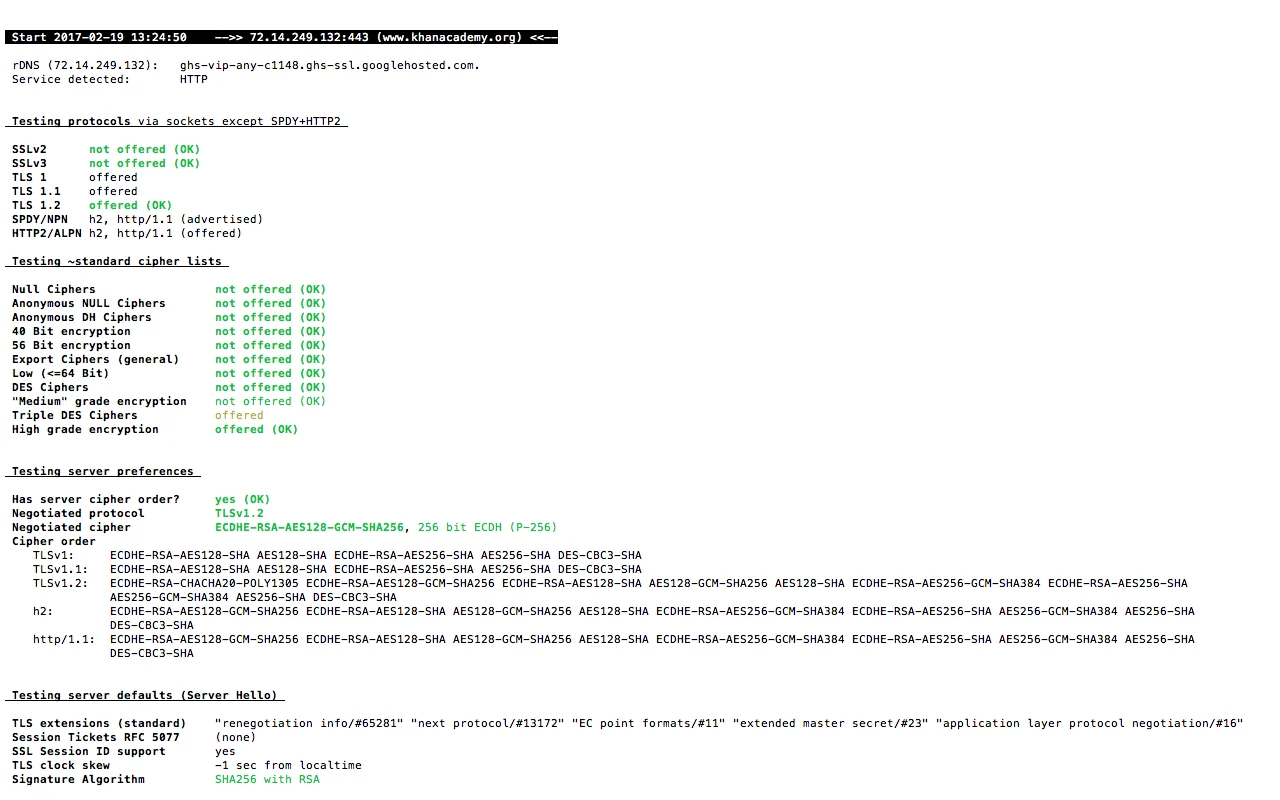
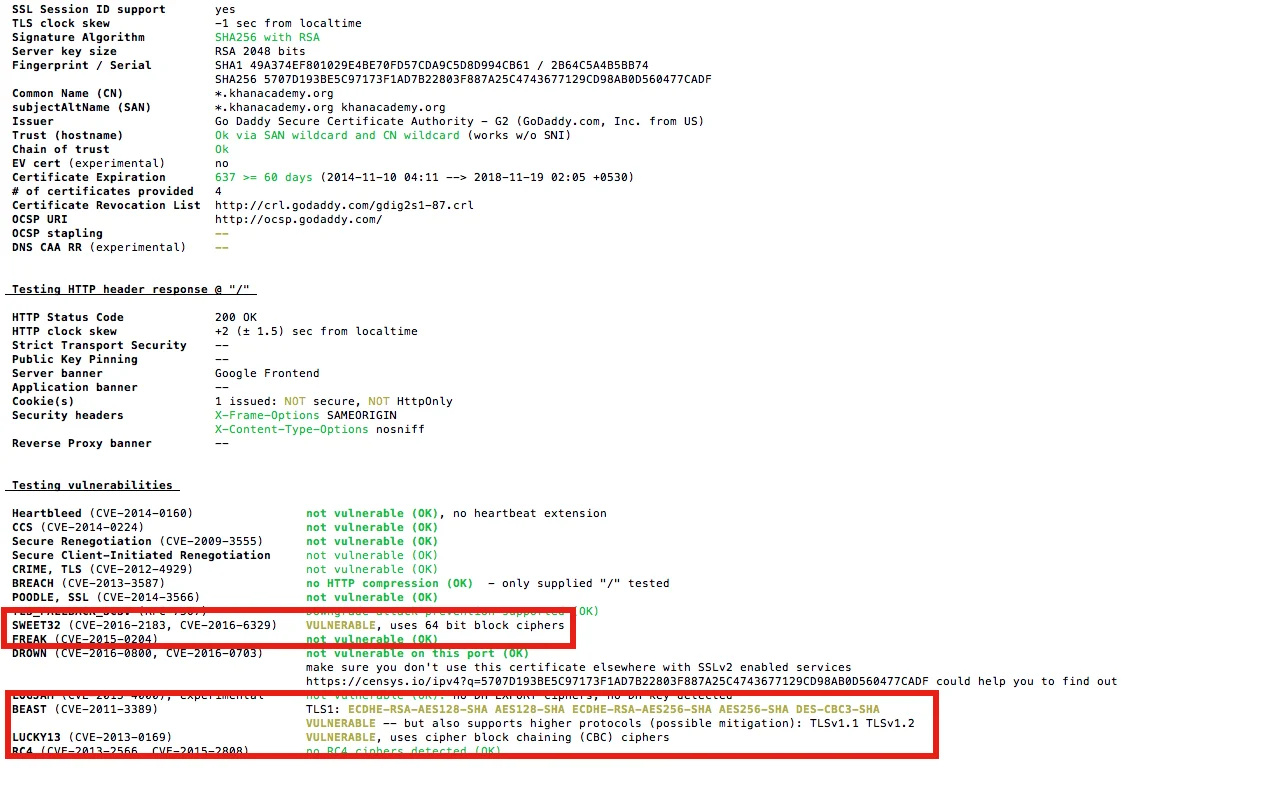
The report claims that khanacademy.org's HTTPS endpoint supported outdated TLS configurations vulnerable to BEAST, Lucky Thirteen and Sweet32, all of which are weaknesses in CBC-mode ciphersuites. An attacker in a position to intercept traffic could in principle recover some plaintext from encrypted sessions, though the report gives no proof of exploitation.

- Disclosed after 3 days
CVE - 2011 - 3389 Description : The SSL protocol, as used in certain configurations in Microsoft Windows and Microsoft Internet Explorer, Mozilla Firefox, Google Chrome, Opera, and other products, encrypts data by using CBC mode with chained initialization vectors, which allows man-in-the-middle attackers to obtain plaintext HTTP headers via a blockwise chosen-boundary attack (BCBA) on an HTTPS session, in conjunction with JavaScript code that uses (1) the HTML5 WebSocket API, (2) the Java URLConnection API, or (3) the Silverlight WebClient API, aka a "BEAST" attack.
Problem Location : https://www.khanacademy.org/
Mitigation : The Upgrade TLS version on the server to latest stable version
CVE - 2013 - 0169 :
Description : The TLS protocol 1.1 and 1.2 and the DTLS protocol 1.0 and 1.2, as used in OpenSSL, OpenJDK, PolarSSL, and other products, do not properly consider timing side-channel attacks on a MAC check requirement during the processing of malformed CBC padding, which allows remote attackers to conduct distinguishing attacks and plaintext-recovery attacks via statistical analysis of timing data for crafted packets, aka the "Lucky Thirteen" issue.
Problem Location : https://www.khanacademy.org/
Mitigation : The Upgrade TLS version on the server to latest stable version .
Sweet 32 Attack - CVE-2016-2183,
Description : A flaw was found in the way the DES/3DES cipher was used as part of the TLS/SSL protocol. A man-in-the-middle attacker could use this flaw to recover some plaintext data by capturing large amounts of encrypted traffic between TLS/SSL server and client if the communication used a DES/3DES based ciphersuite.
Problem Location : https://www.khanacademy.org/
Mitigation :
The removed DES/3DES from the supported lists of crypto algorithms.
TLS libraries and applications should limit the length of TLS sessions with a 64-bit cipher.
References : https://sweet32.info/
Attachments
Not written yet. The AI write-up for this report has not been written yet. The Original tab links to the source.
How it worked
Root cause
Likely the server's TLS configuration still permitted legacy CBC-mode ciphersuites (including 3DES) and older protocol versions instead of restricting to modern AEAD ciphers.
Impact
A man-in-the-middle capturing large amounts of encrypted traffic could potentially recover some plaintext; the report shows no actual exploitation.
What the attacker needed
Attacker can intercept network traffic; large volume of traffic captured
The fix
The server should disable legacy CBC and 3DES ciphersuites and only allow current TLS versions with modern ciphers.
Explained by bugbounty.wiki with AI from the original and checked against quotes from it; it can still be wrong. Read the original before relying on a detail.
Not written yet. The AI write-up for this report has not been written yet. The Original tab links to the source.
When a browser talks to a website over HTTPS, it agrees with the server on a set of rules for scrambling the data, called a ciphersuite. Some old rules have known weaknesses that let someone who can watch the network slowly work out pieces of the supposedly secret traffic. This report says the site still allowed those old rules and should have turned them off.
What is Crypto?
Encryption, signatures, randomness or certificate checks that do not protect what they claim to.



