Clickjacking at app.lemlist.com
The web application did not send an X-Frame-Options header, so pages could be embedded in an iframe on another site. An attacker could trick a logged-in user into clicking hidden interface elements, potentially leading to account takeover, account deletion, or password change.
 Originally disclosed on HackerOne
- Triaged in 38 hours
- Fixed in 3 days
- Disclosed after 3 days
Summary by the researcher
Clickjacking at app.lemlist.com Account Takeover, Account Deletion and Password Change
The report
Hi team,
While performing security testing of your website i have found the vulnerability called Clickjacking. Many URLS are in scope and vulnerable to Clickjacking.
What is Clickjacking ?
Clickjacking (User Interface redress attack, UI redress attack, UI redressing) is a malicious technique of tricking a Web user into clicking on something different from what the user perceives they are clicking on, thus potentially revealing confidential information or taking control of their computer while clicking on seemingly innocuous web pages.
The server didn't return an X-Frame-Options header which means that this website could be at risk of a clickjacking attack. The X-Frame-Options HTTP response header can be used to indicate whether or not a browser should be allowed to render a page in a <frame> or <iframe>. Sites can use this to avoid clickjacking attacks, by ensuring that their content is not embedded into other sites. This vulnerability affects Web Server.
Vulnerable Urls:
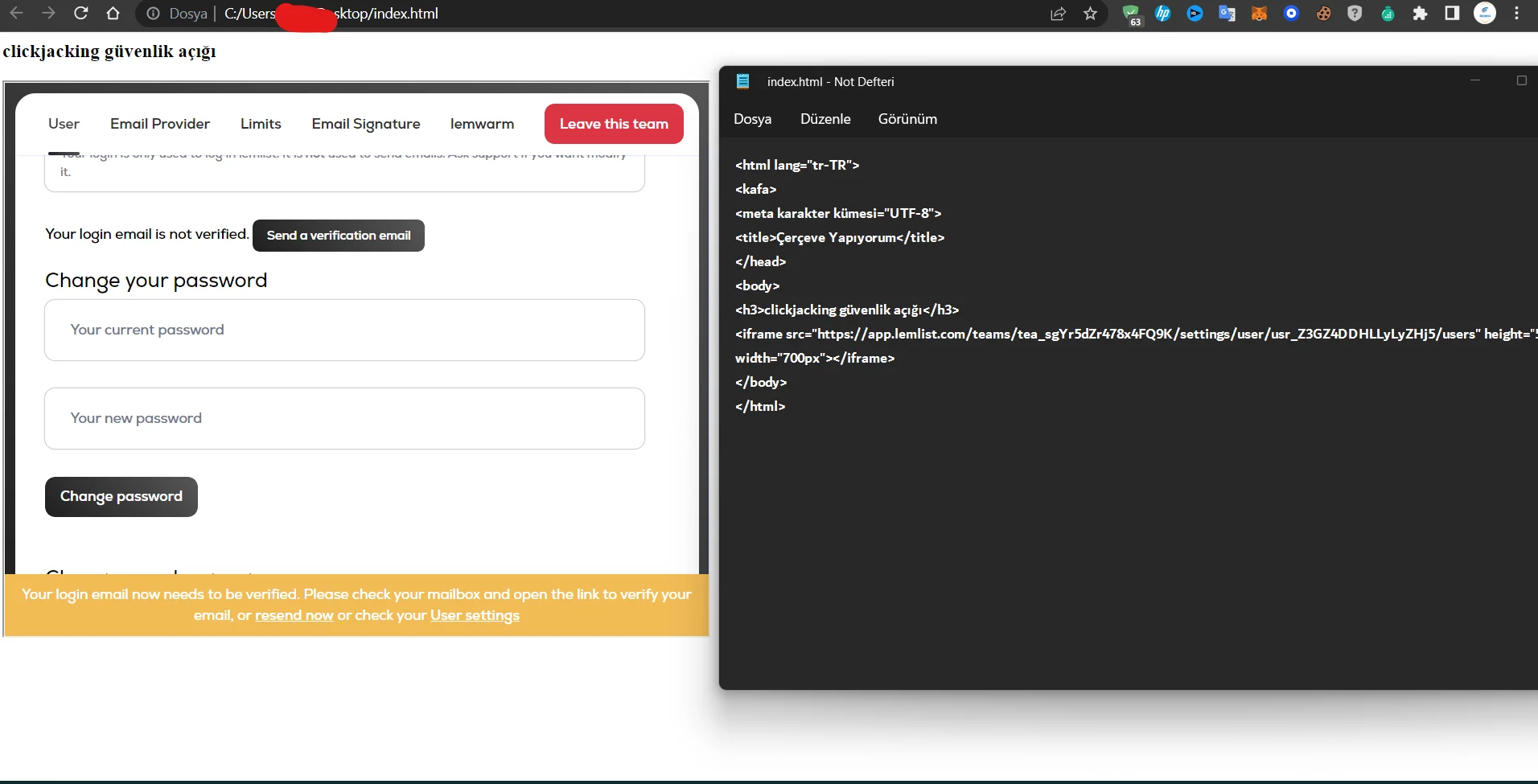
Put every above url one by one in the code of iframe, which is given below
<html lang="tr-TR">
<kafa>
<meta karakter kümesi="UTF-8">
<title>Çerçeve Yapıyorum</title>
</head>
<body>
<h3>clickjacking güvenlik açığı</h3>
<iframe src="https://app.lemlist.com/teams/tea_sgYr5dZr478x4FQ9K/settings/user/usr_Z3GZ4DDHLLyLyZHj5/users" height="550px" width="700px"></iframe>
</body>
</html>
Impact
Using a similar technique, keystrokes can also be hijacked. With a carefully crafted combination of stylesheets, iframes, and text boxes, a user can be led to believe they are typing in the password to their email or bank account, but are instead typing into an invisible frame controlled by the attacker.
Attachments
Not written yet. The AI write-up for this report has not been written yet. The Original tab links to the source.
How it worked
Root cause
The application did not set the X-Frame-Options HTTP response header, allowing its pages to be framed by other origins.
Impact
An attacker could trick a logged-in user into performing sensitive actions such as account takeover, account deletion, or password change, though the report only demonstrates framing and does not show a working exploit.
What the attacker needed
Victim is logged in; victim visits attacker-controlled page
How it was found
- Create an HTML page containing an iframe that points to a vulnerable URL on the target site.
- Open the HTML page in a browser while logged in to the target site.
- Observe that the target page is rendered inside the iframe, confirming the clickjacking vulnerability.
Explained by bugbounty.wiki with AI from the original and checked against quotes from it; it can still be wrong. Read the original before relying on a detail.
Not written yet. The AI write-up for this report has not been written yet. The Original tab links to the source.
Clickjacking is when a malicious site loads a real site inside an invisible frame and tricks you into clicking buttons you cannot see. Because the site did not tell browsers to block being framed, an attacker could overlay it and make you perform actions like changing your password.
What is UI spoofing?
The interface lies to the user: a framed page catches their clicks, or a browser shows the wrong address or a fake prompt. Paid when it leads to a sensitive action or convincing phishing.




