IDOR when creating App on [platform.streamlabs.com/api/v1/store/whitelist] with user_id field
The application form submission endpoint accepted a user_id parameter that could be changed to another user's ID, allowing an attacker to submit the form on behalf of any user. Since user IDs are sequential, an attacker could repeatedly submit forms with random data for many victims, causing their legitimate applications to be rejected.

- Triaged in 10 hours
- Fixed in 18 hours
- Paid in 17 hours
- Disclosed after 2 months
Summary:
Hi team, There is a IDOR when applying to platform.streamlabs.com after loginning.
If you login to platform.streamlabs.com and click Create App. You will see the "apply form". And if you submit it, you will see the user_id parameter in JSON data of the apply request. (api/v1/store/whitelist). This parameter is vulnerable for IDOR, you can apply to platform as another accounts.
Also these user_ids are sequential, so any attacker can apply this form with a lot of accounts with random values. Attacker can force the victims' apply forms to be rejected.
Steps To Reproduce:
- Sign-up to platform.streamlabs.com with 2 different accounts (Make sure you didn't apply the apply form before.)
- Click
Create Appand turn on the proxy - Fill in the form and click
Apply - Change the
user_idon the JSON data of the request to your another account's ID. - Forward the request.
user_id's are sequential, for finding your user_id you can go to https://platform.streamlabs.com/api/v1/s/user/me
If you see 200 OK in response, that means you submitted the form as victim.
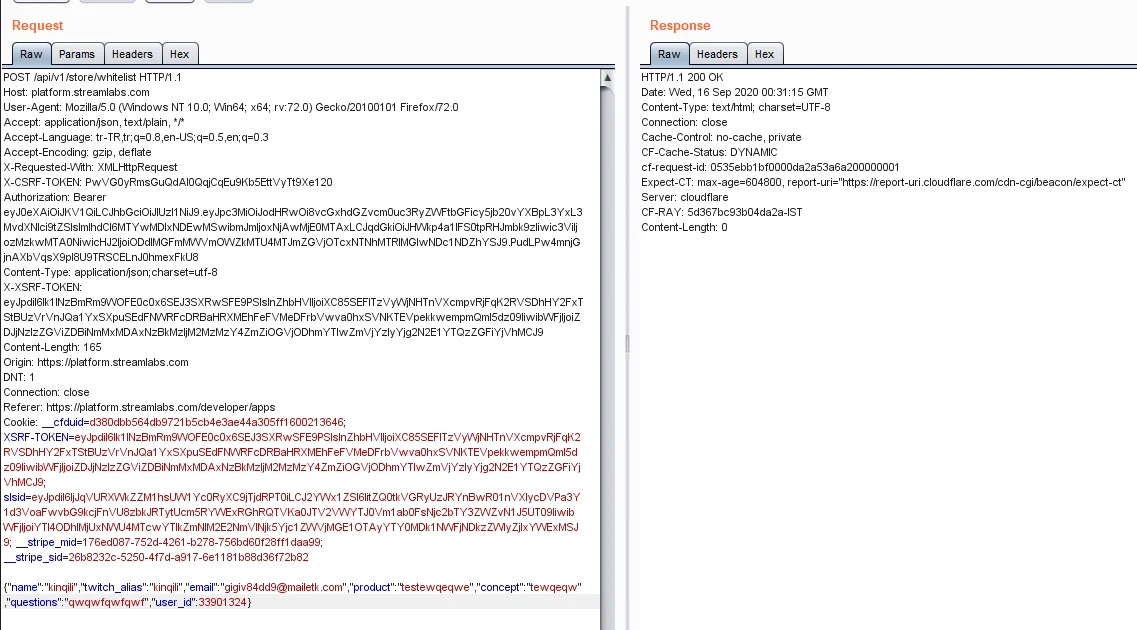
Now, the victim can't apply the form again. And if you fill the form with random values. Streamlabs will probably reject the victim's form because of random values.
Impact
Any attacker can apply the platform form with a lot of accounts with random values. So attacker can force the victims' apply forms to be rejected. I don't know the full impact because I didn't get response for my Platform request yet. Maybe there is more serious impact on this issue but I can't figure it out for now.
Thanks, Bugra
Context
Streamlabs runs a developer platform at platform.streamlabs.com, where users can register applications. Before an application can be created, the user has to submit an application form through the Create App flow. That form is submitted to the API endpoint api/v1/store/whitelist, and the request body is JSON that includes a user_id field identifying the account the application belongs to.
The report describes an Insecure Direct Object Reference in that submission: the user_id in the JSON body is taken from the request rather than being bound to the authenticated session, so one account can submit the form on behalf of another.
Setup
To reproduce the issue you need two accounts on platform.streamlabs.com. Neither account should have submitted the application form before, because the form can only be submitted once per account, and that single-submission behaviour is what makes the attack meaningful.
A proxy that can intercept and modify requests is required, since the user_id has to be changed in the JSON body before the request is forwarded.
Finding it
After logging in to platform.streamlabs.com and clicking Create App, the user is shown the application form. Submitting the form produces a request to api/v1/store/whitelist whose JSON body contains a user_id parameter. That parameter is the account identifier the application is being filed for, and it is supplied by the client.
Two properties made this look wrong. First, the value is a direct reference to an account that the client controls, so changing it should let one account act on another. Second, the user_id values are sequential, which means an attacker does not need to know a victim's identifier in advance: values can simply be enumerated.
Exploitation
Step 1: Create two accounts
Sign up to platform.streamlabs.com with two different accounts, making sure neither has applied through the form before. The second account is the victim in this scenario.
Step 2: Start the form and the proxy
Click Create App with the proxy turned on, so the submission request can be intercepted.
Step 3: Fill in and submit the form
Fill in the form and click Apply. The request goes to api/v1/store/whitelist and carries the JSON body with the user_id field.
Step 4: Swap the user_id
Change the user_id in the JSON data of the request to the other account's ID. The report does not reproduce the full request, only the parameter name and endpoint.
Step 5: Forward the request
Forward the modified request. A 200 OK response means the form was submitted as the victim account.
The screenshot shows the 200 OK response that confirms the submission was accepted for the other account.
If you do not know the target account's identifier, the report points to an endpoint that returns the current user's own ID:
https://platform.streamlabs.com/api/v1/s/user/me
Because the identifiers are sequential, the value returned there can be adjusted to reach other accounts.
Root cause
The endpoint trusts the user_id supplied in the JSON body of the request instead of deriving the account from the authenticated session. The server therefore has no way to tell that the account making the request is not the account the form is being filed for. The report does not describe any server-side check that would have prevented this, and the fact that a modified value returns 200 OK indicates the value was accepted as given.
Impact
Once the form has been submitted for a victim account, the victim can no longer apply the form again. The attacker can therefore take away a victim's one opportunity to apply.
Beyond that, the attacker can submit the form with random values for many accounts. Streamlabs will probably reject the victim's form because of those random values, so the attacker can force victims' applications to be rejected. The researcher notes that the full impact is unknown because no response had been received for their own platform request at the time of writing, and that there may be a more serious impact that they had not identified.
Fix
The report does not describe a fix or a change made by the vendor.
Variants to test
- Submit a form or profile update with the account identifier changed in the JSON body. A positive result is a
200 OKand a visible change on the other account. - Replace the identifier in the URL path rather than the body, for example on endpoints that take an account or object ID as a path segment. A positive result is a response containing the other account's data or a successful write against it.
- Enumerate sequential identifiers through an endpoint that returns the current user's own record, then try neighbouring values on write endpoints. A positive result is a successful write for an identifier that does not belong to the session.
- Look for one-shot actions, such as a single application, a single claim or a single submission per account, and try to consume another account's action. A positive result is that the victim can no longer perform the action.
Hunting notes
This kind of bug tends to sit in endpoints that accept an object identifier in a JSON body, especially where the identifier is a simple sequential integer and the endpoint performs a write. The signal during recon is a request body that contains an account or object ID alongside the data being submitted, combined with an endpoint that returns the current user's own ID so that the numbering scheme can be inferred.
The report describes the victim losing the ability to submit the form, and that submissions with random values will probably cause rejection. That consequence, tied to a reproducible 200 OK on the modified request, is what makes the issue more than a theoretical identifier swap.
What happened, in plain words
Streamlabs runs a website for developers at platform.streamlabs.com. On that site, a user can register an application (an app that connects to Streamlabs). Before the app can be created, the user has to fill in an application form. The form is sent to the site's API, which is the part of the website that receives data and does things with it, rather than showing pages to a person. Think of the API as the kitchen of a restaurant: you (the browser) hand in an order, and the kitchen (the server) prepares it. You never walk into the kitchen yourself.
The form is sent to the address api/v1/store/whitelist, and the data sent along with it is in a format called JSON. JSON is just text that describes data in labelled pieces, a bit like a form with field names and values written out. One of those pieces is called user_id, and it is the number that identifies which account the application belongs to.
The problem the researcher found is that the server believed whatever user_id the browser sent. The server did not check that the number matched the account that was actually logged in. So one person could send the form with someone else's user_id and file the application on that other person's behalf. This kind of bug is called an Insecure Direct Object Reference, or IDOR: the server lets you point directly at an object (here, an account) by its identifier, without checking that the object is yours.
There is a second problem that makes it worse. The user_id numbers are sequential, meaning they go up one by one (for example, one account is 1001, the next is 1002, and so on). An attacker does not need to know a victim's number in advance; they can simply guess nearby numbers.
Because each account can only submit the application form once, an attacker who submits the form for a victim uses up the victim's only chance. The victim can no longer apply. And if the attacker fills the form with random values, Streamlabs will probably reject the application, so the victim's application is effectively ruined.
Background you need first
A few ideas come up again and again in this report, so here they are from zero.
- Account and login session. When you log in to a website, the server needs a way to remember that the next request is still you. It usually gives your browser a small piece of data, called a cookie or a session token, which the browser sends back with every request. The server looks at that token to know who you are. The important point: the server already knows who is asking, from the token, without you having to say so.
- API endpoint. An endpoint is a specific address on the server that accepts a particular kind of request.
api/v1/store/whitelistis one endpoint.api/v1/s/user/meis another. - JSON body. When a browser sends data to an API, the data travels in the request body. JSON is a common way to write that data: it is a list of names and values in curly braces. The server reads the names to know what each value means.
- Proxy. A proxy is a tool that sits between your browser and the server. It can pause a request before it leaves, let you look at it, change it, and then send it on. Security testers use proxies to see and edit exactly what the browser sends.
- IDOR (Insecure Direct Object Reference). The server accepts an identifier from the user and uses it to look up a record, without checking that the user is allowed to touch that record. A simple comparison: a hotel receptionist hands out room keys to anyone who says a room number, without checking that the person is actually staying in that room. The room number is the direct reference, and the missing check is the insecurity.
- Sequential identifiers. Numbers that increase by one for each new record. If you know your own number, you can guess your neighbour's.
Setting up the test
To reproduce the issue you need two accounts on platform.streamlabs.com. Neither account should have submitted the application form before, because the form can only be submitted once per account. That single-submission rule is exactly what makes the attack matter: if a victim could simply apply again, using up their submission would be harmless.
You also need a proxy that can intercept and modify requests, because the user_id has to be changed in the JSON body before the request is forwarded to the server.
Finding it
- Log in to
platform.streamlabs.com. - Click
Create App. The site shows you the application form. - Fill in the form and submit it. Your browser sends a request to
api/v1/store/whitelist, and the JSON body of that request contains auser_idparameter.
That user_id is the account identifier the application is being filed for, and it is supplied by the browser, not by the server. Two things made the researcher suspicious. First, the value points directly at an account that the browser controls, so changing it should let one account act on another. Second, the user_id values are sequential, so an attacker does not need to know a victim's identifier in advance: they can just try nearby numbers.
Exploitation, step by step
Step 1: Create two accounts
Sign up to platform.streamlabs.com with two different accounts, making sure neither has applied through the form before. The second account plays the victim in this scenario. You need two because the whole point is to make one account act on the other.
Step 2: Start the form and the proxy
Click Create App with the proxy turned on, so the submission request can be intercepted. Turning the proxy on before you submit means the request will pause on its way out, giving you a chance to edit it.
Step 3: Fill in and submit the form
Fill in the form and click Apply. The request goes to api/v1/store/whitelist and carries the JSON body with the user_id field. At this point the request is paused in your proxy, and you can see the user_id sitting in the body.
Step 4: Swap the user_id
Change the user_id in the JSON data of the request to the other account's ID. The report does not reproduce the full request, only the parameter name and the endpoint. The reason for this step is simple: if the server trusts this number, then changing it changes whose application is being filed.
Step 5: Forward the request
Forward the modified request. A 200 OK response means the form was submitted as the victim account. 200 OK is the standard HTTP status code for "the request succeeded", so seeing it here tells you the server accepted the submission for the other account.
The screenshot shows the 200 OK response that confirms the submission was accepted for the other account.
If you do not know the target account's identifier, the report points to an endpoint that returns the current user's own ID:
https://platform.streamlabs.com/api/v1/s/user/me
This is a plain address you can open in a browser while logged in. It returns information about the account you are currently using, including your own user_id. Because the identifiers are sequential, the value returned there can be adjusted to reach other accounts: if yours is 1001, then 1002 is probably the next account.
Why it works
The endpoint trusts the user_id supplied in the JSON body of the request instead of working out the account from the logged-in session. The server therefore has no way to tell that the account making the request is not the account the form is being filed for. The report does not describe any server-side check that would have prevented this, and the fact that a modified value returns 200 OK indicates the value was accepted as given.
Put another way: the server had two sources of truth about who you are, the session token and the user_id in the body, and it believed the one the user can edit.
Impact
Once the form has been submitted for a victim account, the victim can no longer apply the form again. The attacker can therefore take away a victim's one opportunity to apply.
Beyond that, the attacker can submit the form with random values for many accounts. Streamlabs will probably reject the victim's form because of those random values, so the attacker can force victims' applications to be rejected. The researcher notes that the full impact is unknown because no response had been received for their own platform request at the time of writing, and that there may be a more serious impact that they had not identified.
Fix
The report does not describe a fix or a change made by the vendor. In everyday terms: the receptionist should look up your room from your key card, not from the room number you say out loud.
Variants to test
- Submit a form or profile update with the account identifier changed in the JSON body. A positive result is a
200 OKand a visible change on the other account. - Replace the identifier in the URL path rather than the body, for example on endpoints that take an account or object ID as a path segment. A positive result is a response containing the other account's data or a successful write against it.
- Enumerate sequential identifiers through an endpoint that returns the current user's own record, then try neighbouring values on write endpoints. A positive result is a successful write for an identifier that does not belong to the session.
- Look for one-shot actions, such as a single application, a single claim or a single submission per account, and try to consume another account's action. A positive result is that the victim can no longer perform the action.
Hunting notes
This kind of bug tends to sit in endpoints that accept an object identifier in a JSON body, especially where the identifier is a simple sequential integer and the endpoint performs a write. The signal during recon is a request body that contains an account or object ID alongside the data being submitted, combined with an endpoint that returns the current user's own ID so that the numbering scheme can be inferred.
The report describes the victim losing the ability to submit the form, and that submissions with random values will probably cause rejection. That consequence, tied to a reproducible 200 OK on the modified request, is what makes the issue more than a theoretical identifier swap.
Glossary
- API: the part of a website that receives data and performs actions on the server, as opposed to the pages a person looks at.
- API endpoint: a specific address on the server that accepts a particular kind of request, such as
api/v1/store/whitelist. - Application form: the form a user fills in on
platform.streamlabs.combefore an app can be created. - Cookie / session token: a small piece of data the server gives your browser after login, which the browser sends back so the server knows who you are.
- Create App: the button on
platform.streamlabs.comthat opens the application form. - IDOR (Insecure Direct Object Reference): a bug where the server accepts an identifier from the user and uses it to look up a record without checking that the user is allowed to touch that record.
- JSON: a text format for data made of names and values, used in request bodies.
- JSON body: the part of a request that carries the data, written in JSON.
- Parameter / field: a named piece of data inside a request, such as
user_id. - Proxy: a tool that sits between your browser and the server, letting you pause, inspect and change requests.
- Request: the message your browser sends to the server when you do something on a site.
- Response: the message the server sends back, including a status code.
200 OK: the HTTP status code meaning the request succeeded.- Sequential identifiers: numbers that increase by one for each new record, so nearby numbers belong to nearby accounts.
user_id: the number that identifies which account an application belongs to.- Write endpoint: an endpoint that changes data on the server, as opposed to one that only reads it.
- Enumerate: to try a series of values one after another, such as guessing sequential identifiers.
- Recon: the early stage of testing where you look around a site to understand how it works.
- Vendor: the company that runs the site, here Streamlabs.