You’ve Crossed the Line — Disturbing a Host’s Rest
Two denial-of-service vulnerabilities were found in the Windows Local Session Manager RPC interface. An attacker could crash the LSM service or block new sandbox sessions, affecting container and session services.
 Published on akamai.com
Client-Side Protection & Compliance
The full write-up lives on its author's site
It belongs to its author, so we link to it rather than copy it. The other two tabs are our own rewrites, checked against it.
Context
MS-RPC is a protocol that does a great deal on Windows, yet it remains largely under-researched. That matters because vulnerabilities in an RPC interface become exposed to anyone who can reach that interface. This write-up looks at the Local Session Manager (LSM) RPC interface.
LSM is part of the Session Manager Subsystem. It manages local sessions related to terminal server sessions on a Windows machine and communicates with related components such as Winlogon and Csrss. It is implemented in lsm.dll and contains both client and server logic. LSM exposes several RPC interfaces; the interesting one here manages sessions of containers running inside a Hyper-V virtual machine.
The interface is assigned the UUID c938b419-5092-4385-8360-7cdc9625976a and exposes exactly two functions: ContainerCom_AskForSession and ContainerCom_SessionLoggedOff. It is registered with a security callback that always returns RPC_S_OK, allowing access to everyone. The LSM server registers a Hyper-V socket (hvsocket) endpoint that is only accessible to Hyper-V containers.
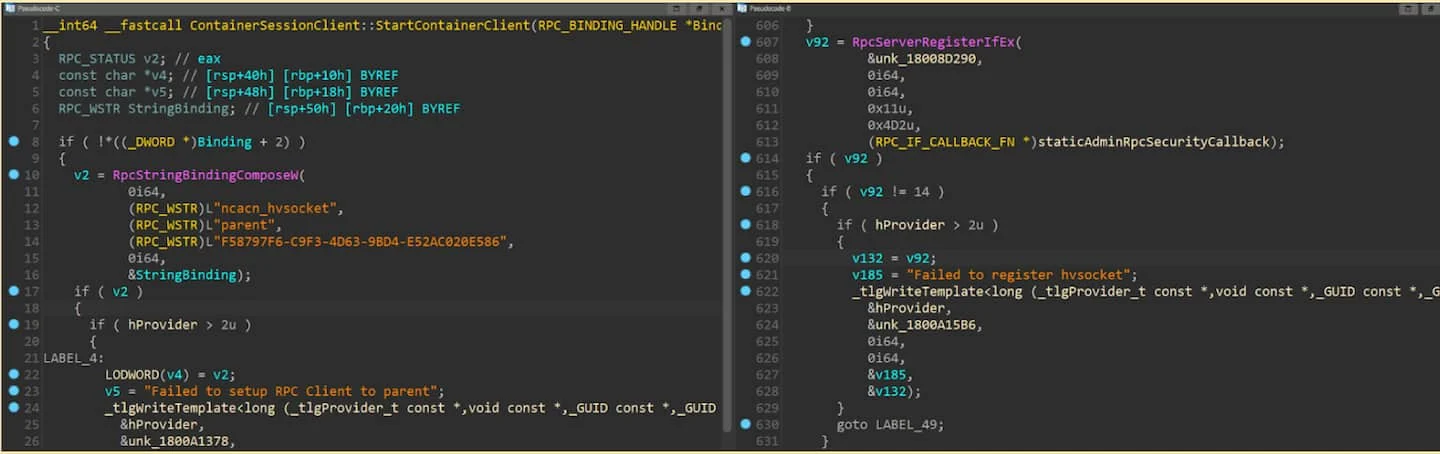
When a session is created inside a container (for example because of an RDP connection), the LSM client first calls RpcGetRequestForWinlogon inside the container's LSM. That function arbitrates session creation and, when running inside a container, first asks the host for permission by invoking ContainerCom_AskForSession over an hvsocket to the parent. The interface limits the number of sessions to containers by tracking newly created sessions.
Setup
The vulnerability exists in unpatched Windows 10, Windows 11 and Windows Server 2022 machines. The interface is reachable from inside a Hyper-V container over hvsocket, and, as described below, also remotely through a named pipe endpoint. The proof of concept is published in the Akamai security research repository, alongside an RPC toolkit.
Finding it
The starting point is the session-tracking design. A global object called ContainerSessionServer holds two variables:
- Counter of total sessions created. Limited to one, so only one session is allowed at any given moment.
- A map between a container's GUID and its container's session count. Limited to two for each container.
Each time a container asks for a session, ContainerSessionServer::AskForSession first checks whether the total session counter is less than one. If so, it increments the total session count and also increments the container's session counter in the map. When ContainerSessionServer::OnSessionLoggedOff is called (upon container exit or directly as an RPC call), it decrements both the total session count and the container's session count by one.
The interface sounds simple, but auditing it turned up four bugs, chained into two vulnerabilities.
Exploitation
Chain #1, Bug #1: failure to exit a critical section (CVE-2022-37998)
ContainerSessionServer::AskForSession uses a critical section to synchronise access to the global ContainerSessionServer object.
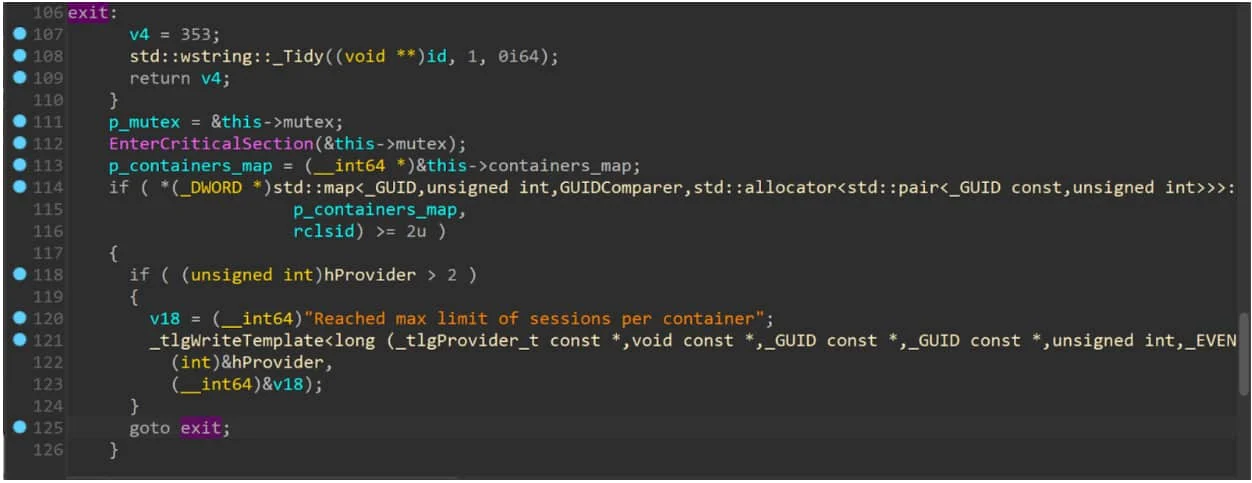
The critical section is entered at line 112. At lines 114 to 116 there is a check whether the container's session counter is at its limit of two. If so, LSM does not track the session and exits the function immediately at line 125, without leaving the critical section it entered. Further calls to the interface then block waiting for that critical section to be released.
The catch is the total session counter limit of one: logically a container's session counter should never reach two. The second bug removes that obstacle.
Chain #1, Bug #2: incorrect tracking of the counter
When a session to the container is logged off, an RPC call is made to ContainerSessionServer::OnSessionLoggedOff in the host. The function first decreases the total session counter by calling DecreaseTotalSessionCount, regardless of whether the container is being tracked. If it then finds the container is not tracked, it exits without incrementing the total session counter back.
Because the counter is a signed integer, this drives it negative. Sending many OnSessionLoggedOff requests before any AskForSession requests keeps decrementing the total session counter to an arbitrary negative number.
Chain #1: combining the two bugs
Use bug #2 to push the total session counter negative. Then send two AskForSession requests. On the second call, the function sees the total session counter is less than one (true, thanks to bug #2), then sees the container session counter is two, and returns without exiting the critical section.
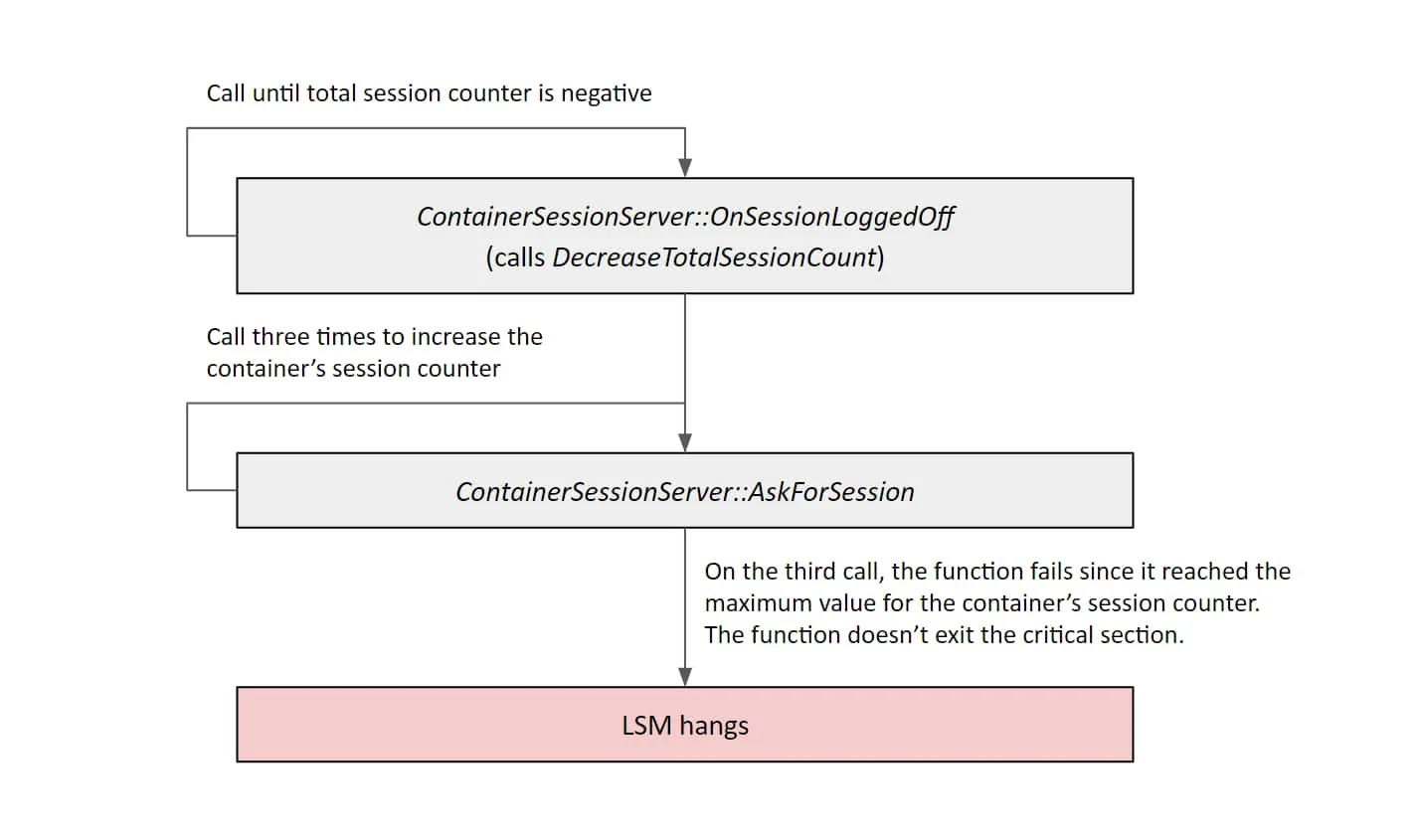
Whether the DoS actually lands depends on thread dispatch. If the RPC runtime dispatches new calls to the same thread that created the deadlock, nothing happens, because EnterCriticalSection allows nested ownership: the same thread can call it twice. If the call is dispatched to any other thread, that thread waits forever.
Chain #2, Bug #3: memory leak (CVE-2022-37973)
ContainerSessionServer::AskForSession also tracks container events such as exit, pause and resume. It calls HcsOpenComputeSystem with the container's GUID and registers a callback with HcsRegisterComputeSystemCallback. The callback receives a context object allocated inside AskForSession. In many error paths the function exits without freeing that context, so an attacker can trigger the leak repeatedly. Enough calls exhaust memory in the LSM process and it crashes.
In testing, RPC requests in an endless loop produced roughly 3 MB of allocation per second. The LSM service crashed after about 24 GB had been allocated, which took about two hours. The service is not automatically re-spawned.
Chain #2, Bug #4: remote access
Endpoints in MS-RPC are multiplexed: if a server registers multiple interfaces and multiple endpoints, each interface is reachable through each endpoint. Endpoints and interfaces are not bound to each other.
The container interface is supposed to be reachable only over hvsocket to containers. But LSM also registers a named pipe endpoint, \pipe\LSM_API_service, which is remotely accessible. Thanks to multiplexing, a remote attacker can connect to the named pipe and send a request to the container interface.
Chain #2: combining the two bugs
Container tracking keys off the client identifier property: for hvsocket it is the container's GUID, for a named pipe it is the client's machine name. Triggering the critical-section bug therefore needs a client identifier that is the GUID of a running container, so a remote client would have to learn a running container's GUID and change its machine name, an improbable scenario.
The memory leak, however, allocates its objects before any checks on the requested container. A remote attacker using bug #4 can therefore trigger the leak, repeat it, exhaust memory and crash the process.
Root cause
Four distinct mistakes combine here:
- An early return path in AskForSession leaves a critical section held, so the lock is never released.
- OnSessionLoggedOff decrements the total session counter for untracked containers and does not restore it, letting a signed counter go negative and defeating the limit of one.
- Error paths in AskForSession leak the callback context allocated for HcsRegisterComputeSystemCallback.
- The security callback always returns
RPC_S_OKand does not check which endpoint the client used, so the hvsocket-only intent is not enforced against the named pipe endpoint.
Impact
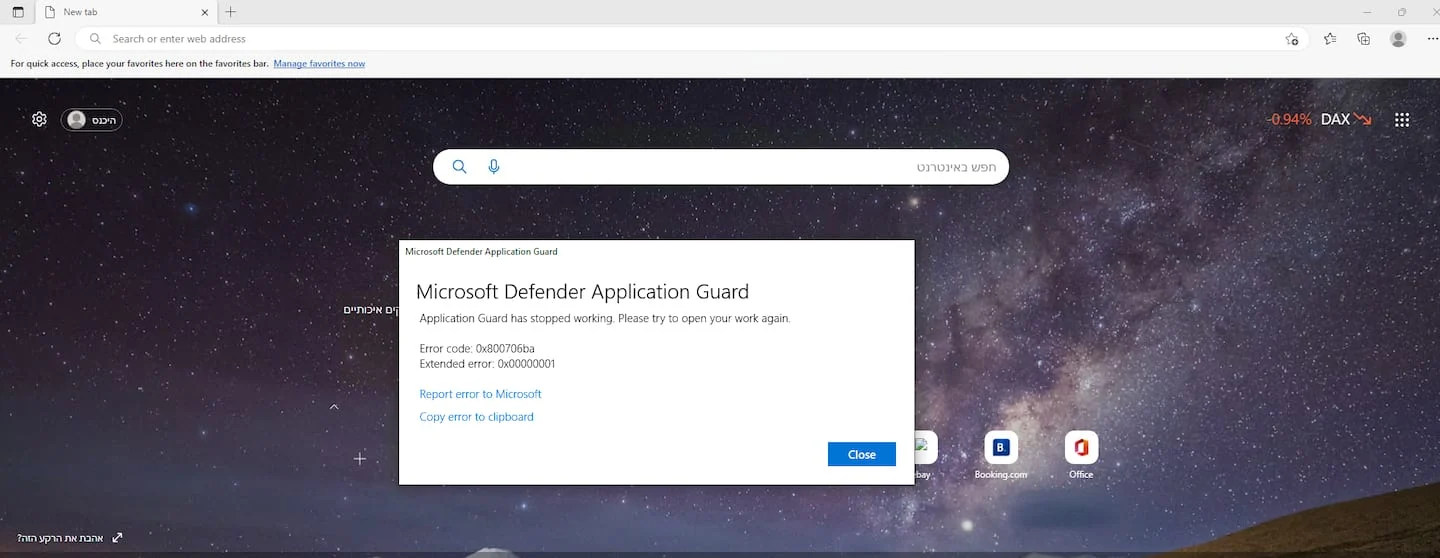
Both vulnerabilities are categorised as denial of service, but they have security impact because they let an attacker bypass security features. The critical-section exploit causes a DoS on the specific new interface, preventing creation of new sandbox instances. The memory-leak exploit, triggerable both remotely and from a container, crashes the whole process, so everything depending on LSM stops working: Microsoft Defender Application Guard and Sandbox, and also RDP and Docker.
The vulnerabilities were responsibly disclosed to Microsoft and addressed in the October 2022 Patch Tuesday; the CVEs carry a base score of 7.7.
Fix
Microsoft addressed both issues in October 2022. For the remote-access bug the report proposes a fix: the security callback should check which endpoint the client used and deny access if it is not hvsocket.
Variants to test
- Critical sections with early returns. Audit RPC server functions that enter a critical section and then return on a limit or error check. A positive result is a call that leaves the lock held and makes subsequent calls to the same interface hang.
- Signed counters decremented on untracked objects. Look for decrement paths that run before a tracking check and never restore the value. A positive result is a counter that can be driven negative, defeating a limit that should be impossible to exceed.
- Callback contexts on error paths. Trace allocations made before validation and freed only on success. A positive result is steady memory growth per request, visible as allocation per second and eventual process crash.
- Endpoint multiplexing. For any RPC server with several endpoints, connect over each endpoint and call interfaces meant for another. A positive result is a privileged interface answering on a broadly reachable endpoint such as a named pipe.
- Client identifier assumptions. Check whether authorisation depends on the client identifier (GUID versus machine name). A positive result is a path where the identifier can be influenced or where checks happen after allocation.
What happened, in plain words
Microsoft Windows has a background service called the Local Session Manager, or LSM. It keeps track of the sessions that people and programs open on a machine, including sessions inside containers, which are lightweight, isolated mini-systems that run inside a real machine. A researcher at Akamai, Ben Barnea, looked closely at the way LSM talks to containers and found four separate mistakes in its code. Two of those mistakes could be combined into one attack, and the other two into a second attack. Both attacks are denial-of-service attacks: they do not steal data, they stop things from working. One can freeze a specific feature so that new sandbox instances cannot be created. The other can crash the LSM service entirely, which takes down Microsoft Defender Application Guard, Sandbox, RDP and Docker on that machine. The bugs were reported to Microsoft and addressed in the October 2022 Patch Tuesday, and they were assigned the identifiers CVE-2022-37998 and CVE-2022-37973 with a base score of 7.7.

This article walks through the same material as the technical write-up, but from zero. Every term is explained the first time it appears, and every step is described in terms of why it was taken, not just what it does.
The background you need first
What RPC is
RPC stands for Remote Procedure Call. The idea is simple: one program can ask another program, possibly on a different machine, to run a function for it, as if that function were local. Think of it like ordering at a restaurant. You do not walk into the kitchen and cook; you tell the waiter what you want, the kitchen prepares it, and the waiter brings the result back. RPC is the waiter. The program making the request is the client, and the program answering is the server.
MS-RPC is Microsoft's implementation of this idea, and it is used all over Windows. A great deal of Windows functionality is built on it, which is why the report says it does a great deal on Windows. The report also notes that MS-RPC is largely under-researched, meaning relatively few people study it compared with how much it does. That matters because, as the report puts it, vulnerabilities in an RPC interface become exposed to anyone who can reach that interface. In other words, if the waiter can be reached from far away, so can the kitchen.
What an interface is
An interface, in this context, is a named collection of functions that a server offers. Think of a restaurant menu: the menu is the interface, and each dish on it is a function. A client can only order what is on the menu. Each interface is identified by a UUID, which is a long string of letters and numbers that is meant to be unique, like a serial number for the menu.
What LSM is
LSM, the Local Session Manager, is part of the Session Manager Subsystem in Windows. It manages local sessions related to terminal server sessions on a Windows machine. A session, here, is roughly one logged-in user's working environment: the desktop, the programs, and the resources tied to that login. Terminal server sessions are sessions that can be accessed remotely, for example over Remote Desktop. LSM communicates with other Windows components such as Winlogon, which handles logging users in, and Csrss, a core Windows process. LSM is implemented in a file called lsm.dll and contains both client and server logic, meaning it can both ask for things and answer requests.
LSM exposes several RPC interfaces. The one this research focuses on manages sessions of containers running inside a Hyper-V virtual machine. A container is a lightweight, isolated environment that shares the host machine's operating system kernel but keeps its own files and processes separate. Hyper-V is Microsoft's virtualisation technology, which lets one physical machine run several virtual machines. A Hyper-V container is a container that runs inside such a virtual machine, which gives it an extra layer of isolation.
The interface under study
The interface is assigned the UUID c938b419-5092-4385-8360-7cdc9625976a and exposes exactly two functions: ContainerCom_AskForSession and ContainerCom_SessionLoggedOff. In plain terms, one function asks for permission to start a session, and the other says that a session has ended.
The interface is registered with a security callback that always returns RPC_S_OK, allowing access to everyone. A security callback is a small piece of code the server runs to decide whether a caller is allowed in. Returning RPC_S_OK is the RPC way of saying yes. So this callback says yes to everybody, every time. That is the first thing worth noticing: the door has a lock, but the lock is wired to always open.
The LSM server registers a Hyper-V socket (hvsocket) endpoint that is only accessible to Hyper-V containers. An endpoint is the actual address where clients connect, like a specific door into the building. An hvsocket is a communication channel that only works between a Hyper-V host and the containers running inside it, so it is not reachable from the network.
Fig. 1 shows the two sides: a client setting up an RPC connection over hvsocket, and the server setting up an hvsocket endpoint. The point of the picture is that the intended path is a private, internal one.
How a session gets created
When a session is created inside a container, for example because of an RDP connection, the LSM client first calls RpcGetRequestForWinlogon inside the container's LSM. RDP is Remote Desktop Protocol, the technology that lets you see and control another machine's desktop over a network. RpcGetRequestForWinlogon arbitrates session creation, meaning it decides whether the session may go ahead. When it is running inside a container, it first asks the host for permission by invoking ContainerCom_AskForSession over an hvsocket to the parent. The parent is the host machine that runs the container.
The interface limits the number of sessions to the containers by tracking newly created sessions. This is the whole purpose of the interface: to act as a bouncer counting how many sessions are allowed in.
How LSM keeps track of sessions
The report describes a global object called ContainerSessionServer. A global object is a single shared piece of memory that all parts of the program can see, like a whiteboard in an office that everyone reads and writes on. It holds two variables:
- Counter of total sessions created. This is limited to one, meaning only one session is allowed at any given moment across the whole machine.
- A map between a container's GUID and its container's session count. A map is a lookup table: you give it a key and it gives you a value. A GUID is a globally unique identifier, a long string that identifies one specific thing, here one specific container. This second counter is limited to two for each container.
Each time a container asks for a session, ContainerSessionServer::AskForSession first checks whether the total session counter is less than one. If so, it increments the total session count and also increments the container's session counter in the map. Increment means add one.
When ContainerSessionServer::OnSessionLoggedOff is called, either upon container exit or directly as an RPC call, it decrements both the total session count and the container's session count by one. Decrement means subtract one.
So the design is: a global limit of one session at a time, and a per-container limit of two. The interface sounds simple, but auditing it turned up four bugs, which the researcher chained into two vulnerabilities. Auditing, here, means reading the code carefully looking for mistakes, the way an editor reads a manuscript looking for errors.
The setup
The vulnerability exists in unpatched Windows 10, Windows 11 and Windows Server 2022 machines. Unpatched means the security updates had not been installed. The interface is reachable from inside a Hyper-V container over hvsocket, and, as described below, also remotely through a named pipe endpoint. A named pipe is a communication channel that Windows programs use to talk to each other, and some named pipes can be reached over the network. The proof of concept is published in the Akamai security research repository, alongside an RPC toolkit. A proof of concept is a small program that demonstrates the bug actually works, rather than just describing it.
Chain #1: the critical section bug (CVE-2022-37998)
Bug #1: failure to exit a critical section
ContainerSessionServer::AskForSession uses a critical section to synchronise access to the global ContainerSessionServer object. A critical section is a lock that only one thread can hold at a time. A thread is one sequence of instructions that a program runs; a program can run several threads at once. The lock exists so that two threads do not write to the shared whiteboard at the same time and corrupt it. The rule is: enter the critical section, do your work, then leave it. If you forget to leave, everyone else waits forever.
Fig. 2 shows the decompiled code of the vulnerability. Decompiled means the code was turned from the machine's low-level instructions back into something readable. The function exits without releasing the critical section.
The critical section is entered at line 112. At lines 114 to 116 there is a check whether the container's session counter is at its limit of two. If so, LSM does not track the session and exits the function immediately at line 125, without leaving the critical section it entered. Further calls to the interface then block waiting for that critical section to be released. Block means they stop and wait, doing nothing, potentially forever.
Why does this matter? Because the lock is now held by a function that has already returned. Any other thread that tries to enter the same critical section will wait for a release that never comes. That is the first half of a denial of service: the feature stops responding.
The catch is the total session counter limit of one. Logically, a container's session counter should never reach two, because the global limit of one should stop a second session before the per-container counter can climb. The second bug removes that obstacle.
Bug #2: incorrect tracking of the counter
When a session to the container is logged off, an RPC call is made to ContainerSessionServer::OnSessionLoggedOff in the host. The function first decreases the total session counter by calling DecreaseTotalSessionCount, regardless of whether the container is being tracked. If it then finds the container is not tracked, it exits without incrementing the total session counter back.
In plain terms: the function subtracts one from the global counter before checking whether it should have. If the container was never being tracked, it leaves the counter lower than it found it. Because the counter is a signed integer, this drives it negative. A signed integer is a number that can be positive, zero or negative, as opposed to an unsigned one that can only be zero or positive. Sending many OnSessionLoggedOff requests before any AskForSession requests keeps decrementing the total session counter to an arbitrary negative number.
Why is that useful to an attacker? Because the check in AskForSession is whether the total session counter is less than one. A negative number is less than one. So by pushing the counter negative, the attacker makes the check pass when it should not.
Chain #1: combining the two bugs
Use bug #2 to push the total session counter negative. Then send two AskForSession requests. On the second call, the function sees the total session counter is less than one, which is true thanks to bug #2, then sees the container session counter is two, and returns without exiting the critical section.
Fig. 3 outlines the exploitation process: first the counter is driven negative, then two session requests are sent, and the second one leaves the lock held.
Whether the DoS actually lands depends on thread dispatch. Dispatch, here, means which thread the RPC runtime chooses to run the incoming call on. If the RPC runtime dispatches new calls to the same thread that created the deadlock, nothing happens, because EnterCriticalSection allows nested ownership: the same thread can call it twice. Think of a person holding a door closed from the inside; if they are the one knocking, they can just open it. If the call is dispatched to any other thread, that thread waits forever, like a second person outside a door held shut from within.
Chain #2: the memory leak bug (CVE-2022-37973)
Bug #3: memory leak
ContainerSessionServer::AskForSession also tracks container events such as exit, pause and resume. It calls HcsOpenComputeSystem with the container's GUID and registers a callback with HcsRegisterComputeSystemCallback. A callback is a function you hand to someone else and say: call this when something happens. Here, the callback is what LSM runs when a container exits, pauses or resumes.
The callback receives a context object. A context object is a small bundle of information the callback needs in order to do its job, like a folder handed to a colleague along with a task. The context is allocated inside ContainerSessionServer::AskForSession. Allocated means memory was reserved for it. In many error paths the function exits without freeing that context, so an attacker can trigger the leak repeatedly. Freeing means giving the memory back so it can be reused. A memory leak is memory that is reserved and then forgotten, so it can never be reused.
Enough calls exhaust memory in the LSM process and it crashes. Exhaust means there is no memory left to hand out. In testing, RPC requests in an endless loop produced roughly 3 MB of allocation per second. The LSM service crashed after about 24 GB had been allocated, which took about two hours. The service is not automatically re-spawned, meaning Windows does not restart it on its own, so the outage persists until someone intervenes.
Why does this matter? Because a memory leak that an attacker can trigger at will is a slow, reliable way to stop a service. You do not need a clever exploit; you just need patience and a loop.
Bug #4: remote access
Endpoints in MS-RPC are multiplexed: if a server registers multiple interfaces and multiple endpoints, each interface is reachable through each endpoint. Endpoints and interfaces are not bound to each other. Multiplexing, here, means one connection point carries traffic for several services, like a single reception desk that handles enquiries for every department in the building.
The container interface is supposed to be reachable only over hvsocket to containers. But LSM also registers a named pipe endpoint, \pipe\LSM_API_service, which is remotely accessible. Thanks to multiplexing, a remote attacker can connect to the named pipe and send a request to the container interface. The intended private door turns out to be reachable from the street because the same reception desk also serves the public entrance.
Chain #2: combining the two bugs
Container tracking keys off the client identifier property: for hvsocket it is the container's GUID, for a named pipe it is the client's machine name. The client identifier is how the server knows who is calling. Triggering the critical-section bug therefore needs a client identifier that is the GUID of a running container, so a remote client would have to learn a running container's GUID and change its machine name, an improbable scenario.
The memory leak, however, allocates its objects before any checks on the requested container. A remote attacker using bug #4 can therefore trigger the leak, repeat it, exhaust memory and crash the process. The order of operations is the key: because the allocation happens before the identity check, the attacker does not need to pass the check at all.
Root cause
Four distinct mistakes combine here:
- An early return path in AskForSession leaves a critical section held, so the lock is never released.
- OnSessionLoggedOff decrements the total session counter for untracked containers and does not restore it, letting a signed counter go negative and defeating the limit of one.
- Error paths in AskForSession leak the callback context allocated for HcsRegisterComputeSystemCallback.
- The security callback always returns
RPC_S_OKand does not check which endpoint the client used, so the hvsocket-only intent is not enforced against the named pipe endpoint.
Each of these is a small, ordinary programming mistake. The danger comes from how they combine.
Impact
Both vulnerabilities are categorised as denial of service, but they have security impact because they let an attacker bypass security features. The critical-section exploit causes a DoS on the specific new interface, preventing creation of new sandbox instances. A sandbox is an isolated environment used to run untrusted content safely. The memory-leak exploit, triggerable both remotely and from a container, crashes the whole process, so everything depending on LSM stops working: Microsoft Defender Application Guard and Sandbox, and also RDP and Docker. Microsoft Defender Application Guard is a Windows feature that runs untrusted websites in a disposable container; Docker is a popular container platform.
Fig. 4 shows the MDAG error as displayed in Microsoft Edge.
The vulnerabilities were responsibly disclosed to Microsoft and addressed in the October 2022 Patch Tuesday, with a base score of 7.7. Responsible disclosure means telling the vendor privately and giving them time to fix before publishing. Patch Tuesday is Microsoft's monthly update day. A base score of 7.7 is a severity rating from the Common Vulnerability Scoring System, where higher means more severe.
Fix
Microsoft addressed both issues in October 2022. For the remote-access bug the report proposes a fix: the security callback should check which endpoint the client used and deny access if it is not hvsocket. In other words, the reception desk should ask which door you came through, and turn away anyone who did not come through the private one.
Variants to test
These are the patterns to look for in other software, written as things a beginner can understand and a tester can act on:
- Critical sections with early returns. Audit RPC server functions that enter a critical section and then return on a limit or error check. A positive result is a call that leaves the lock held and makes subsequent calls to the same interface hang. In everyday terms: look for a function that locks the door, then leaves through the window.
- Signed counters decremented on untracked objects. Look for decrement paths that run before a tracking check and never restore the value. A positive result is a counter that can be driven negative, defeating a limit that should be impossible to exceed. In everyday terms: look for a tally that can go below zero because someone subtracts before checking whether they should.
- Callback contexts on error paths. Trace allocations made before validation and freed only on success. A positive result is steady memory growth per request, visible as allocation per second and eventual process crash. In everyday terms: look for a function that reserves a room, then forgets to cancel the booking when the guest is turned away.
- Endpoint multiplexing. For any RPC server with several endpoints, connect over each endpoint and call interfaces meant for another. A positive result is a privileged interface answering on a broadly reachable endpoint such as a named pipe. In everyday terms: try the public entrance and see whether it lets you into the staff-only rooms.
- Client identifier assumptions. Check whether authorisation depends on the client identifier, such as a GUID versus a machine name. A positive result is a path where the identifier can be influenced or where checks happen after allocation. In everyday terms: see whether the bouncer checks your name badge before or after letting you into the building.
Glossary
- API: Application Programming Interface, a defined set of functions one program offers so another program can use it.
- Audit (code): reading code carefully, looking for mistakes.
- Base score: a severity number from the Common Vulnerability Scoring System, where higher means more severe.
- Callback: a function you hand to another piece of code, to be run when a particular event happens.
- Client: the program that asks another program to do something.
- Client identifier: the value the server uses to know who is calling, such as a container's GUID or a machine name.
- Container: a lightweight, isolated environment that shares the host's operating system kernel but keeps its own files and processes separate.
- Context object: a small bundle of information passed to a callback so it can do its job.
- Counter: a number that is incremented or decremented to keep track of how many of something exist.
- Critical section: a lock that only one thread can hold at a time, used to stop two threads writing to shared data at once.
- CVE: Common Vulnerabilities and Exposures, a public identifier assigned to a specific security vulnerability.
- Csrss: a core Windows process that handles parts of the user-mode environment.
- Decrement: subtract one.
- Denial of service (DoS): an attack that stops a service from working, rather than stealing data.
- Decompile: turn low-level machine instructions back into readable code.
- Dispatch (thread): the choice of which thread runs an incoming call.
- Docker: a popular platform for building and running containers.
- Endpoint: the actual address where clients connect to a service, such as a named pipe or a socket.
- Exhaust (memory): use up all available memory so nothing is left to hand out.
- Free (memory): give reserved memory back so it can be reused.
- Global object: a single shared piece of memory that all parts of a program can see.
- GUID: Globally Unique Identifier, a long string that identifies one specific thing.
- Host: the real machine that runs virtual machines or containers.
- Hvsocket: Hyper-V socket, a communication channel that only works between a Hyper-V host and the containers running inside it.
- Hyper-V: Microsoft's virtualisation technology, which lets one physical machine run several virtual machines.
- Increment: add one.
- Interface (RPC): a named collection of functions a server offers, identified by a UUID.
- Local Session Manager (LSM): the Windows service that manages local sessions related to terminal server sessions.
- Map: a lookup table that gives you a value when you give it a key.
- Memory leak: memory that is reserved and then forgotten, so it can never be reused.
- Microsoft Defender Application Guard: a Windows feature that runs untrusted websites in a disposable container.
- MS-RPC: Microsoft's implementation of Remote Procedure Call, used widely across Windows.
- Multiplexing (endpoints): one connection point carrying traffic for several services, so each interface is reachable through each endpoint.
- Named pipe: a communication channel Windows programs use to talk to each other; some are reachable over the network.
- Nested ownership (critical section): the same thread being allowed to enter the same critical section more than once.
- Patch Tuesday: Microsoft's monthly day for releasing security updates.
- Proof of concept (PoC): a small program that demonstrates a bug actually works.
- RDP: Remote Desktop Protocol, the technology that lets you see and control another machine's desktop over a network.
- Responsible disclosure: telling the vendor privately and giving them time to fix before publishing.
- RPC: Remote Procedure Call, a way for one program to ask another to run a function for it.
- RPC_S_OK: the RPC status value meaning success, used by a security callback to say yes.
- Sandbox: an isolated environment used to run untrusted content safely.
- Security callback: a small piece of code a server runs to decide whether a caller is allowed in.
- Server: the program that answers requests from a client.
- Session: roughly one logged-in user's working environment on a Windows machine.
- Signed integer: a number that can be positive, zero or negative.
- Terminal server session: a session that can be accessed remotely, for example over Remote Desktop.
- Thread: one sequence of instructions a program runs; a program can run several at once.
- Unpatched: a machine that has not had the relevant security updates installed.
- UUID: Universally Unique Identifier, a long string meant to be unique, used to identify an interface.
- Virtual machine: a simulated computer running inside a real one.
- Winlogon: the Windows component that handles logging users in.



