CVE-2018-0296 Cisco ASA Denial of Service & Path Traversal vulnerable on [mtn.co.ug]
The Cisco ASA web interface on the target host did not properly validate the HTTP URL, allowing an unauthenticated attacker to use directory traversal to view sensitive system information. The same flaw could also cause the device to reload unexpectedly, resulting in a denial of service.

- Triaged in 14 hours
- Fixed in 4 months
- Disclosed after 6 months
Summary:
A vulnerability in the web interface of the Cisco Adaptive Security Appliance (ASA) could allow an unauthenticated, remote attacker to cause an affected device to reload unexpectedly, resulting in a denial of service (DoS) condition. It is also possible on certain software releases that the ASA will not reload, but an attacker could view sensitive system information without authentication by using directory traversal techniques. The vulnerability is due to lack of proper input validation of the HTTP URL. An attacker could exploit this vulnerability by sending a crafted HTTP request to an affected device. An exploit could allow the attacker to cause a DoS condition or unauthenticated disclosure of information. This vulnerability applies to IPv4 and IPv6 HTTP traffic. This vulnerability affects Cisco ASA Software and Cisco Firepower Threat Defense (FTD) Software that is running on the following Cisco products: 3000 Series Industrial Security Appliance (ISA), ASA 1000V Cloud Firewall, ASA 5500 Series Adaptive Security Appliances, ASA 5500-X Series Next-Generation Firewalls, ASA Services Module for Cisco Catalyst 6500 Series Switches and Cisco 7600 Series Routers, Adaptive Security Virtual Appliance (ASAv), Firepower 2100 Series Security Appliance, Firepower 4100 Series Security Appliance, Firepower 9300 ASA Security Module, FTD Virtual (FTDv).
Proof of concept
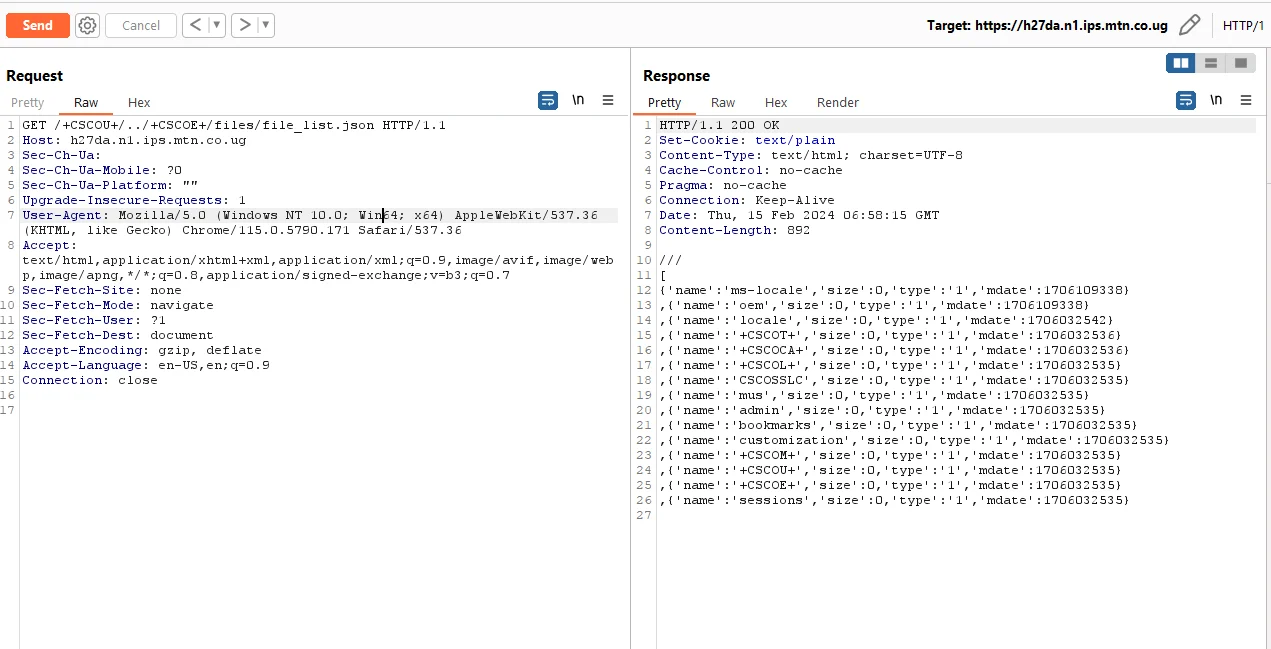
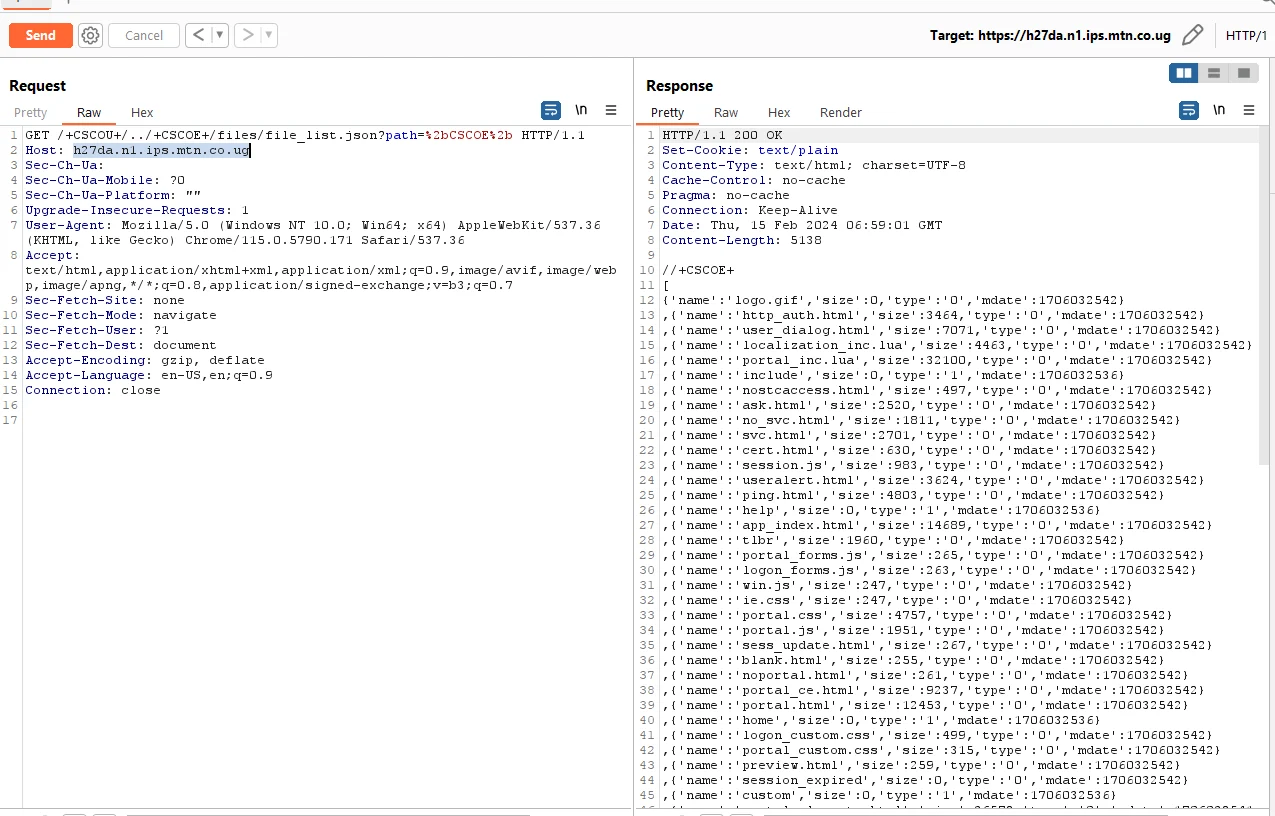
Vulnerability Host Server : https://h27da.n1.ips.mtn.co.ug/+CSCOU+/../+CSCOE+/files/file_list.json?path=%2bCSCOE%2b
- Navigate intercept request to burp-suite
h27da.n1.ips.mtn.co.ug/+CSCOU+/../+CSCOE+/files/file_list.json - See the PoCs Screenshots of vulnerable bellow
Supporting Material/References:
- https://tools.cisco.com/security/center/content/CiscoSecurityAdvisory/cisco-sa-20180606-asaftd
- https://nvd.nist.gov/vuln/detail/CVE-2018-0296
- https://hackerone.com/reports/378698
- https://hackerone.com/reports/377542
- https://hackerone.com/reports/622864
Impact
High - This vulnerability allows the attacker to browse files past the authentication and disclose sensitive information.
Context
The target is mtn.co.ug, an MTN Group asset. The host named in the report, h27da.n1.ips.mtn.co.ug, runs the web interface of a Cisco Adaptive Security Appliance (ASA). That interface is the management and clientless-access front end of the appliance: it serves the login portal and the clientless SSL VPN components, including the +CSCOE+ and +CSCOU+ paths that the appliance uses internally for its web resources.
The bug exercised here is CVE-2018-0296, a vulnerability in the ASA web interface caused by a lack of proper input validation of the HTTP URL. Per the advisory, an unauthenticated remote attacker can send a crafted HTTP request that either causes the device to reload unexpectedly (a denial of service) or, on certain software releases, lets the attacker view sensitive system information without authentication through directory traversal. The advisory states the issue applies to IPv4 and IPv6 HTTP traffic and affects Cisco ASA Software and Cisco Firepower Threat Defence (FTD) Software running on a list of products: 3000 Series Industrial Security Appliance (ISA), ASA 1000V Cloud Firewall, ASA 5500 Series Adaptive Security Appliances, ASA 5500-X Series Next-Generation Firewalls, ASA Services Module for Cisco Catalyst 6500 Series Switches and Cisco 7600 Series Routers, Adaptive Security Virtual Appliance (ASAv), Firepower 2100 Series Security Appliance, Firepower 4100 Series Security Appliance, Firepower 9300 ASA Security Module, and FTD Virtual (FTDv).
Setup
The report describes no accounts, roles or credentials, which is consistent with the vulnerability being unauthenticated. The only tool named is Burp Suite, used to intercept and modify the request. The precondition is simply that the ASA web interface is reachable over HTTP at the host in question.
Finding it
The researcher identified the host as an ASA web interface and tested it against the known CVE-2018-0296 traversal pattern. The path construction abuses the +CSCOU+ and +CSCOE+ pseudo-directories: a request is made into +CSCOU+, then traverses back out with ../ and into +CSCOE+, where the files/file_list.json endpoint is reached with a path parameter. The request uses traversal to reach the files/file_list.json endpoint under +CSCOE+.
Exploitation
Step 1: Intercept the request
The researcher navigates to the vulnerable host and intercepts the request in Burp Suite. The vulnerable host server and URL given in the report are:
https://h27da.n1.ips.mtn.co.ug/+CSCOU+/../+CSCOE+/files/file_list.json?path=%2bCSCOE%2b
Breaking this down: the request enters the +CSCOU+ path, which is reachable without authentication, then uses ../ to step back to the root and forward into +CSCOE+. The endpoint files/file_list.json is then requested with path=%2bCSCOE%2b, the URL-encoded form of +CSCOE+, so the file listing is produced for that directory. The report shows the crafted request as proof of concept of the vulnerable host.
Step 2: Observe the result
The report presents two screenshots as proof of concept of the vulnerable host.
The report does not describe the response body or the contents of the listing in text; the evidence is the screenshots above.
Root cause
The advisory attributes the flaw to a lack of proper input validation of the HTTP URL. The web interface accepts a URL containing traversal sequences and resolves them before enforcing authentication on the protected +CSCOE+ resources, so a request that starts in an unauthenticated area can end up reading from an authenticated one. The report does not go into the server-side implementation, so the precise parsing behaviour is not documented here.
Impact
The report rates the impact as high: the vulnerability allows an attacker to browse files past the authentication and disclose sensitive information. The advisory adds that the same class of crafted request can cause the affected device to reload unexpectedly, producing a denial of service, and that on certain software releases the device will not reload but sensitive system information can be viewed without authentication. The report does not state which of these outcomes was observed on this host beyond the file listing shown in the screenshots.
Fix
The remediation for this issue is the one published by Cisco in the advisory referenced below: upgrading the ASA or FTD software to a release that validates the HTTP URL correctly. The report itself only links to the advisory.
Variants to test
- Other ASA and FTD web interfaces on the same estate: send the same
+CSCOU+/../+CSCOE+/files/file_list.json?path=%2bCSCOE%2brequest. A positive result is a JSON file listing returned without a session. - Different traversal depths and encodings of the same pattern, for example additional
../segments or encoded variants of the separators. A positive result is the same unauthenticated listing or any other+CSCOE+resource returned. - IPv6 reachability of the same interface, since the advisory states the issue applies to IPv4 and IPv6 HTTP traffic. A positive result is the same response over IPv6.
- Other products in the advisory's affected list (ASA 5500-X, ASAv, Firepower appliances, FTDv) exposed with a web interface. A positive result is the same traversal behaviour.
Hunting notes
This kind of bug hides on internet-facing management interfaces of network appliances, particularly where a vendor-specific pseudo-path scheme (+CSCOE+, +CSCOU+) sits in front of an authentication check. During recon, an ASA login portal or clientless VPN page on a host is the signal to test the known CVE-2018-0296 pattern.
References
What happened, in plain words
A security researcher found that a web address belonging to MTN Group, mtn.co.ug, was running a piece of networking equipment with a known, publicly documented flaw. The equipment is a Cisco Adaptive Security Appliance, usually shortened to ASA. An ASA is a box that sits between a company network and the internet and decides what traffic is allowed in and out; it also has a small website built in so administrators can log in and manage it, and so staff can reach internal resources through a browser without installing a VPN client.
That built-in website had a bug tracked as CVE-2018-0296. "CVE" stands for Common Vulnerabilities and Exposures: it is a public catalogue number given to a specific security flaw so that everyone, vendors and defenders alike, can refer to the same thing. The bug means the website does not properly check the web address (the URL) it is asked to serve. By crafting a URL that walks out of a public area and back into a protected one, a person who has not logged in can reach files that should only be visible after authentication. On some software versions the same kind of request can also crash the device so it restarts, which is a denial of service.
The researcher sent one such crafted request to the host h27da.n1.ips.mtn.co.ug and captured screenshots showing the result. The report rates the impact as high, because files can be browsed past the login check and sensitive information can be disclosed.
The target and the product
The asset named in the report is mtn.co.ug. The specific machine involved is h27da.n1.ips.mtn.co.ug. Reading a hostname from left to right, the rightmost part is the domain the organisation owns, and the parts to the left narrow it down to one machine.
What the report does say is that this host runs the web interface of a Cisco ASA. That interface has two jobs:
- It serves the login portal where administrators sign in.
- It serves the clientless SSL VPN. A VPN (virtual private network) normally means installing a small program on your computer that creates an encrypted tunnel to the office. "Clientless" means no program is needed: you open a browser, log in to a web page, and the appliance shows you internal sites and files through that page.
To make that work, the ASA uses some unusual internal folder names, +CSCOE+ and +CSCOU+. The plus signs are part of the name, not decoration. Think of a building where the lobby is open to the public and the records room is locked: +CSCOU+ is the lobby, +CSCOE+ is the records room.
The vulnerability class: path traversal
Path traversal (also called directory traversal) is a bug where a program builds a file path from something the user supplied, and the user supplies characters that mean "go up a level". In web addresses, ../ means "parent folder". If a website serves files from /public/ and you ask for /public/../private/secret.txt, a careless server resolves the ../, steps up out of public, and hands you the file from private.
A simple comparison: a hotel clerk told to fetch "the folder labelled 12, then go back one shelf and take the folder there" will do exactly that, even though the second folder was never meant for you. The clerk followed instructions literally; the instructions were the problem.
CVE-2018-0296 is exactly this, in the ASA web interface. The advisory says the cause is a lack of proper input validation of the HTTP URL. "Input validation" means checking that what the user sent is sane before acting on it. Here the appliance accepted a URL containing ../ and resolved it before deciding whether the requester was allowed into +CSCOE+.
What the advisory says about scope
The report quotes Cisco's advisory. According to it, an unauthenticated, remote attacker can send a crafted HTTP request that either:
- causes the affected device to reload unexpectedly, a denial of service, or
- on certain software releases, does not reload the device but lets the attacker view sensitive system information without authentication through directory traversal.
"Unauthenticated" means no username or password is needed. "Remote" means over the network, not standing at the device. "Denial of service" means making a service unavailable, here by forcing a restart.
The advisory also states the issue applies to IPv4 and IPv6 HTTP traffic. IPv4 and IPv6 are the two versions of the addressing system the internet uses; every device has an address in one or both. Saying the bug applies to both means the crafted request works whichever address family you use to reach the device.
The affected products listed in the advisory are:
- 3000 Series Industrial Security Appliance (ISA)
- ASA 1000V Cloud Firewall
- ASA 5500 Series Adaptive Security Appliances
- ASA 5500-X Series Next-Generation Firewalls
- ASA Services Module for Cisco Catalyst 6500 Series Switches and Cisco 7600 Series Routers
- Adaptive Security Virtual Appliance (ASAv)
- Firepower 2100 Series Security Appliance
- Firepower 4100 Series Security Appliance
- Firepower 9300 ASA Security Module
- FTD Virtual (FTDv)
FTD stands for Firepower Threat Defence, Cisco's newer software that runs on some of the same hardware. "Virtual appliance" (the V in ASAv and FTDv) means the same software packaged to run as a virtual machine on a server rather than on a dedicated physical box.
Setup: what you need to reproduce this
The report names no accounts, roles or credentials, which fits the fact that the bug needs no login. The only tool mentioned is Burp Suite. Burp Suite is a program that sits between your browser and a website and lets you pause a request before it is sent, read it, change it, and then forward it. Without it you would type a URL and the browser would send it immediately; with it you can inspect and edit the request first.
The only precondition is that the ASA web interface is reachable over HTTP at the host in question. HTTP is the language browsers and web servers use to exchange pages and data; HTTPS is the same language wrapped in encryption.
Finding it
The researcher recognised the host as an ASA web interface and tested it against the known CVE-2018-0296 pattern. The trick relies on the two pseudo-directories described earlier. The request starts inside +CSCOU+, the area that does not require a login. It then uses ../ to step back out to the root, and from there goes forward into +CSCOE+, the protected area. Inside +CSCOE+ it asks for files/file_list.json, an endpoint that produces a listing of files.
An "endpoint" is simply a specific address on a server that does one job, like a particular counter in a post office. file_list.json is the counter that returns a file listing. The .json ending tells you the answer comes back in JSON, a text format for structured data that looks like {"name": "value"} and is easy for programs to read.
The path parameter at the end tells the endpoint which directory to list. A "parameter" is a named value attached to a URL after a question mark; here path is the name and %2bCSCOE%2b is the value. %2b is how a plus sign is written when it has to travel inside a URL, because a bare + can be misread as a space. So %2bCSCOE%2b decodes to +CSCOE+.
The key point is ordering. The request used ../ to step from +CSCOU+ into +CSCOE+ and asked for files/file_list.json.
Exploitation
Step 1: Intercept the request
The researcher navigates to the vulnerable host and intercepts the request in Burp Suite. The vulnerable host server and URL given in the report are:
https://h27da.n1.ips.mtn.co.ug/+CSCOU+/../+CSCOE+/files/file_list.json?path=%2bCSCOE%2b
Line by line, in plain words:
https://is the scheme: the browser will speak HTTP over an encrypted connection.h27da.n1.ips.mtn.co.ugis the machine being contacted./+CSCOU+/is the first folder in the path, the open lobby that needs no login./../means "go up one level", back to the root of the site. This is the traversal./+CSCOE+/is the protected folder the request is now aimed at, reached only because of the step above./files/file_list.jsonis the endpoint that returns a file listing.?path=%2bCSCOE%2bis the parameter telling that endpoint which folder to list, namely+CSCOE+once the%2bis decoded.
Why intercept at all? Because a normal browser may tidy up or encode a URL before sending it, and you want to see and control the exact bytes that reach the server. Burp Suite gives you that control.
Step 2: Observe the result
The report presents two screenshots as proof of concept of the vulnerable host.
The report does not describe the response body or the contents of the listing in text; the evidence is the screenshots above.
Root cause
The advisory attributes the flaw to a lack of proper input validation of the HTTP URL. In plain terms: the web interface accepted a URL containing traversal sequences and resolved them before enforcing authentication on the protected +CSCOE+ resources. A request that starts in an unauthenticated area can therefore end up reading from an authenticated one.
The report does not go into the server-side implementation, so the precise parsing behaviour is not documented here.
Impact
The report rates the impact as high: the vulnerability allows an attacker to browse files past the authentication and disclose sensitive information. The advisory adds that the same class of crafted request can cause the affected device to reload unexpectedly, producing a denial of service, and that on certain software releases the device will not reload but sensitive system information can be viewed without authentication. The report does not state which of these outcomes was observed on this host beyond the file listing shown in the screenshots.
Fix
The remediation for this issue is the one published by Cisco in the advisory referenced below: upgrading the ASA or FTD software to a release that validates the HTTP URL correctly. The report itself only links to the advisory.
Variants to test
- Other ASA and FTD web interfaces on the same estate: send the same
+CSCOU+/../+CSCOE+/files/file_list.json?path=%2bCSCOE%2brequest. A positive result is a JSON file listing returned without a session. - Different traversal depths and encodings of the same pattern, for example additional
../segments or encoded variants of the separators. A positive result is the same unauthenticated listing or any other+CSCOE+resource returned. - IPv6 reachability of the same interface, since the advisory states the issue applies to IPv4 and IPv6 HTTP traffic. A positive result is the same response over IPv6.
- Other products in the advisory's affected list (ASA 5500-X, ASAv, Firepower appliances, FTDv) exposed with a web interface. A positive result is the same traversal behaviour.
Hunting notes
This kind of bug hides on internet-facing management interfaces of network appliances, particularly where a vendor-specific pseudo-path scheme (+CSCOE+, +CSCOU+) sits in front of an authentication check. During recon, an ASA login portal or clientless VPN page on a host is the signal to test the known CVE-2018-0296 pattern.
References
- https://tools.cisco.com/security/center/content/CiscoSecurityAdvisory/cisco-sa-20180606-asaftd
- https://nvd.nist.gov/vuln/detail/CVE-2018-0296
- https://hackerone.com/reports/378698
- https://hackerone.com/reports/377542
- https://hackerone.com/reports/622864
Glossary
- API: a defined way for one program to ask another for data or actions, like a service counter with fixed request forms.
- ASA (Adaptive Security Appliance): Cisco networking device that filters traffic and provides VPN access, with a built-in management website.
- Authentication: proving who you are, usually with a username and password, before being allowed in.
- Burp Suite: a tool that intercepts, displays and lets you edit web requests between your browser and a server.
- Clientless SSL VPN: remote access through a web browser only, with no VPN client program installed.
- CVE: Common Vulnerabilities and Exposures, a public catalogue number for a specific security flaw.
- Denial of service (DoS): making a service unavailable, here by forcing the device to restart.
- Directory traversal / path traversal: a bug where
../in a supplied path lets a request escape its intended folder. - Endpoint: a specific address on a server that performs one function.
- FTD (Firepower Threat Defence): Cisco's newer security software that runs on some ASA-class hardware and virtual appliances.
- HTTP / HTTPS: the request-and-response language of the web; HTTPS is the same language encrypted.
- Input validation: checking that data supplied by a user is well formed and safe before acting on it.
- IPv4 / IPv6: the two versions of internet addressing; a device may be reachable over either or both.
- JSON: a text format for structured data, written as name and value pairs.
- Parameter: a named value attached to a URL after a question mark, such as
path=.... - Pseudo-directory: a folder-like name used internally by a product that is not an ordinary folder on disk, such as
+CSCOE+and+CSCOU+. - Recon: the information-gathering phase before testing, where you identify what a host is and what it runs.
- URL: the address of a resource on the web, including scheme, host, path and parameters.
- URL encoding: writing special characters in a URL as
%plus a code, for example%2bfor+. - Virtual appliance: software packaged to run as a virtual machine instead of on dedicated hardware.
- VPN (virtual private network): an encrypted connection that makes a remote network reachable as if you were on it.