Exposure Of Admin Username & Password
A subdomain's page source contained a hardcoded username and MD5-hashed password for an advertising API. An attacker could read the credentials, crack the weak hash, and use the account to access client information.
 Originally disclosed on HackerOne
- Triaged in 22 hours
- Fixed in 2 months
- Disclosed after 3 months
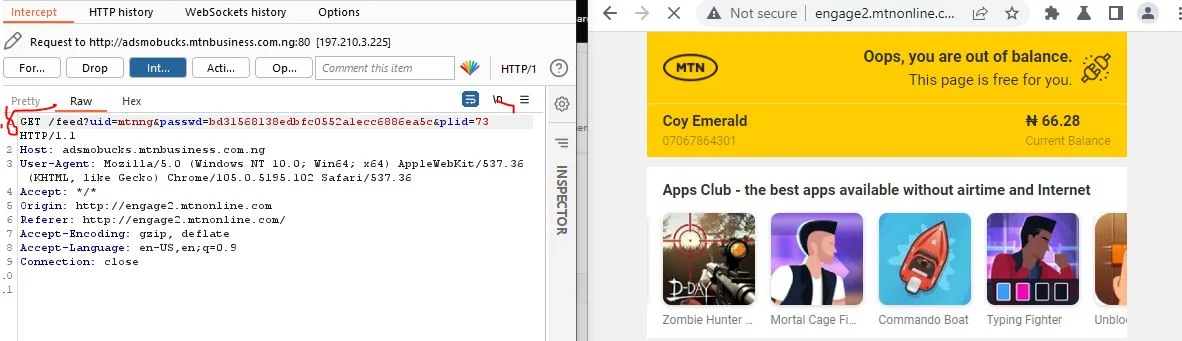
Hello Team, Ther an exposure of your username and password on this subdomain █████
uid: "mtnng",
    passwd: "██████████",
Steps To Reproduce:
Visit ███
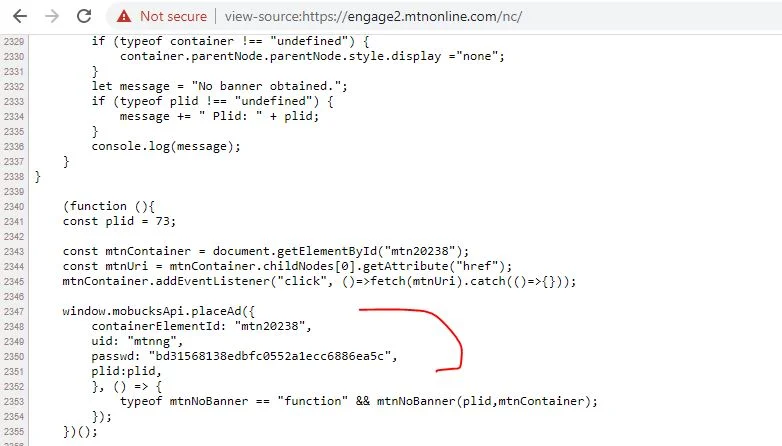
Now, press CTRL+U to view the source code of this page,
Look for this code
   console.log(message);
}
}
(function (){
const plid = 73;

const mtnContainer = document.getElementById("mtn20238");
const mtnUri = mtnContainer.childNodes[0].getAttribute("href");
mtnContainer.addEventListener("click", ()=>fetch(mtnUri).catch(()=>{}));

window.mobucksApi.placeAd({
    containerElementId: "mtn20238",
    uid: "mtnng",
    passwd: "███████",
    plid:plid,
    }, () => {
        typeof mtnNoBanner == "function" && mtnNoBanner(plid,mtnContainer);
Impact
The exposed password is in md5 which I was able to decrypt easily
uid: mtnng hash = bd31568138edbfc0552a1ecc6886ea plain password: ███
And as an attacker, this can be abused in lots of ways such as exposing some client's info
████
Attachments
Not written yet. The AI write-up for this report has not been written yet. The Original tab links to the source.
How it worked
Root cause
Likely, credentials for a third-party advertising API were hardcoded in client-side JavaScript, and the password was stored as an unsalted MD5 hash that is trivial to crack.
Impact
The cracked credentials could be used to access client information through the advertising service, though the text does not show what data was actually reachable.
What the attacker needed
None
How it was found
- Visit the affected subdomain.
- View the page source code.
- Locate the embedded script containing the credentials.
Explained by bugbounty.wiki with AI from the original and checked against quotes from it; it can still be wrong. Read the original before relying on a detail.
Not written yet. The AI write-up for this report has not been written yet. The Original tab links to the source.
A website's source code included a username and a scrambled password (a hash) for an advertising service. The hash was made with an old, weak method (MD5), so the reporter could turn it back into the real password. Anyone who viewed the page source could do the same and log in as that account.
What is Leaked secrets?
Keys, tokens or passwords left in public code, apps, logs or responses, that grant real access.





