Content spoofing on https://surveyserver.nextcloud.com
The forbidden page on the survey server reflected the request URI without validation, so an attacker could inject arbitrary text into the page. An attacker could craft a link that makes the error page display misleading content, such as a fake notice that the site has moved.

- Triaged in 44 hours
- Fixed in 5 days
- Disclosed after 2.1 years
Hi NextCloud team,
the https://surveyserver.nextcloud.com domain is vulnerable against content spoofing in the forbidden page due to the fact that the request URI is reflected without validation inside the aforementioned page.
- Go on https://surveyserver.nextcloud.com/.htaccess%20because%20the%20webserver%20has%20been%20moved%20on%20http://evil.com%20and%20only%20an%20old%20version%20is%20present
- Text injected successfully
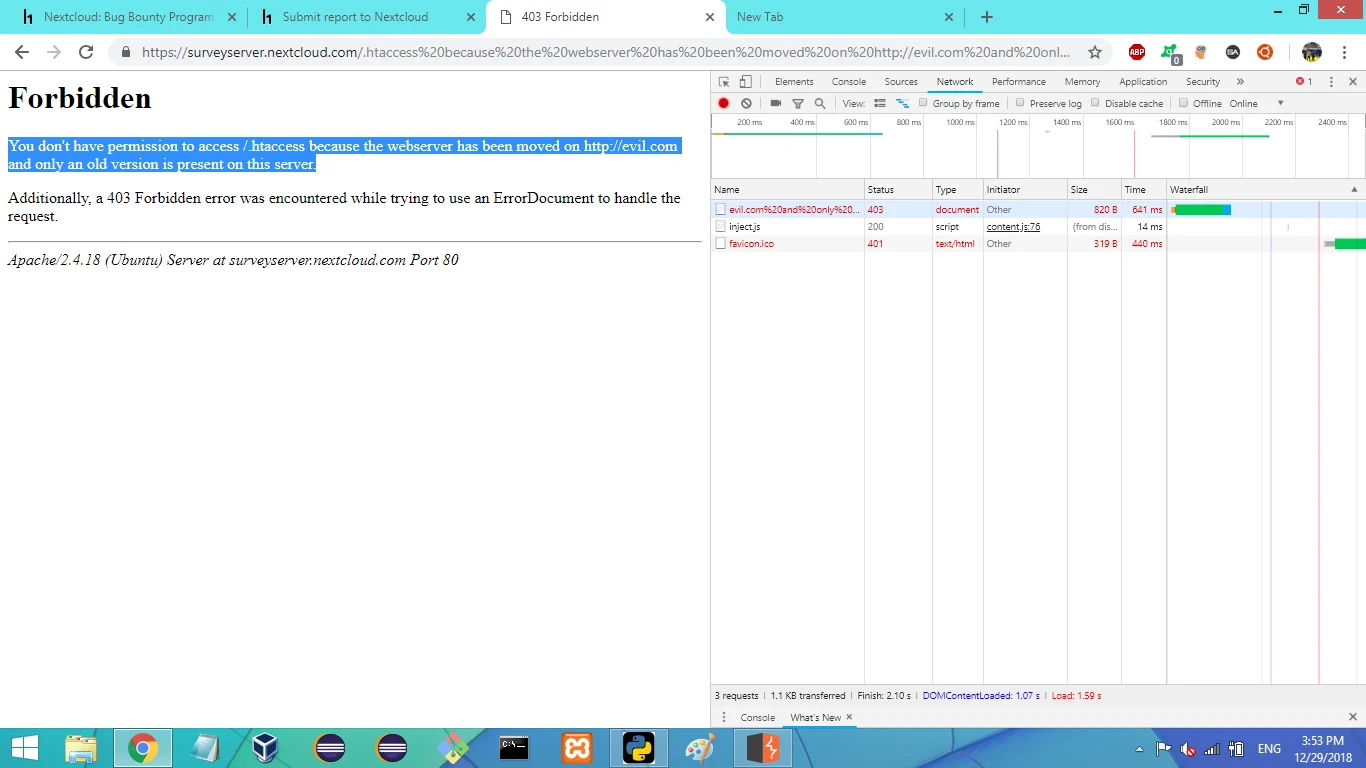
content.png From the original on HackerOne
Impact
Insert arbitrary text inside the forbidden page via request URI
Not written yet. The AI write-up for this report has not been written yet. The Original tab links to the source.
How it worked
Impact
An attacker could insert arbitrary text into the forbidden page via the request URI, which could be used to mislead users.
What the attacker needed
Victim opens a crafted link
How it was found
- Request a path on the survey server whose URI contains injected text.
- Observe that the text appears on the forbidden page.
Explained by bugbounty.wiki with AI from the original and checked against quotes from it; it can still be wrong. Read the original before relying on a detail.
Not written yet. The AI write-up for this report has not been written yet. The Original tab links to the source.
When a website shows an error page, it sometimes repeats back the address you typed. Here the site did that without cleaning it first, so someone could put their own words into the address and have them appear on the page. That lets an attacker make a link that shows a fake message, like claiming the site has moved elsewhere.
What is UI spoofing?
The interface lies to the user: a framed page catches their clicks, or a browser shows the wrong address or a fake prompt. Paid when it leads to a sensitive action or convincing phishing.