Cross-room signaling injection enabling unauthorized force-mute
The server authorised moderator-only control messages against the sender's own room but delivered them to any recipient session ID, so a low-privileged user could inject a forceMute into another room's call. The shipped client then muted the victim's local session.

- Triaged in 6 hours
- Fixed in 3 days
- Disclosed after 7 months
Summary:
A low-privileged participant can read another participant's live Talk sessionId from the room participant list, then use moderator rights in an unrelated room they control to inject moderator-only internal-signaling control messages into the victim's room session.
The server checks moderator permissions only against the sender session's own room, but it queues the message to any attacker-supplied recipient sessionId. Message delivery is then keyed only by recipient session ID, not by room. I reproduced this by sending a forceMute control from room B into a victim active in room A.
When the victim is in a call, the shipped client handles forceMute by muting the local user session.
Product / Version
- Nextcloud Server:
34.0.0.1(status.phpreportedversionstring: 34.0.0 dev) - Talk app:
24.0.0-dev.2 spreedcommit:031e0708bde280b2a83943a0e7a6102d8eede207- Server commit used in the lab:
b71661a38bb40fbdfc071f273ea506a4a9fae091 - Reproduced with the default internal-signaling mode on a local Nextcloud lab
Affected Code
lib/Controller/RoomController.php:1217-1220Active participant session IDs are exposed in the participant list.lib/Controller/RoomController.php:1250-1253Single-session participants are returned withsessionIds.lib/Controller/SignalingController.php:387-418controlmessages are authorized against the sender's session, then queued to arbitrarydecodedMessage['to'].lib/Signaling/Messages.php:48-56Queue entries storesender,recipient, andmessageonly.lib/Signaling/Messages.php:102-110Messages are fetched solely byrecipient = $sessionId.lib/Controller/SignalingController.php:551-585Victim polling consumes any queued message for that session.src/utils/webrtc/simplewebrtc/simplewebrtc.js:108-113IncomingforceMutecauses the client to mute itself whenpeerIdmatches the current session.
Steps To Reproduce:
Preconditions:
- Victim and attacker both participate in room A.
- Attacker is only a normal participant in room A.
- Attacker owns or moderates unrelated room B.
- Internal signaling is enabled.
Steps:
-
On nextcloud spreed (34.0.0.1 / Talk 24.0.0-dev.2),
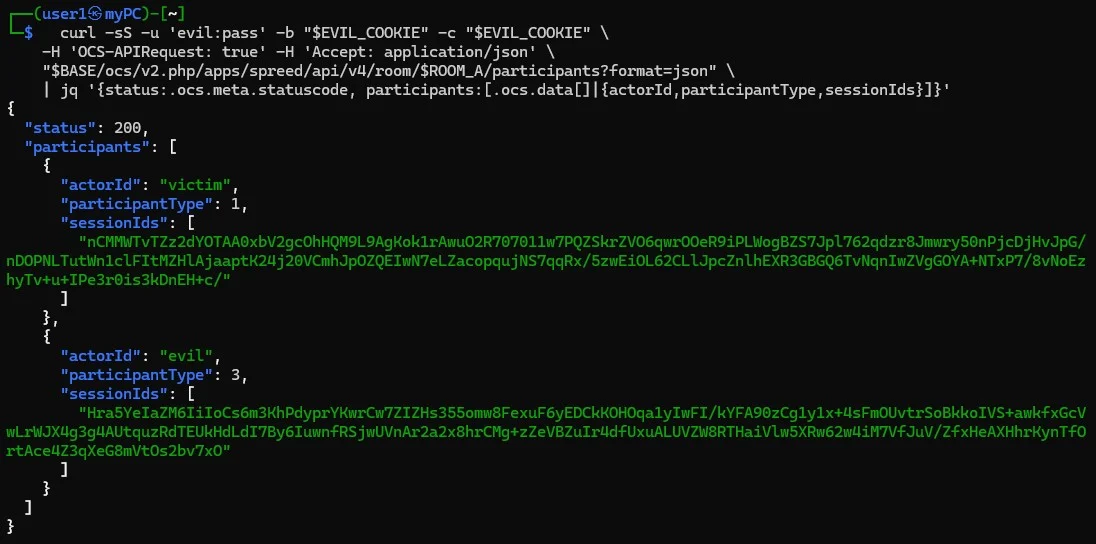
victimcreated room A and addedattacker(evil). Both joined room A. evil queried GET /ocs/v2.php/apps/spreed/api/v4/room/97oqymwq/participants?format=json and received victim’s live room-A session ID JRal9O65.... -
evil created unrelated room B, joined it, and got room-B sender session pekgCNiV....
-
evil sent this to room B:
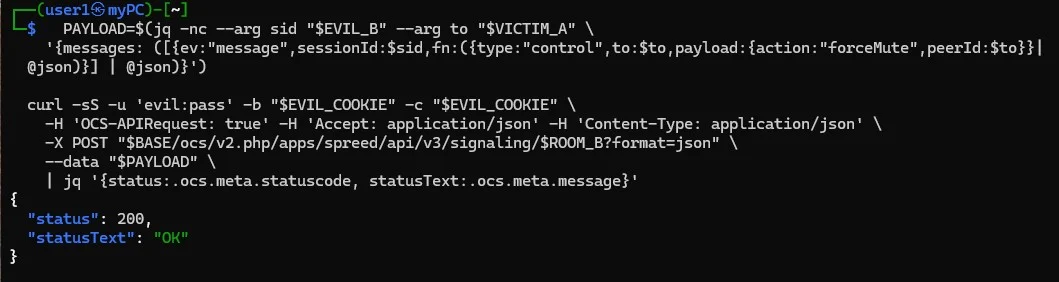
{ "messages": "[{"ev":"message","sessionId":"<evil_room_b_session>","fn":"{\"type\":\"control\",\"to\":\"<victim_room_a_session>\",\"payload\":{\"action\":\"forceMute\",\"peerId\":\"<victim_room_a_session>\"}}"}]" } to POST /ocs/v2.php/apps/spreed/api/v3/signaling/pfo7kdcz?format=json
-
Server-side evidence showed a queued row with sender pekgCNiV... and recipient JRal9O65... in oc_talk_internalsignaling.
-
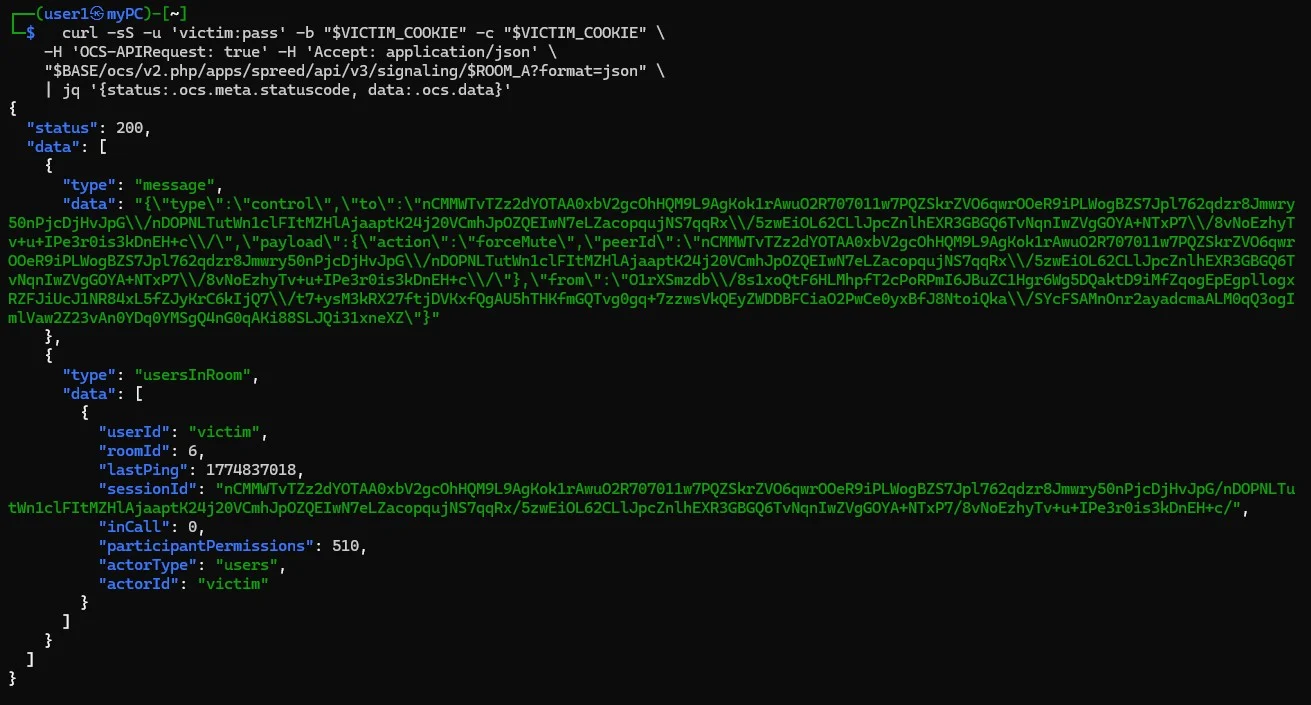
victim then polled room A with GET /ocs/v2.php/apps/spreed/api/v3/signaling/97oqymwq?format=json and received the injected control message with "from":"pekgCNiV...".
-
Negative control: sending the same forceMute from room A itself, using evil’s room-A session QBL3zUuH..., created no victim-targeted queue row and victim’s next poll returned only usersInRoom.
Supporting Material/References:
Here the attacker reads the session of the victim in the shared room
the attacker uses the victim's session as the recipient and the attackers room B as the sender
victim in room A receives injected message from attacker in room B and is muted
Impact
- A low-privileged user can inject moderator-only internal-signaling controls into a room they do not moderate.
- The reproduced payload is
forceMute. When the victim is in a call, the shipped client handles this by muting the local session. - More generally, the room boundary for internal signaling is broken because delivery is keyed only by recipient session ID.
Not written yet. The AI write-up for this report has not been written yet. The Original tab links to the source.
How it worked
Root cause
Likely the signalling queue stores and fetches messages only by recipient session ID, so authorisation is checked against the sender's room while delivery ignores the room boundary.
Impact
A low-privileged user could inject moderator-only controls into a room they do not moderate; the reproduced forceMute muted the victim's local session when in a call, and the room boundary for internal signalling is broken.
What the attacker needed
Victim and attacker share a room; attacker is a normal participant there; attacker moderates another room; internal signalling enabled
How it was found
- The attacker reads the victim's live session ID from the shared room's participant list.
- The attacker creates and joins an unrelated room they moderate to obtain a sender session.
- The attacker posts a control message to the unrelated room's signalling endpoint, naming the victim's session as the recipient.
- The server queues the message with the attacker's sender session and the victim's recipient session.
- The victim polls their own room and receives the injected control message.
- A negative control sent from the shared room itself produced no victim-targeted queue row.
Explained by bugbounty.wiki with AI from the original and checked against quotes from it; it can still be wrong. Read the original before relying on a detail.
Not written yet. The AI write-up for this report has not been written yet. The Original tab links to the source.
The server checked that the sender was a moderator of their own room, but then sent the message to whatever person the sender named, even in a different room. That let a normal user in one room mute someone in another room.
What is Access control?
A user can do something their role should not allow: reach an admin function, act on a feature they have not paid for, or skip a permission check. IDOR is the special case where the object belongs to someone else.


