Log pollution can lead to HTML Injection.
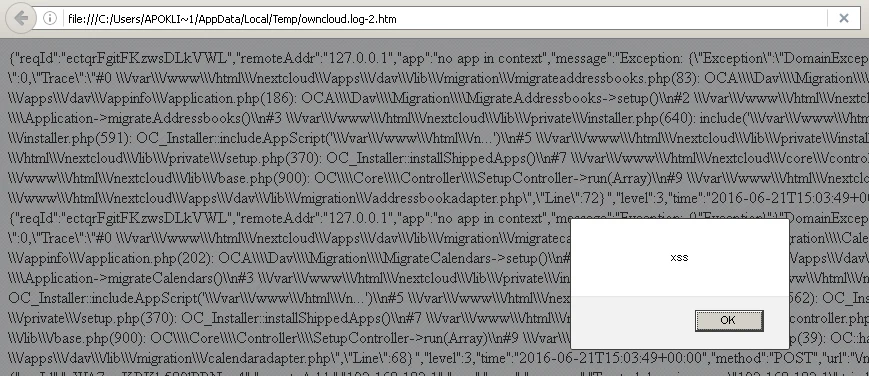
The admin log download was served as an HTML file, and log entries could contain unescaped user input such as the Host header. An attacker could inject HTML into the log so that when an administrator opened the downloaded file in Firefox on Windows, script in the log would run.

- Triaged in 2 hours
- Fixed in 14 days
- Paid in 2 months
- Disclosed after 28 days
Summary by the program
The "download log" functionality in the admin screen is delivering the log in JSON format to the end-user. The file was delivered with an attachment disposition forcing the browser to download the document. However, Firefox running on Microsoft Windows would offer the user to open the data in the browser as HTML document. Thus any injected data in the log would be executed.
While the document would only be executed locally (thus on another scope) we have decided to fix this to protect our users.
A detailed advisory can be found at https://nextcloud.com/security/advisory/?id=nc-sa-2016-002.
Thanks a lot, @apok for pointing out this vulnerability!
The report
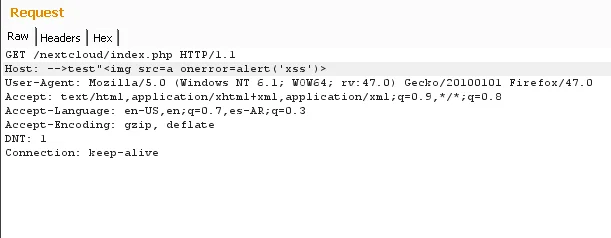
Hi Team, I was looking around in your app and on the log part (accessed by the admin), I noticed that the log file is downloaded as an HTML file. Naturally I started trying to inject code I noticed that when HTML code is inserted, a HTML comment start tag is inserted. But I was able to bypass this protection by inserting a comment end tag and then the HTML code, which resulted in HTML injection.
To reproduce this behaviour I started looking where a user is able to inject data onto the log file, and I noticed that when the "Host" header is different from the one configured for the app, a warning is injected onto the app. There likely many other sections that could serve to inject into the log, but I've just started to analyze the app so I couldn't find any yet.
Proof of Concept:
- Generate the following request to the server:
GET /nextcloud/index.php HTTP/1.1 Host: -->test"<img src=a onerror=alert('xss')> User-Agent: Mozilla/5.0 (Windows NT 6.1; WOW64; rv:47.0) Gecko/20100101 Firefox/47.0 Accept: text/html,application/xhtml+xml,application/xml;q=0.9,/;q=0.8 Accept-Language: en-US,en;q=0.7,es-AR;q=0.3 Accept-Encoding: gzip, deflate DNT: 1 Connection: keep-alive 2) Download the log file. 3) Observe that the code is executed properly.
Why is this a vulnerability? A malicious individual could use this to execute malicious code on an administrator that happened to open the downloaded Log file.
How to fix?: We can defeat this attack by adding an additional filter on the log file which escapes html special characters.
I'm sending a couple of screenshots. I'll keep digging and if I find anything else I'll send you another report.
Kind Regards, Apok.
Attachments
Not written yet. The AI write-up for this report has not been written yet. The Original tab links to the source.
How it worked
Root cause
Likely the log download was served as HTML without escaping HTML special characters in log entries, so user-controlled log content was rendered as markup.
Impact
An attacker could execute malicious code on an administrator who opened the downloaded log file, though the document would only be executed locally and the issue was limited to Firefox on Microsoft Windows.
What the attacker needed
Admin downloads and opens the log; Firefox on Microsoft Windows; attacker can send a crafted Host header
The fix
The reporter suggested escaping HTML special characters in the log file, and the team decided to fix the issue.
How it was found
- Send a request to the server with a crafted Host header containing HTML.
- Download the log file from the admin screen.
- Open the downloaded log file and observe that the injected code executes.
Explained by bugbounty.wiki with AI from the original and checked against quotes from it; it can still be wrong. Read the original before relying on a detail.
Not written yet. The AI write-up for this report has not been written yet. The Original tab links to the source.
A log file records events, and some events include text supplied by visitors, such as the Host header. The admin page let you download that log as an HTML file, and HTML files can contain scripts. If an attacker puts script-like text into a logged value, an administrator who opens the downloaded log in a browser may run that script.
What is XSS?
Script an attacker supplies runs in another user's browser, on the target's origin, with that user's session.







