[anywhere] An iframe element with url to malicious HTML file (with eg. JavaScript malware) can be used as filename and served via anywhere
The static file server 'anywhere' does not escape HTML in filenames, so a file named with an iframe tag can cause JavaScript execution when the directory is served. An attacker who can place a file with such a name in the served directory could run malicious script in a victim's browser.

- Triaged in 4 days
- Fixed in 32 days
- Disclosed after 32 days
Hi Guys,
anywhere allows to embed HTML in file names, which (in certain conditions) might lead to execute malicious JavaScript.
Module:
Running static file server anywhere.
https://www.npmjs.com/package/anywhere
Description
To embed malicious <script> tag with JavaScript code to execute, / character is necessary.
In all operating systems, / is not allowed as a character used in file name. This means there is very few option to craft an attack using file name as injection point.
Steps To Reproduce:
However, if attacker wants to, one can still use some tricks and change one of the filenames into something like following example:
"><iframe src="malware_frame.html">
Then, HTML file with following content have to be saved in the same directory as file with the name changed:
<html>

<head>
    <meta charset="utf8" />
    <title>Frame embeded with malware :P</title>
</head>

<body>
    <p>iframe element with malicious code</p>
    <script type="text/javascript" src="malware.js"></script>
</body>

</html>
An src attribute value I've used here is just for PoC purpose, this can be any external url.
On my local machine, malware.js has following content:
alert('Uh oh, I am very bad malware!')
Now, if you run anywhere in directory where both file with filename changed and malware_frame.html are saved:
$ ./node_modules/anywhere/bin/anywhere -p 8080
Running at http://192.168.1.1:8080/
Also running at https://192.168.1.1:8081/
and open http://127.0.0.1:8080 in the browser, you can see JavaScript from malware.js is executed:
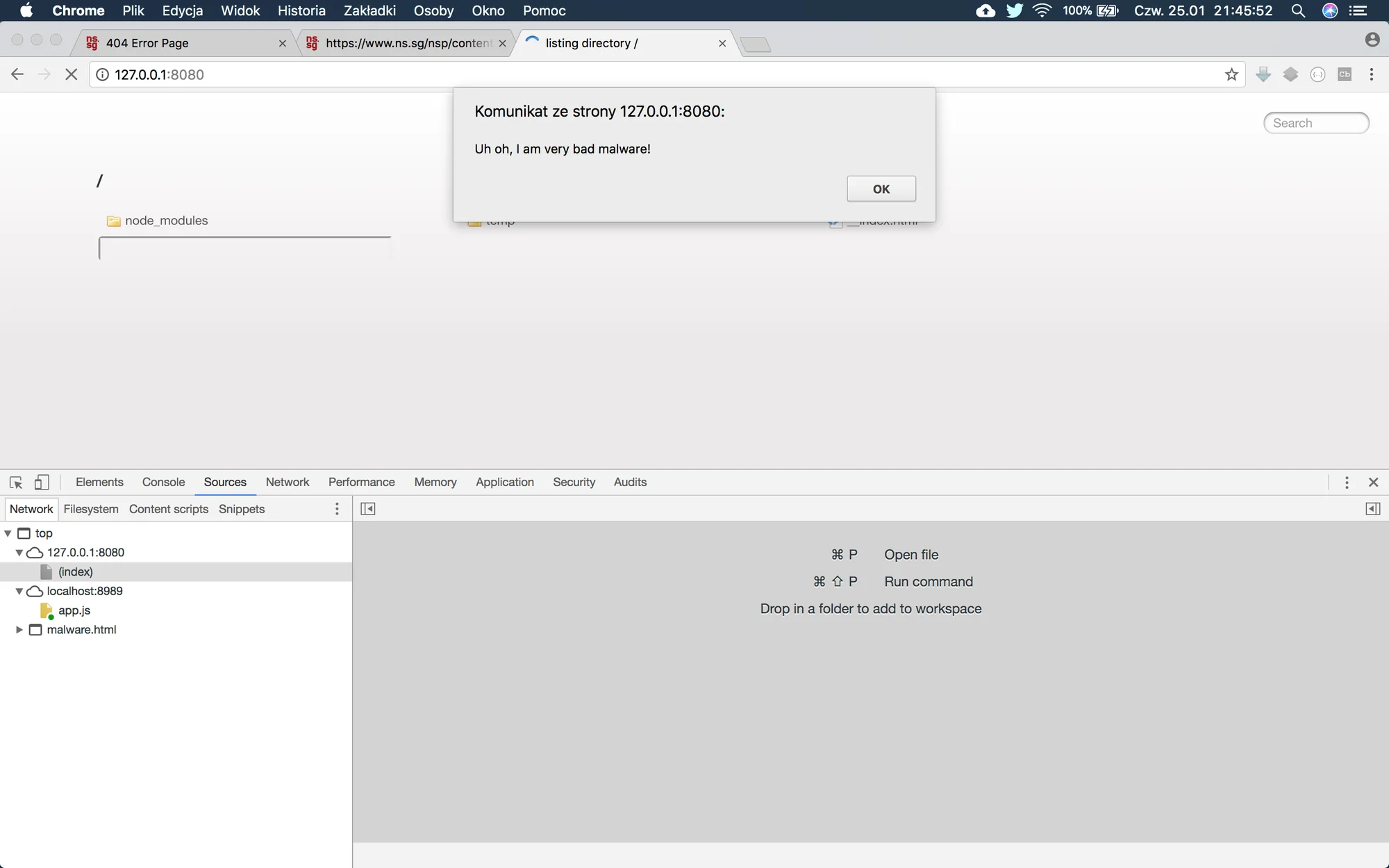
Supporting Material/References:
Configuration I've used to find this vulnerability:
- macOS HighSierra 10.13.3
- node 8.9.3
- npm 5.5.1
- curl 7.54.0
Wrap up
I hope this report will help to keep Node ecosystem more safe. If you have any questions about any details of this finding, please let me know in comment.
Thank you
Regards,
Rafal 'bl4de' Janicki
Impact
Exploitation of this vulnerability in the wild might be hard, however it's not impossible and it depends only on attacker's skills to get into directory on the server, where anywhere is used to serve static content.
Not written yet. The AI write-up for this report has not been written yet. The Original tab links to the source.
How it worked
Root cause
Likely the server does not HTML-encode filenames when generating the directory listing, allowing injected markup to be interpreted by the browser.
Impact
Exploitation might be hard and depends on the attacker's ability to place a file in the served directory, but if successful it could execute malicious JavaScript in a victim's browser.
What the attacker needed
Attacker can write a file to the served directory; victim visits the directory listing
How it was found
- Create a file with a name containing an iframe tag pointing to a malicious HTML file.
- Place a malicious HTML file in the same directory.
- Run anywhere in that directory.
- Open the server URL in a browser and observe JavaScript execution.
Explained by bugbounty.wiki with AI from the original and checked against quotes from it; it can still be wrong. Read the original before relying on a detail.
Not written yet. The AI write-up for this report has not been written yet. The Original tab links to the source.
A static file server shows files from a folder. If a filename contains HTML code, the server should display it as text, but here it is inserted into the page as real HTML. That means a file with a tricky name can make the browser run JavaScript, which could do harmful things.
What is XSS?
Script an attacker supplies runs in another user's browser, on the target's origin, with that user's session.






