SSRF in webhooks leads to AWS private keys disclosure
The webhook implementation followed HTTP 303 redirects, allowing an attacker to make the server request arbitrary URLs and read the responses. This enabled access to the AWS EC2 metadata service, exposing IAM credentials including private keys.
 Originally disclosed on HackerOne
- Paid in 2 days
- Disclosed after 4 months
Vulnerability Summary
Omise makes use of Amazon AWS as their application environment. Due to a vulnerability in the way webhooks are implemented, an attacker can make arbitrary HTTP/HTTPS requests from the application server and read their responses. This is known as a server-side request forgery (SSRF) vulnerability.
This vulnerability leads to access to Omise's Amazon EC2 instance with the user role aws-opsworks-ec2-role, including AWS private keys.
Description
The vulnerability exists in the way webhooks follow redirects. In general, it appears that redirects are not followed, but a HTTP 303 See Other status code allows an attacker to bypass this restriction.
By pointing my webhook URL to a server that issues a 303 redirect, I am able to redirect and read the responses of arbitrary HTTP/HTTPS requests from the application server. E.g. the following PHP script results in a successful request that is followed by the server:
<?php header('Location: http://<arbitrary-location>', TRUE, 303); ?>
As a result, it is possible to request a number of things, including AWS credentials on the metadata server located at http://169.254.169.254/latest/meta-data/iam/security-credentials/aws-opsworks-ec2-role
Steps to reproduce
- Host the following payload on
https://<your-attacker-server>/redir.php:
<?php header('Location: http://169.254.169.254/latest/meta-data/iam/security-credentials/aws-opsworks-ec2-role', TRUE, 303); ?>
- Point your webhook endpoint on https://dashboard.omise.co/test/webhooks/edit to
https://<your-attacker-server>/redir.php - Make a random call to the API, e.g. adding a user;
- View the "Recent Deliveries" of the webhook calls on https://dashboard.omise.co/test/webhooks
- Note the
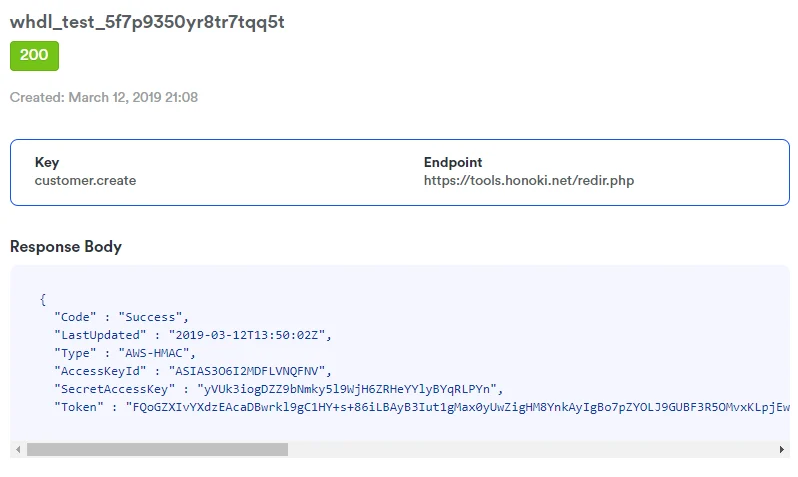
200 OKstatus code indicating a successful redirect - Click the event to view the response body of the AWS metadata
Recommendation
I recommend to ensure all input provided to the endpoint is validated. In this case, ensure that 303 redirects are not followed either.
I also recommend resetting all AWS access tokens. In addition, I recommend reviewing the Amazon access logs to investigate if this vulnerbility has been exploited in the past.
Attachments
- 20190312_AWS-SSRF-303-redirect-2.png - Screenshot showing the output of the AWS credentials obtained through the SSRF vulnerability.
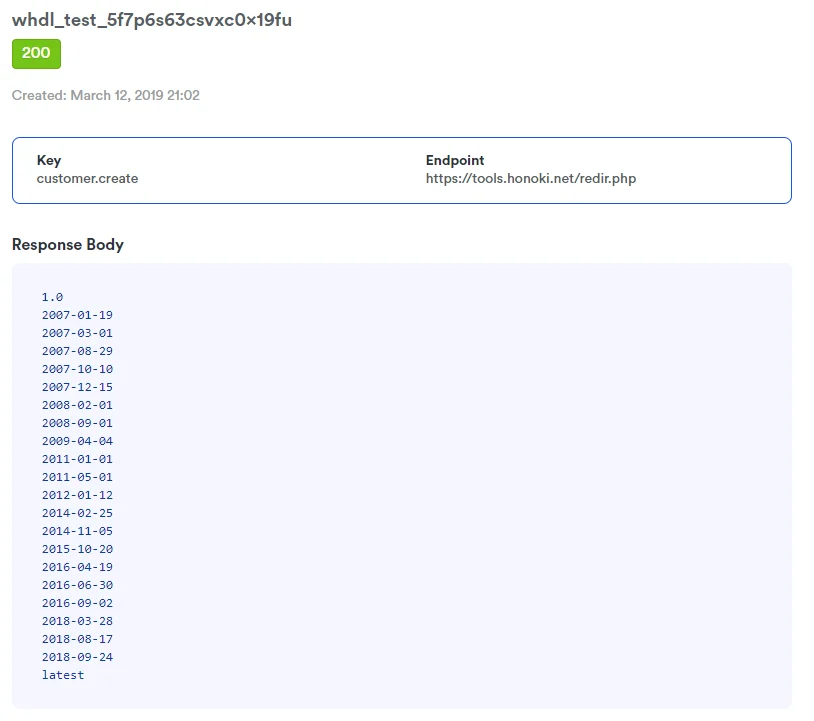
- 20190312_AWS-SSRF-303-redirect.png - Screenshot showing the output of the AWS index of metadata.
Impact
By exploiting this vulnerability, an unauthorized attacker could gain access to the AWS environment of Omise. Note that the SSRF vulnerability could be abused in a variety of ways, not just limited to obtaining AWS credentials. For example, to enumerate and access services and web applications running on the internal network.
Attachments
Not written yet. The AI write-up for this report has not been written yet. The Original tab links to the source.
How it worked
Root cause
The webhook handler blocked most redirects but allowed HTTP 303 redirects, so an attacker could redirect the server to internal addresses such as the AWS metadata endpoint.
Impact
An attacker could gain access to the AWS environment, including private keys, and could also enumerate and access internal services.
What the attacker needed
Ability to set a webhook URL; Attacker-controlled server; Trigger a webhook event
The fix
The webhook handler should be changed to not follow 303 redirects, and all AWS access tokens should be reset.
How it was found
- Host a script on an attacker-controlled server that responds with a 303 redirect to the AWS metadata URL.
- Set the webhook endpoint to point to that attacker script.
- Trigger a webhook by making a random API call, such as adding a user.
- View the recent webhook deliveries and note the 200 OK status indicating a successful redirect.
- Click the event to view the response body containing the AWS metadata.
Explained by bugbounty.wiki with AI from the original and checked against quotes from it; it can still be wrong. Read the original before relying on a detail.
Not written yet. The AI write-up for this report has not been written yet. The Original tab links to the source.
A webhook is a way for one website to notify another when something happens. Here, the server would fetch a URL you provide, and it would follow a special redirect (HTTP 303) to a different address. The attacker used this to make the server fetch internal AWS metadata that contains secret keys, which should never be reachable from outside.
What is SSRF?
The server can be made to fetch an address the attacker chooses, reaching internal services, cloud metadata or other customers' data.



