Directory Disclose,Email Disclose Zendmail vulnerability
The signup form allowed special characters in usernames, which led to directory path disclosure and email address disclosure. The report also claimed a possible Zendmail remote code execution via a crafted email address, but the attacker could not confirm file creation.

- Fixed in 7 hours
- Paid in 38 days
- Disclosed after 39 days
i found three vulnerability Directory information disclose,Email address disclose, and possible Remote code execution in Zendmail during signup your code accept username with ',",/,@ while all of the special character must be forbidden or encoded in username
Directory Disclose:
- goto sign-up page and create a account with username with double quote like as"
- signin and goto ur account and add email address, then logout
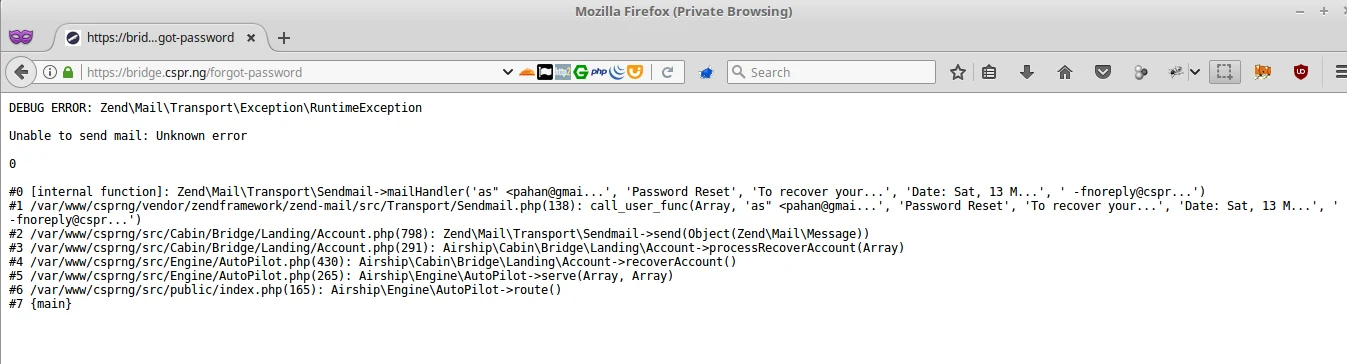
3.goto Forgot-Password section and enter username of above ( as" ) 4.and see full path of server has been disclose (screenshot: directory.png)
Email address Disclose
if you look close to screenshot below that email address of the user also disclose
Zendmail rce
from the above screenshot, ur are using zendmail for email verification and searching through exploit of zendmail ,i found that Zendmail is vulnerable to Remote code Execution a security researcher Dawid Golunski discover its flaw CVE-2016-10034 in December where user can set corrupted email like '"attacker" -oQ/tmp/ -X/var/www/cache/phpcode.php "@email.com'; cause RCE His link https://legalhackers.com/advisories/ZendFramework-Exploit-ZendMail-Remote-Code-Exec-CVE-2016-10034-Vuln.html its possible to add such email in user account i also reported this flaw of email REGEX https://hackerone.com/reports/226334 but you ignored
i also tried this payload but cant confirm that file has been created or not because i was testing in your website you can also confirm by locally
Using the above username ( as") break the sql query during email sending cause exception throw
also checked that if i used that username in password reset ,server response time is delayed it may cause Dos attack but it not possible in that case because u using Cloudflare network to prevent
Attachments
Not written yet. The AI write-up for this report has not been written yet. The Original tab links to the source.
How it worked
Root cause
Likely the application failed to validate or encode special characters in usernames, and used an outdated Zendmail library.
Impact
An attacker could learn the server's internal file path and a user's email address; the claimed remote code execution was not confirmed.
What the attacker needed
A free account; victim's username known
The fix
The application should validate and encode special characters in usernames and update the Zendmail library to a patched version.
How it was found
- Create an account with a username containing a double quote.
- Sign in, add an email address to the account, then log out.
- Go to the Forgot-Password section and enter the same username.
- Observe the full server path and the user's email address in the response.
Explained by bugbounty.wiki with AI from the original and checked against quotes from it; it can still be wrong. Read the original before relying on a detail.
Not written yet. The AI write-up for this report has not been written yet. The Original tab links to the source.
The signup form did not clean up special characters in usernames. When the user later triggered a password reset, the server showed its internal file path and the user's email address. The reporter also worried that a known bug in the email library could let an attacker run code, but they could not prove it.
What is Info disclosure?
Data the application should keep private (personal data, internal details, other users' records) reaches someone it should not.




