Content Spoofing/Text Injection at https://gateway-production.dubsmash.com
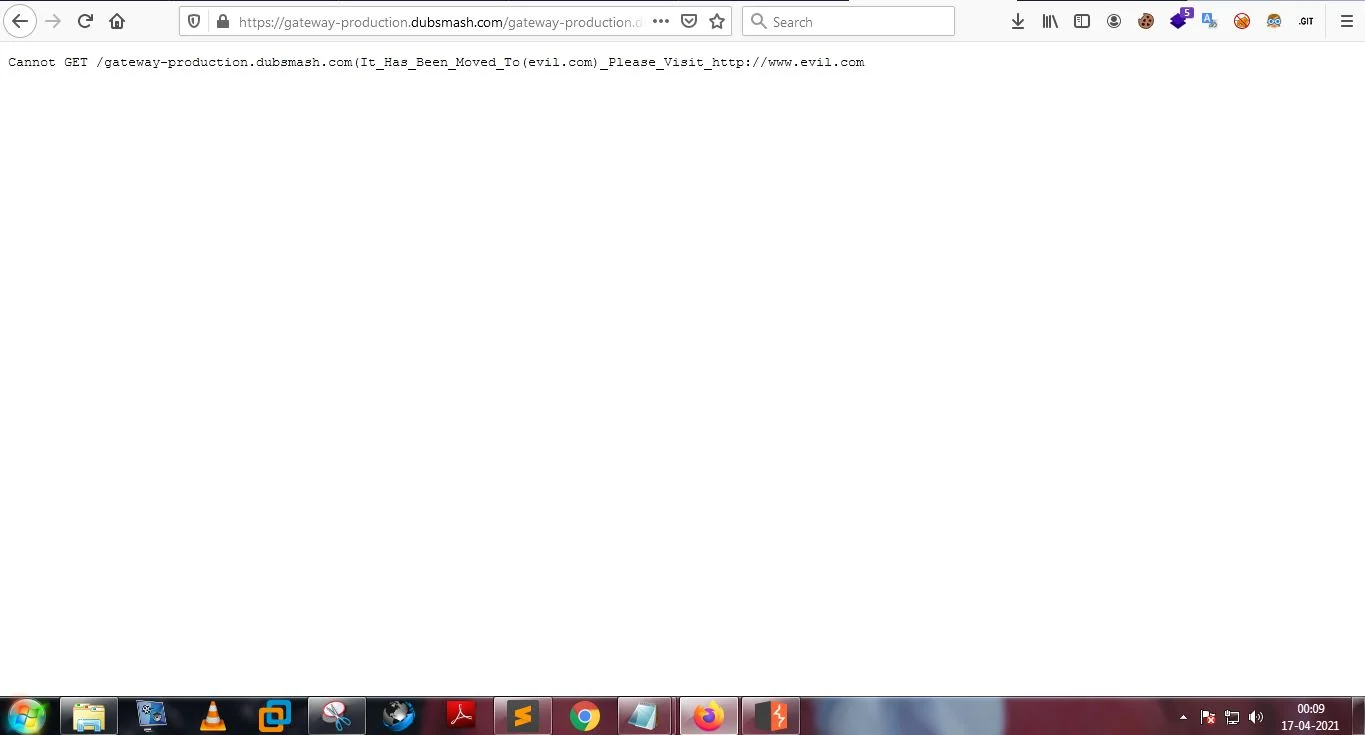
The gateway endpoint reflected the requested path in its 404 error page, allowing an attacker to craft a URL that displayed arbitrary text and a link to a phishing site. An attacker could trick a user into visiting such a link and then clicking through to a malicious site.

- Disclosed after 6 months
##Summary:- Hi team i found security issue on your website https://gateway-production.dubsmash.com
##Description:- I have found a "Content Spoofing/Text Injection" on one of the domain which is in scope https://gateway-production.dubsmash.com in which Using the link the attacker can trick any genuine user to go to the attacker's phishing site.
##Steps:- 1.visit the url https://gateway-production.dubsmash.com you get that 404 error(Cannot GET /) 2.Now here an attacker can trick any user by sending below link like example:- https://gateway-production.dubsmash.com/gateway-production.dubsmash.com(It_Has_Been_Moved_To(evil.com)_Please_Visit_http://www.evil.com
##Reference:- https://hackerone.com/reports/997198
##Proof:- attached screenshot
Impact
As i mentioned above Crafted phishing attacks on gateway-production.dubsmash.com
Attachments
Not written yet. The AI write-up for this report has not been written yet. The Original tab links to the source.
How it worked
Root cause
Likely the 404 error page reflected the requested path without sanitising or encoding it, allowing arbitrary text and links to be injected.
Impact
An attacker could use the legitimate domain to display crafted text and a link, making phishing attacks more convincing.
What the attacker needed
Victim clicks a crafted link
Explained by bugbounty.wiki with AI from the original and checked against quotes from it; it can still be wrong. Read the original before relying on a detail.
Not written yet. The AI write-up for this report has not been written yet. The Original tab links to the source.
When a website cannot find a page, it often shows an error message that includes the address you asked for. Here, the site put that address into the page without cleaning it, so an attacker could make the error page say anything they wanted, including a link to a fake site. This is called content spoofing because the attacker makes the real site display misleading content.
What is UI spoofing?
The interface lies to the user: a framed page catches their clicks, or a browser shows the wrong address or a fake prompt. Paid when it leads to a sensitive action or convincing phishing.