Failed Certificate Validation On Custom Server (Register)
The application allows a user to specify a custom server during registration but does not validate the server's SSL certificate. An attacker on the network path could intercept and tamper with the data exchanged between the application and that server.

- Triaged in 15 days
- Fixed in 38 days
- Paid in 38 days
- Disclosed after 2 months
Hi,
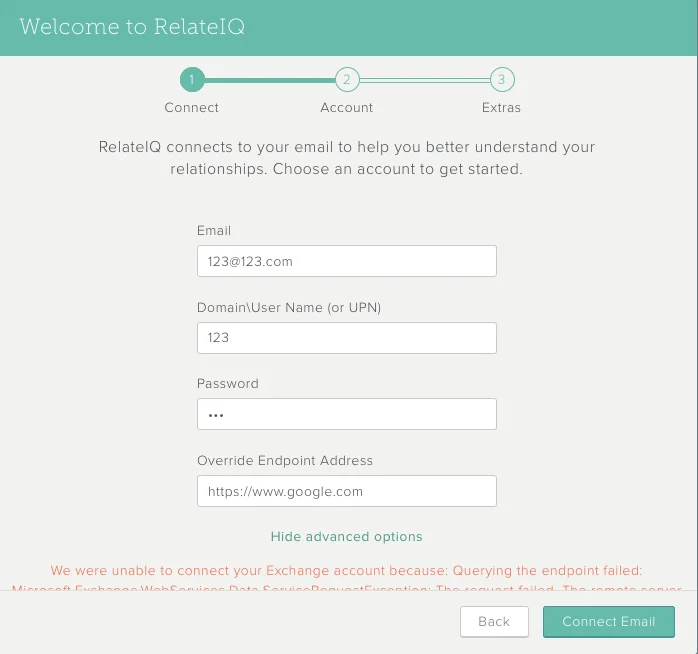
in the register page a custom server can be used to define "where to connect to". Your system does not validate the SSL certificate of this host which makes it easy to tamper with the data your system do in behalf of the user.
As only SSL links are allowed by the application the user could assume that the implementation is according to security best practice and would validate the certificate trustchain on connect. Additional "relateiq" might can guarantee the security of any connection under control, but the connection made over insecure networks could be tampered by anyone with access to this system.
I have used ncat which generates a certificate on the fly to demonstrate the issue:
ncat --ssl -p 443 -v -n -l Ncat: Version 6.46 ( http://nmap.org/ncat ) Ncat: Generating a temporary 1024-bit RSA key. Use --ssl-key and --ssl-cert to use a permanent one. Ncat: SHA-1 fingerprint: 541F EC41 71A1 BDDC D7AE DA96 8950 5584 4BC5 E9D3 Ncat: Listening on :::443 Ncat: Listening on 0.0.0.0:443 Ncat: Connection from 54.218.20.199. Ncat: Connection from 54.218.20.199:53669. POST / HTTP/1.1 Content-Type: text/xml; charset=utf-8 Accept: text/xml User-Agent: ExchangeServicesClient/15.00.0516.014 Accept-Encoding: gzip,deflate Host: pum.no-ip.org X-ClientStatistics: MessageId=0ba62fc8-5767-4578-b789-0951dcf8e559,ResponseTime=389,SoapAction=FindItem`1; Content-Length: 1464 Expect: 100-continue Connection: Keep-Alive
<?xml version="1.0" encoding="utf-8"?><soap:Envelope xmlns:xsi="http://www.w3.org/2001/XMLSchema-instance" xmlns:m="http://schemas.microsoft.com/exchange/services/2006/messages" xmlns:t="http://schemas.microsoft.com/exchange/services/2006/types" xmlns:soap="http://schemas.xmlsoap.org/soap/envelope/"> soap:Header <t:RequestServerVersion Version="Exchange2007_SP1" /> <t:TimeZoneContext> <t:TimeZoneDefinition Id="Pacific Standard Time" /> </t:TimeZoneContext> </soap:Header> soap:Body <m:FindFolder Traversal="Shallow"> <m:FolderShape> <t:BaseShape>AllProperties</t:BaseShape> </m:FolderShape> <m:IndexedPageFolderView MaxEntriesReturned="1000" Offset="0" BasePoint="Beginning" /> <m:Restriction> <t:And> <t:IsEqualTo> <t:ExtendedFieldURI PropertyTag="13825" PropertyType="Integer" /> <t:FieldURIOrConstant> <t:Constant Value="2" /> </t:FieldURIOrConstant> </t:IsEqualTo> <t:IsEqualTo> <t:FieldURI FieldURI="folder:DisplayName" /> <t:FieldURIOrConstant> <t:Constant Value="allitems" /> </t:FieldURIOrConstant> </t:IsEqualTo> </t:And> </m:Restriction> <m:ParentFolderIds> <t:DistinguishedFolderId Id="root" /> </m:ParentFolderIds> </m:FindFolder> </soap:Body> </soap:Envelope>
cheers
pUm
Attachments
Not written yet. The AI write-up for this report has not been written yet. The Original tab links to the source.
How it worked
Root cause
Likely the application's SSL/TLS client is configured to accept any certificate without verifying the trust chain or hostname.
Impact
An attacker with access to the network path could intercept and modify data the application sends to the custom server, potentially compromising user data.
What the attacker needed
Attacker on the network path; user configures a custom server
The fix
The application should validate the SSL certificate trust chain and hostname when connecting to a custom server.
How it was found
- Set up a listener with a self-signed certificate on port 443.
- In the register page, configure a custom server pointing to that listener.
- Observe that the application connects and sends data without rejecting the untrusted certificate.
Explained by bugbounty.wiki with AI from the original and checked against quotes from it; it can still be wrong. Read the original before relying on a detail.
Not written yet. The AI write-up for this report has not been written yet. The Original tab links to the source.
When your app connects to a server over SSL, it should check that the server's certificate is genuine. Here, the app skips that check, so someone who can intercept the network traffic could pretend to be the server and read or change the data.
What is Crypto?
Encryption, signatures, randomness or certificate checks that do not protect what they claim to.