SSRF (Portscan) via Register Function (Custom Server)
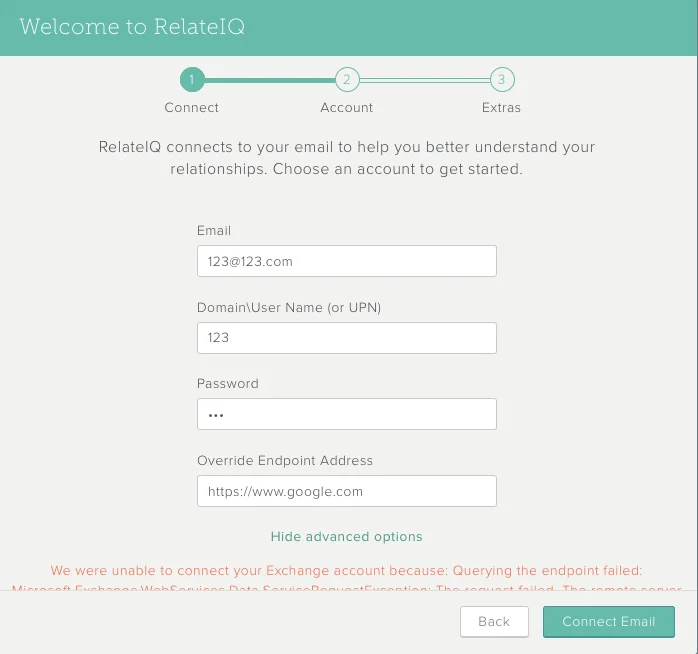
The custom server option during registration accepted a user-supplied URL and made a server-side request to it, letting an attacker probe internal hosts and ports. By changing the IP and port and reading the error messages, the attacker could tell whether a port was open or closed.

- Triaged in 24 hours
- Fixed in 3 days
- Paid in 3 days
- Disclosed after 41 days
Hi,
the custom server option during registration allows performing portscans (or "Server Side Request Forgery") from "relateiq" systems to external (and potential internal systems).
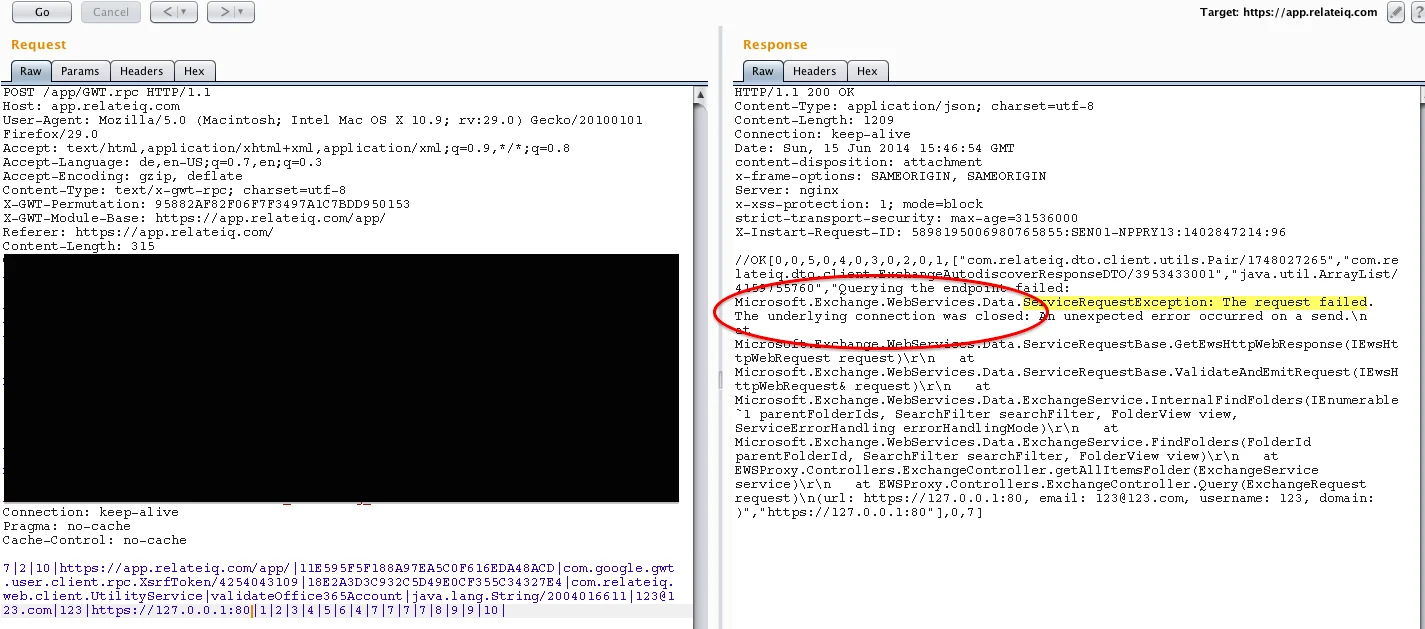
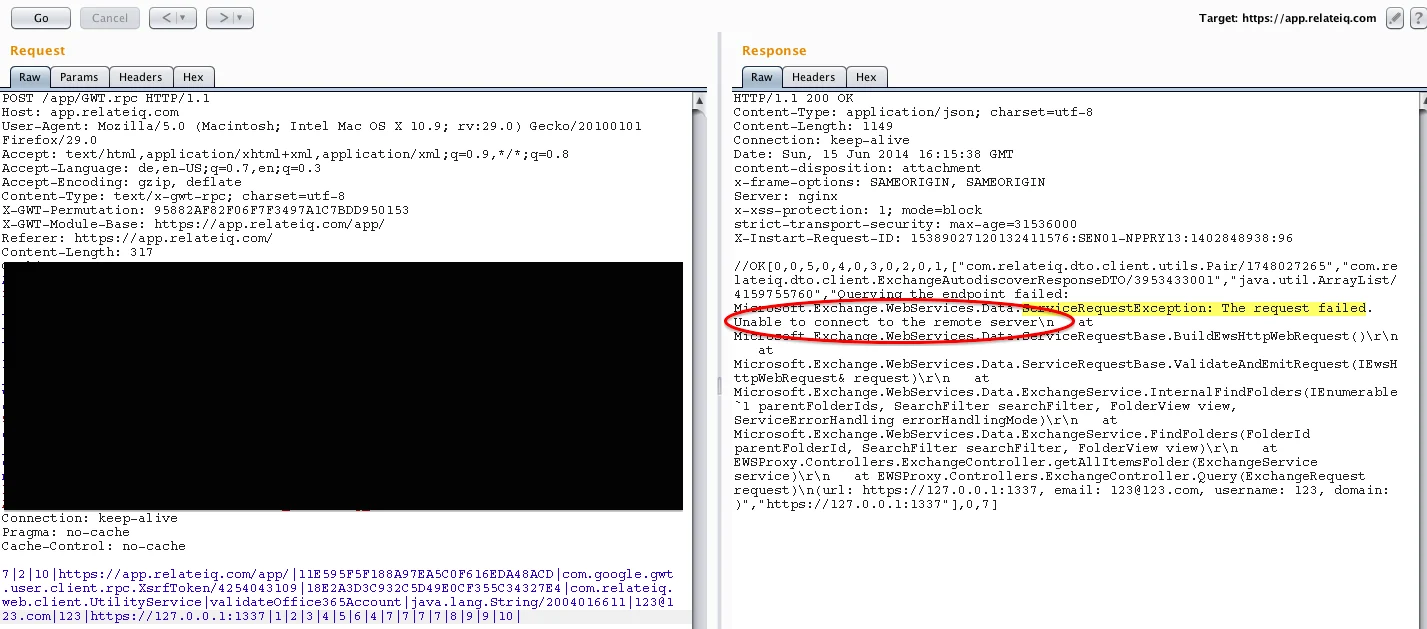
the following is a sample request used (excluding cookies): POST /app/GWT.rpc HTTP/1.1 Host: app.relateiq.com User-Agent: Mozilla/5.0 (Macintosh; Intel Mac OS X 10.9; rv:29.0) Gecko/20100101 Firefox/29.0 Accept: text/html,application/xhtml+xml,application/xml;q=0.9,/;q=0.8 Accept-Language: de,en-US;q=0.7,en;q=0.3 Accept-Encoding: gzip, deflate Content-Type: text/x-gwt-rpc; charset=utf-8 X-GWT-Permutation: 95882AF82F06F7F3497A1C7BDD950153 X-GWT-Module-Base: https://app.relateiq.com/app/ Referer: https://app.relateiq.com/ Content-Length: 317 Connection: keep-alive Pragma: no-cache Cache-Control: no-cache
7|2|10|https://app.relateiq.com/app/|11E595F5F188A97EA5C0F616EDA48ACD|com.google.gwt.user.client.rpc.XsrfToken/4254043109|18E2A3D3C932C5D49E0CF355C34327E4|com.relateiq.web.client.UtilityService|validateOffice365Account|java.lang.String/2004016611|[email protected]|123|https://127.0.0.1:1|1|2|3|4|5|6|4|7|7|7|7|8|9|9|10|
The URL "https://127.0.0.1:1" can be changed to a different IP/DNS and TCP Port. Based on the response received it is possible to identify if a port is open, or closed/filtered.
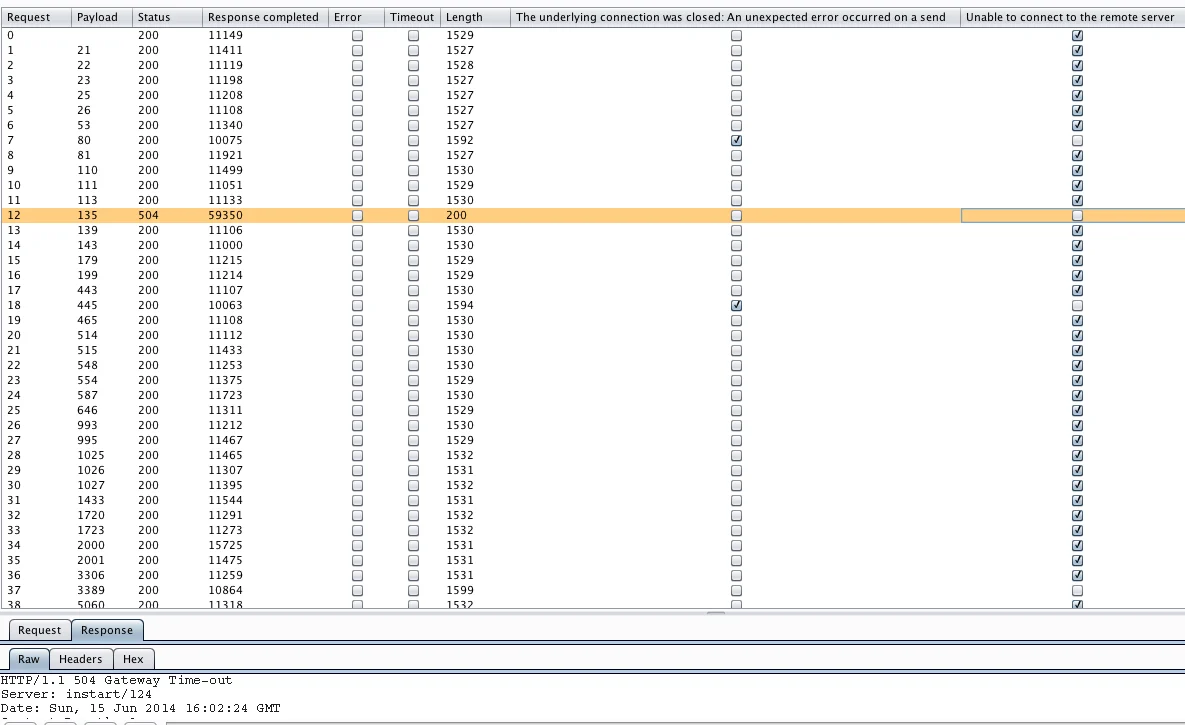
An open port results into a HTTP Status of 504 (Gateway Timeout), or an error message of "The underlying connection was closed: An unexpected error occurred on a send" in the HTTP response.
A closed port usually results into a message of "Unable to connect to the remote server".
This was tested with some external servers and internally only against localhost. If it would change the severity of course some scans against typical private networks within that DMZ could be requested :)
For localhost on the top50 (nmap) ports the following were found open:
- 80
- 135
- 445
- 3389
- 49152
- 49154
Attached you can find some screenshots demonstrating the issue.
best
pUm
Attachments
Not written yet. The AI write-up for this report has not been written yet. The Original tab links to the source.
How it worked
Root cause
Likely the registration flow passed a user-controlled URL to a server-side HTTP client without validating or restricting the destination host or port.
Impact
An attacker could scan internal networks and identify open ports on localhost and potentially other internal hosts, though the report only tested localhost internally.
What the attacker needed
Ability to start registration; custom server option available
How it was found
- Start the registration process and choose the custom server option.
- Send the registration request with the server URL set to the internal address and port to probe.
- Read the response: a 504 or send error indicates an open port, while 'Unable to connect' indicates a closed port.
- Repeat with different addresses and ports to map the internal network.
Explained by bugbounty.wiki with AI from the original and checked against quotes from it; it can still be wrong. Read the original before relying on a detail.
Not written yet. The AI write-up for this report has not been written yet. The Original tab links to the source.
When you sign up, the site lets you enter a server address, and the site's own computers then try to connect to that address. Because the site makes the connection, an attacker can point it at computers inside the company network that outsiders cannot reach. The different error messages reveal whether a port is open, which is a way of mapping the internal network.
What is SSRF?
The server can be made to fetch an address the attacker chooses, reaching internal services, cloud metadata or other customers' data.