Access Control Vulnerability Enabling Unauthorized Access to Limited Disclosure Reports
A user with limited access to a sandbox program could close a report as a duplicate of a report from a different program, including publicly disclosed reports. This could disrupt automation pipelines and make public reports appear to have duplicates from other programs.
 Originally disclosed on HackerOne
- Triaged in 6 days
- Fixed in 12 days
- Paid in 6 days
- Disclosed after 26 days
Summary by the program
Summary A vulnerability has been discovered that allows an unauthorized user to close a report on the HackerOne platform as a duplicate of another report from a different program or organization. This improper access control issue enables potential misuse and disruption of the reporting process.
RCA
We relied on an ACL check can?(:view, original_report) that the report was visible to the team member closing the report as a duplicate, but we didn’t take into account limited disclosed reports also return true on this ACL check or that the original report was in the same organization.
Our forensic investigation confirmed that only the report mentioned in this report was affected. The customer is notified about this.
The report
Summary:
Hi there, I hope you are doing well :)
I found a vulnerability which allows me to close a report as duplicate of another program report. This can cause problems in various ways, i will include some of them and rest needs to be verified on Hackerone side what additional impact it can cause and its root cause analysis.
Steps To Reproduce
- Create a Sandbox program
- Invite a user with Report and Engagement access
- Accept invitation from User B and login
- Check any report and select option to Close Report as duplicate and this will be the HTTP request:
POST /reports/bulk HTTP/2
Host: hackerone.com
Cookie: <USER B Cookies>
User-Agent: Mozilla/5.0 (Macintosh; Intel Mac OS X 10.15; rv:126.0) Gecko/20100101 Firefox/126.0
Accept: */*
Accept-Language: en-US,en;q=0.5
Accept-Encoding: gzip, deflate, br
Referer: https://hackerone.com/reports/2424755
X-Csrf-Token: <USER B CSRF TOKEN>
Content-Type: application/x-www-form-urlencoded; charset=UTF-8
X-Requested-With: XMLHttpRequest
X-Datadog-Origin: rum
X-Datadog-Parent-Id: 2173163794632761452
X-Datadog-Sampling-Priority: 1
X-Datadog-Trace-Id: 3844362884923386826
Content-Length: 289
Origin: https://hackerone.com
Sec-Fetch-Dest: empty
Sec-Fetch-Mode: cors
Sec-Fetch-Site: same-origin
Te: trailers

message=s&substate=duplicate&original_report_id=███████&reference=&add_reporter_to_original=false&reply_action=close-report&mark_ineligible_for_bounty=false&unassign_report_on_close=false&code_review_patch=&code_review_diff_url=&reports_count=1&report_ids%5B%5D=<your report ID>&bounty_currency=USD
Here, Only replace the values which are enclosed inside <> and then forward the request. Notice that the response is 200 OK and the report is closed as duplicate of █████ which is publicly disclosed report of Hackerone program
Impact
There were many scenarios in my mind regarding impact but these are most relevant ones:
It can impact Automation Pipelines because there can be many reports and the program can mistakenly enter other report ID .
This one is just assumption but i believe its possible:
When you close a report as duplicate of other report (Original report), it will show on right side panel the reports which are duplicate of that particular report like this:
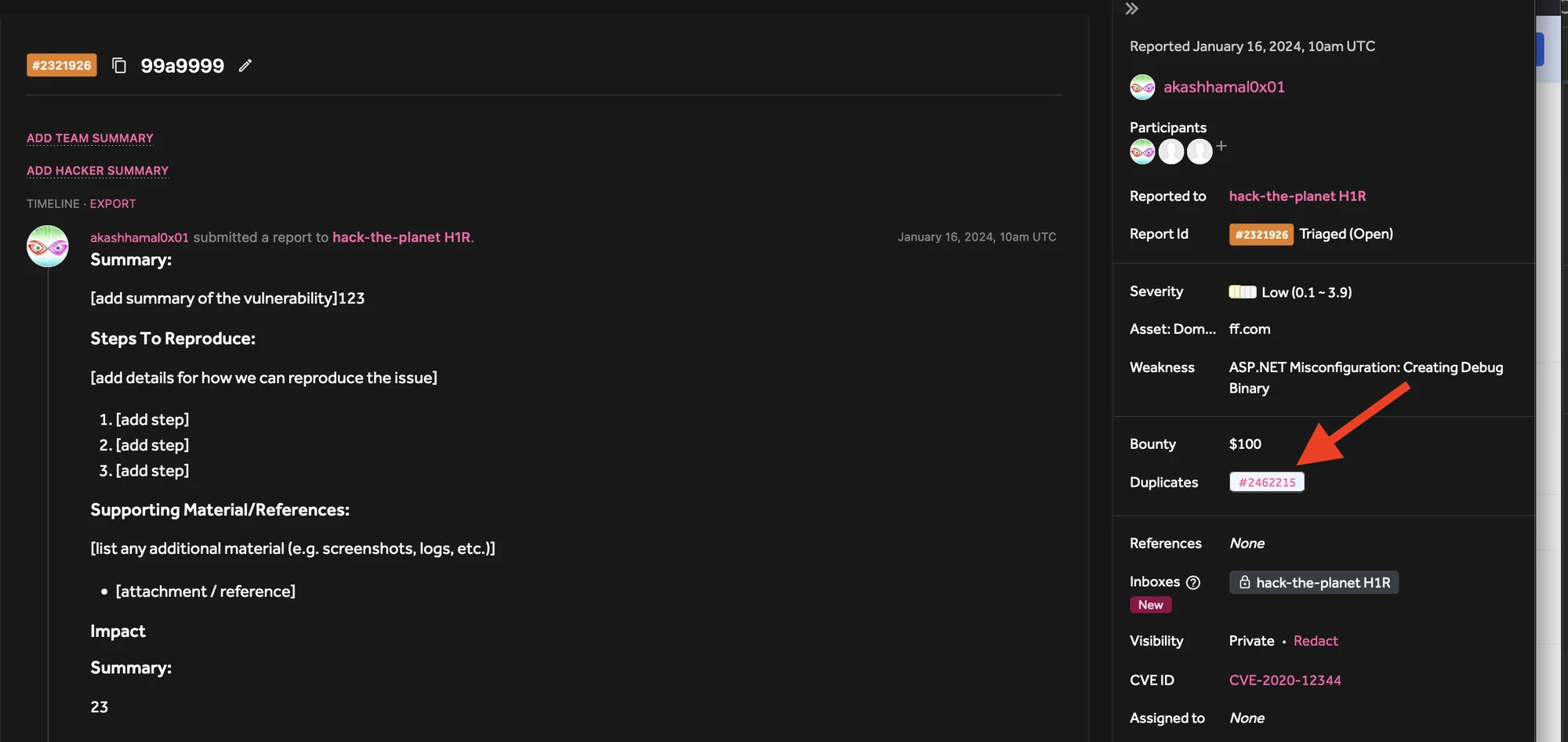
So my assumption is that , it might show like this to the program team in a genuine publicly disclosed report as the attacker can dupe his/her report to public report and the public report will be shown like that to the program manager or the viewers (participants or collaborators) which alternatively means it gives ability for any attacker to make other public reports look like they have duplicates but the duplicates are other reports from other program
Remaining impact, root cause and potential impacts are to be evaluated by h1 team as i am limited by my sandbox program and its privilege.
Not written yet. The AI write-up for this report has not been written yet. The Original tab links to the source.
How it worked
Root cause
Likely the access control check only verified that the user could view the original report, without ensuring it belonged to the same program or organisation.
Impact
This could disrupt automation pipelines and may allow an attacker to make public reports appear to have duplicates from other programs.
What the attacker needed
A sandbox program; a user with Report and Engagement access
The fix
The access control check should also verify the original report is in the same organisation.
How it was found
- Create a sandbox program.
- Invite a user with Report and Engagement access.
- Accept the invitation and log in as that user.
- Select a report and choose to close it as a duplicate, capturing the HTTP request.
- Modify the request's enclosed values and forward it.
- Observe that the report is closed as a duplicate of the other program's report.
Explained by bugbounty.wiki with AI from the original and checked against quotes from it; it can still be wrong. Read the original before relying on a detail.
Not written yet. The AI write-up for this report has not been written yet. The Original tab links to the source.
Access control is about who is allowed to do what. Here, a user with limited permissions could perform an action (closing a report as a duplicate) that should only be possible within their own program, affecting reports from other programs.
What is Access control?
A user can do something their role should not allow: reach an admin function, act on a feature they have not paid for, or skip a permission check. IDOR is the special case where the object belongs to someone else.