Content spoofing on invitations page
The invitation email body includes user-controlled fields (bug title and program name) that an attacker can set to arbitrary text. An attacker could craft a misleading invitation email that appears to come from HackerOne, potentially facilitating phishing.
 Originally disclosed on HackerOne
- Triaged in 15 hours
- Fixed in 8 days
- Disclosed after 15 days
When you are an owner of a program on h1 , you are allowed to invite external users to access any report through email . As you invite someone , this is how the body of invitation is being sent through email :-
[link to researcher's profile] invited you to join the bug [Title Of The Bug] for [Name of the program]
So being an owner of a program I control [Title Of The Bug] and [Name of the program] . So I can create any program on h1 , report a bug to it , keeping the Title of that bug and name of my program as per my choice .
This is how a Verified program on h1 can spoof the body of the email leading to phishing attacks but i suppose h1 trusts all of the verified programs so this may not be a risk .
For the Unverified programs , as you invite an external user , the body of email also contains a warning which minimizes the risk of further phishing attacks BUT it's not necessary to invite someone ONLY through emails .... For eg.
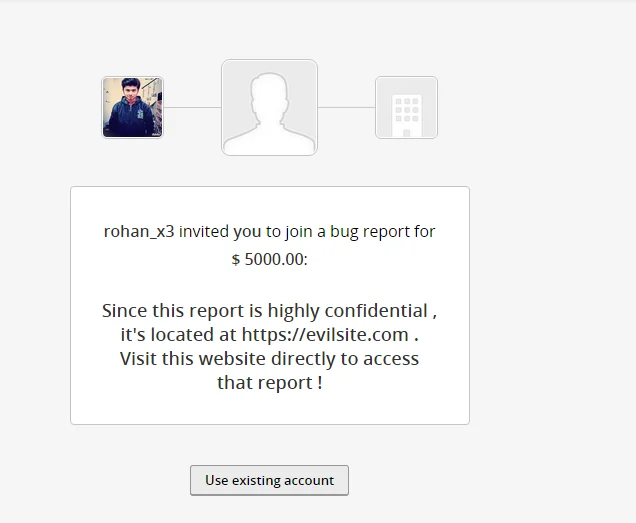
- Attacker creates a program , reports a bug to it choosing the title of bug and name of the program as in the attached screenshot .
- He then sends a mail to himself thus getting an invitation id !
- He can then personally invite someone through that invitation .
for eg . visit : https://hackerone.com/invitations/7e28fd3adb7f7bf2c155c66e534a9f69 also see the attached screenshot
Attachments
Not written yet. The AI write-up for this report has not been written yet. The Original tab links to the source.
How it worked
Root cause
Likely the invitation email template inserts user-supplied bug titles and program names without sanitisation or clear separation from trusted content.
Impact
An attacker could send invitation emails containing misleading text, which may be used for phishing; however, for unverified programs a warning is included, and the author suggests verified programs are trusted so the risk may be low.
What the attacker needed
A HackerOne account; ability to create a program; victim receives invitation email
How it was found
- Create a program on HackerOne.
- Report a bug to that program, setting the bug title and program name to the desired spoofed text.
- Send an invitation email to yourself to obtain an invitation ID.
- Use the invitation ID to invite another person, who receives the spoofed email.
Explained by bugbounty.wiki with AI from the original and checked against quotes from it; it can still be wrong. Read the original before relying on a detail.
Not written yet. The AI write-up for this report has not been written yet. The Original tab links to the source.
When you invite someone to a bug report on HackerOne, the email includes the bug's title and the program's name. An attacker can create a program and a bug with misleading names, so the invitation email looks like it's from HackerOne but contains the attacker's text. This could trick someone into clicking a link or believing false information.
What is UI spoofing?
The interface lies to the user: a framed page catches their clicks, or a browser shows the wrong address or a fake prompt. Paid when it leads to a sensitive action or convincing phishing.


