Minor security issue with Hackerone Invitations from sandbox program
Invitation emails from an unverified sandbox program lacked a warning that the program was unverified, unlike report collaboration invitations; the reporter frames this as a privacy and security concern.

- Triaged in 4 days
- Fixed in 13 days
- Paid in 4 days
- Disclosed after 4 months
Summary: Hello, I noticed that the Hackerone team have recently enabled "Invite Users" feature to add users to organization in sandbox program. When I try to invite other users through email, I observed that there is no precautionary warning message in email stating that the invitation was sent from an unverified program on H1.
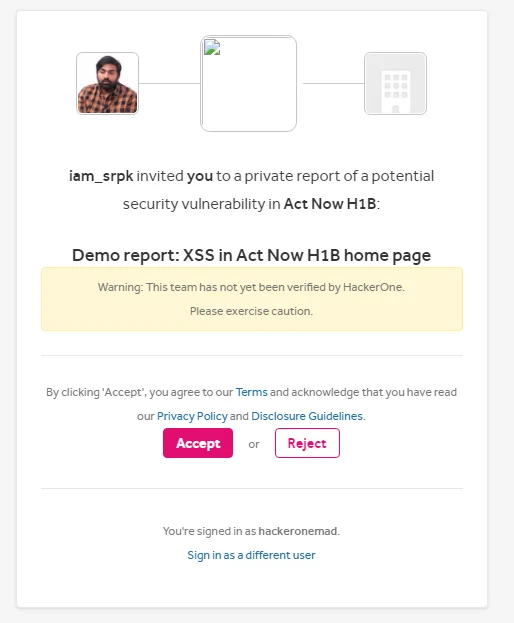
✔️ When Users are Invited to Participate/Collaborate on a report
██████
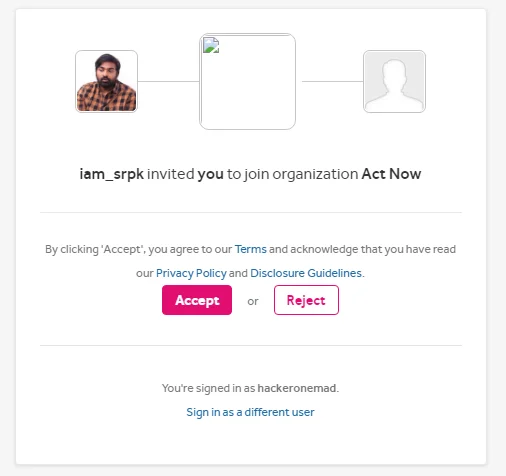
✘ When Users are Invited to Join Organization
████
Impact
Failing to alert users over privacy and security concern
What the report shows
The target is HackerOne itself, specifically the "Invite Users" feature that lets an organisation add users to a sandbox program. The researcher noticed that this feature had recently been enabled for sandbox programs and went on to compare how invitations are communicated in two different flows.
The observation is about the email that a recipient receives, not about the invitation mechanism itself. When a user is invited to participate or collaborate on a report, the email carries a warning. The researcher shows this flow first:
✔️ When Users are Invited to Participate/Collaborate on a report
██████
The second flow is the one the researcher considers deficient. When a user is invited to join an organisation, the email arrives without any precautionary warning that the invitation was sent from an unverified program on H1:
✘ When Users are Invited to Join Organization
████
The comparison is the whole of the finding: the same platform, two invitation emails, and only one of them tells the recipient that the sending program is unverified. The report frames the gap as a privacy and security concern for the person receiving the invitation, because nothing in the message helps them judge whether the program behind it can be trusted.
The report records a low severity with a CVSS score of 3.8, classified as a business logic error on the hackerone.com asset. No bounty figure is given. The report was disclosed on 22 July 2024.
Root cause
The report does not analyse the cause; it only compares the two invitation emails. This is a consistency failure in user-facing messaging rather than a flaw in access control: the invitation itself works as designed, but the recipient is not given the context the platform gives them elsewhere.
Impact
The report frames the gap as failing to alert users over a privacy and security concern. The report describes this as failing to alert users over a privacy and security concern; it does not demonstrate account takeover, data exposure or any other concrete compromise, and the low severity reflects that.
How this kind of bug works
Business logic issues of this shape come from inconsistency between parallel code paths. A platform builds a safety or trust feature into one workflow, then later adds a second workflow that reaches the same kind of recipient through a different template, service or notification job. The shared protection is not refactored into a common layer, so the new path silently omits it. Nothing throws an error, no access check fails, and functional testing passes because the invitation is delivered correctly. The defect only appears when you compare the outputs of the two paths side by side.
Because the behaviour is intentional-looking and the security consequence is indirect, these bugs are easy to dismiss as cosmetic. They matter when the missing element is something users rely on to make a trust decision: a verified-sender badge, a warning banner, a domain indicator, or, as here, a note that the source is unverified. Defences are organisational and architectural: centralise notification content so every template that contacts a user draws from the same trust metadata, and add regression tests that assert the presence of required warnings across all invitation types.
How to test for it
- Map every workflow that sends a message to a user: invitations to organisations or teams, report collaboration invites, password resets, membership confirmations, share links. Note which ones originate from a verified entity and which from an unverified or newly created one.
- Trigger each flow with two accounts you control, one as sender and one as recipient, and capture the resulting emails or in-app notifications in full, including headers and any rendered badges.
- Compare the outputs field by field. A positive result is a message from an unverified source that lacks a warning, label or indicator that an equivalent message from a verified source carries.
- Repeat with the entity in different states (unverified, pending, verified) to confirm the indicator is genuinely tied to verification status and not to some unrelated difference between the two flows.
Common false positives: the warning may be present but rendered only in the HTML part of the email, or only in the in-app notification; the two flows may legitimately differ because one concerns a report and the other an organisation; and the recipient may already have been shown the trust status elsewhere in the product. Check the raw message before concluding anything is missing.
How it is fixed
Hunting notes
This class of bug hides wherever a product has grown several ways to reach the same user: organisation and team invitations, project sharing, collaborator adds, and any feature recently extended to a new tier such as sandbox or trial programs. Recon signals include release notes announcing a feature for a new program type, parallel email templates visible in documentation or help centre articles, and UI badges that appear in one place but not another. To make the report land, show the two messages side by side, state clearly which trust decision the missing element affects, and keep the impact claim to what you can demonstrate.
What happened, in plain words
HackerOne is a platform where companies (called programs) ask security researchers to look for bugs in their software. The report refers to an unverified program and to sandbox programs. The researcher looked at a feature called "Invite Users", which lets an organisation add people to a sandbox program by sending them an email invitation.
The researcher compared two kinds of invitation email that HackerOne sends. In the first, a user is invited to participate or collaborate on a report. That email carries a warning. In the second, a user is invited to join an organisation, and that email arrives with no warning at all that the invitation came from an unverified program.
The flow that does it right
When someone is invited to participate or collaborate on a report, the email includes a precautionary message. The researcher shows this as the good example:
✔️ When Users are Invited to Participate/Collaborate on a report
██████
The flow that does not
When someone is invited to join an organisation, the email has no such warning. The recipient cannot tell from the message that the program behind the invitation is unverified:
✘ When Users are Invited to Join Organization
████
The whole finding is this side-by-side comparison: one platform, two invitation emails, and only one of them tells the recipient that the sending program is unverified. The researcher frames the gap as a privacy and security concern, because nothing in the organisation invitation helps the person receiving it judge whether the program can be trusted.
The report was rated low severity with a CVSS score of 3.8, classified as a business logic error on the hackerone.com asset. No bounty figure is given, and the report was disclosed on 22 July 2024.
In general, how this kind of bug works
A business logic error is a flaw in the rules a product follows, rather than in its locks and walls. Think of a bank that checks your ID at the main counter but forgets to check it at a side window that was opened later: nothing is broken, the side window works, but the safety step is missing. Bugs of this shape come from inconsistency between parallel paths in the same product. A platform builds a safety or trust feature into one workflow, then later adds a second workflow that reaches the same kind of person through a different email template or notification job. The shared protection is never moved into a common layer, so the new path silently omits it. Nothing throws an error, no access check fails, and normal testing passes because the invitation is delivered correctly. The defect only appears when you compare the outputs of the two paths side by side.
Because the behaviour looks intentional and the security consequence is indirect, these bugs are easy to dismiss as cosmetic. They matter when the missing element is something users rely on to make a trust decision: a verified-sender badge, a warning banner, a domain indicator, or, as here, a note that the source is unverified.
The report frames the gap as failing to alert users over a privacy and security concern. The report describes this as failing to alert users over a privacy and security concern; it does not demonstrate account takeover, data exposure or any other concrete compromise, and the low severity reflects that.
How to test for it
- Map every workflow that sends a message to a user: invitations to organisations or teams, report collaboration invites, password resets, membership confirmations, share links. Note which ones come from a verified entity and which from an unverified or newly created one.
- Trigger each flow with two accounts you control, one as sender and one as recipient, and capture the resulting emails or in-app notifications in full, including headers and any rendered badges.
- Compare the outputs field by field. A positive result is a message from an unverified source that lacks a warning, label or indicator that an equivalent message from a verified source carries.
- Repeat with the entity in different states (unverified, pending, verified) to confirm the indicator is genuinely tied to verification status and not to some unrelated difference between the two flows.
Common false positives: the warning may be present but rendered only in the HTML part of the email, or only in the in-app notification; the two flows may legitimately differ because one concerns a report and the other an organisation; and the recipient may already have been shown the trust status elsewhere in the product. Check the raw message before concluding anything is missing.
How it is fixed
Hunting notes
This class of bug hides wherever a product has grown several ways to reach the same user: organisation and team invitations, project sharing, collaborator adds, and any feature recently extended to a new tier such as sandbox or trial programs. Recon signals include release notes announcing a feature for a new program type, parallel email templates visible in documentation or help centre articles, and UI badges that appear in one place but not another. To make the report land, show the two messages side by side, state clearly which trust decision the missing element affects, and keep the impact claim to what you can demonstrate.
Glossary
- HackerOne: a platform where companies invite security researchers to find bugs in their software.
- Program: a company's presence on HackerOne that runs a bug bounty or vulnerability disclosure effort.
- Sandbox program: a program type on HackerOne; the report refers to an unverified program.
- Verified / unverified: whether the platform has confirmed that a program is who it claims to be.
- Invite Users: the HackerOne feature that lets an organisation add people to a program by email invitation.
- Business logic error: a flaw in the rules or workflow a product follows, rather than in its technical access controls.
- CVSS: a standard scoring system that rates the severity of a security issue, here 3.8 (low).
- Severity: a label for how serious an issue is, here low.
- Asset: the specific system or domain affected, here hackerone.com.
- Template: a reusable message layout that a platform fills in and sends, such as an invitation email.
- Notification: a message the platform sends to a user, by email or inside the product.
- HTML part: the formatted version of an email, as opposed to its plain-text version.
- Headers: the technical fields at the top of an email that describe where it came from and how it was handled.
- False positive: a finding that looks like a bug but is not, because the behaviour is correct or the evidence is incomplete.
- Regression test: an automated check that fails if a previously working behaviour, such as a required warning, disappears.
- Recon: the research phase of looking for clues about how a product works before testing it.
- Disclosed: made public, here on 22 July 2024.



