The hacker has access to the administrative part of the management reports in publish report
A researcher found that a publish report they created showed all management permissions as false, yet they could still change its status through a bulk action request. An attacker could therefore alter the state of a publish report despite the interface indicating they had no management rights.
 Originally disclosed on HackerOne
- Triaged in 5 months
- Fixed in 7 months
- Paid in 7 months
- Disclosed after 7 months
Summary: Hi team, @jobert, @bencode . At the moment, I'm not entirely sure that this has a strong effect. But I also assume that this should not be on behalf of the hacker, and also in the future it may create problems, for example when you add new statuses for the report and they will have some impact on the report.
Steps To Reproduce
- https://hackerone.com/hacktivity/publish
- Create publish report
- When we create a report, we can see that there is nothing we can do with it
{"can_manage?":false,"can_export?":false,"can_add_comment?":false,"can_change_state?":false,"can_reopen?":false, "can_award_bounty?":false,"can_award_swag?":false,"can_suggest_bounty_amount?":false,"can_assign_to_user?":false, "can_assign_to_h1_triage?":false,"can_hide_timeline?":false,"can_agree_on_going_public?":false, "can_cancel_disclosure_request?":false,"can_be_publicly_disclosed?":false,"can_post_internal_comments?":false, "can_manage_common_responses?":false,"can_use_common_responses?":false,"can_reassign_to_team?":false, "can_change_title?":false,"can_change_weakness?":false,"can_be_manually_disclosed?":false,"can_clone?":false, "can_close?":false,"can_ban_researcher?":false,"can_create_severity?":true,"can_close_comments?":false, "can_change_structured_scope?":false,"can_manage_collaborators?":false,"can_view_bounty_weights?":true, "can_redact?":false,"can_view_credential_account_details?":true,"can_create_retest?":false,"can_request_retest?":false, "can_manage_link_sharing?":false,"assignable_team_members":[],"assignable_team_member_groups":[]}
and "comments_closed?":true
There is nothing we can do, including the fact that we can't write comments , However, a hacker can use the admin panel to change the status. █████████
- Use this request, we can changed status
https://hackerone.com/reports/bulk
POST:
message=test&substate=triaged&reference=&add_reporter_to_original=false&reply_action=change-state&mark_ineligible_for_bounty=false&reports_count=1&report_ids%5B%5D=ID_PUBLISH_REPORT&bounty_currency=USD
substate=triaged and reply_action=change-state - Change the report to the triaged status
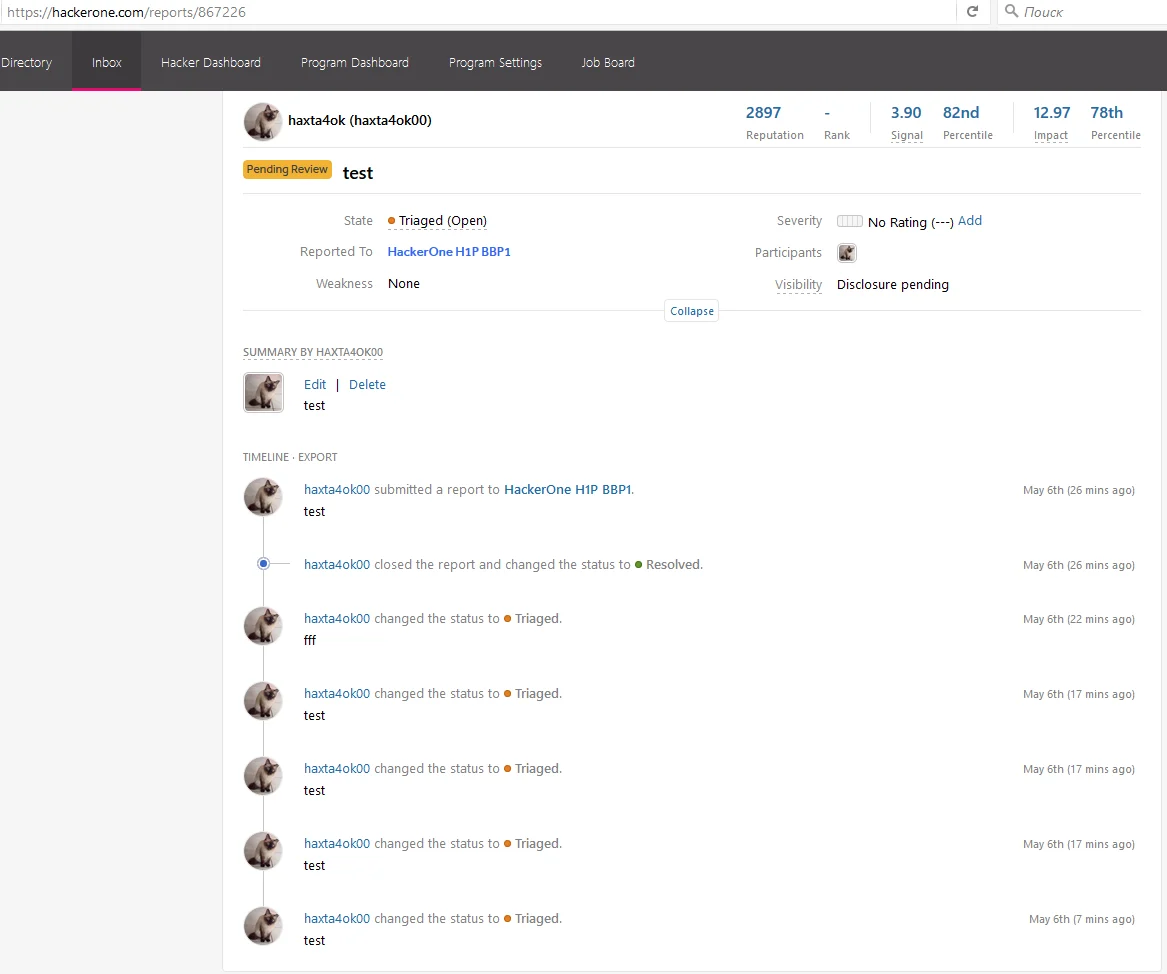
The report which was in the tests: #867226 , #867195 , #867197 , #867218
Impact
Changes to the publish report status
Not written yet. The AI write-up for this report has not been written yet. The Original tab links to the source.
How it worked
Root cause
Likely the bulk report action endpoint did not verify that the user had permission to manage the target publish report, relying only on the client-side permission flags.
Impact
A user could change the status of a publish report they were not permitted to manage, which the reporter notes may cause further problems as new statuses are added.
What the attacker needed
A HackerOne account; ability to create a publish report
How it was found
- Open the publish report creation page and create a publish report.
- Observe that the report's permission flags all indicate no management ability.
- Send a bulk action request to the reports bulk endpoint with the report identifier and a state change.
- Observe that the report status is changed to triaged.
Explained by bugbounty.wiki with AI from the original and checked against quotes from it; it can still be wrong. Read the original before relying on a detail.
Not written yet. The AI write-up for this report has not been written yet. The Original tab links to the source.
A publish report showed the user had no management permissions, but a bulk-action request still changed its status, suggesting the server did not check permission.
What is Access control?
A user can do something their role should not allow: reach an admin function, act on a feature they have not paid for, or skip a permission check. IDOR is the special case where the object belongs to someone else.

