Single Sing On - Clickjacking
The Single Sign-On login page could be embedded in an iframe on another site because no frame-busting protection was present. An attacker could overlay or frame the login page to trick a user into entering credentials or clicking something unintended.

- Triaged in 7 days
- Fixed in 35 days
- Paid in 7 days
- Disclosed after 2 months
Description: Clickjacking (User Interface redress attack, UI redress attack, UI redressing) is a malicious technique of tricking a Web user into clicking on something different from what the user perceives they are clicking on. Browsers Verified In: Any
Steps To Reproduce:
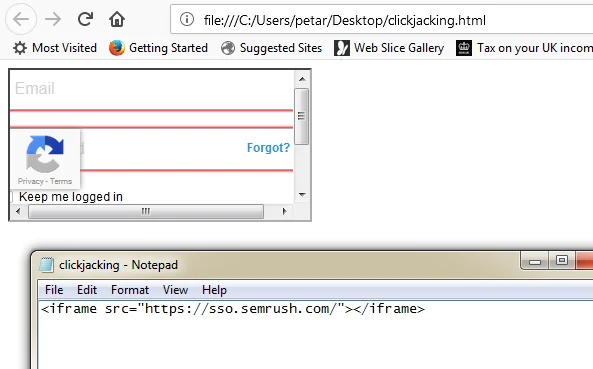
Create HTML file containg following code:
<iframe src="https://sso.semrush.com/"></iframe>
Execute the HTML file & you will see Single Sing On login page present trough the iframe.
Supporting Material/References:
Impact
Revealing confidential information(credentials) AND/OR taking control of their computer/account while clicking on seemingly innocuous web pages.
Attachments
Not written yet. The AI write-up for this report has not been written yet. The Original tab links to the source.
How it worked
Root cause
Likely the Single Sign-On login page did not send headers or use script that stops other sites from framing it.
Impact
An attacker could frame the login page to trick a user into revealing credentials or clicking something unintended, though the report does not show a working credential-theft attack.
What the attacker needed
Victim visits attacker-controlled page; victim interacts with framed login page
How it was found
- Create an HTML file that embeds the Single Sign-On login page in an iframe.
- Open the HTML file in a browser.
- Observe the Single Sign-On login page rendered inside the iframe.
Explained by bugbounty.wiki with AI from the original and checked against quotes from it; it can still be wrong. Read the original before relying on a detail.
Not written yet. The AI write-up for this report has not been written yet. The Original tab links to the source.
Clickjacking is when a malicious page secretly loads another site inside a frame and tricks you into clicking or typing there. Here the login page could be shown inside such a frame, so a user might enter their password believing they are on the real site. The report only shows the page loads in a frame; it does not demonstrate a full credential theft.
What is UI spoofing?
The interface lies to the user: a framed page catches their clicks, or a browser shows the wrong address or a fake prompt. Paid when it leads to a sensitive action or convincing phishing.




