The Untold SendBird Misconfigurations
SendBird applications had default access control settings that allowed users without access tokens to read and write, and customers could not change these ACLs themselves. An attacker could create a user with just a user ID, authenticate, and then list all users, manage channels, and perform other actions on the application.

At a random bug hunting collaboration with my team (thaivu, lamscun, thefool45, fergustr4n), we had bumped into a random private target as usual. On the way exploiting the target, I found that our target has implemented a chatting feature using a service from a third party platform.
The full write-up lives on its author's site
It belongs to its author, so we link to it rather than copy it. The other two tabs are our own rewrites, checked against it.
Context
During a collaboration with my team (thaivu, lamscun, thefool45 and fergustr4n) we were working on a random private target. While exploiting it, I noticed that the target had a chatting feature built on a third-party platform. Some Google dorking showed that the chat was a product of SendBird, described on its site as "the leading interaction API platform trusted by modern digital apps like Paypal, Yahoo, Reddit, Delivery Hero, and Hinge to easily embed real-time chat, voice, and video into their apps". That caught my interest, so I started reading how SendBird works to look for hidden actions and configurations that developers might miss.
Setup
The relevant preconditions come from the platform's own documentation at the time of the research (some of it may be outdated now):
- The host of a customer's SendBird Application takes the form
https://api-{application_id}.sendbird.com. - SendBird provides various access control options, and some are turned on by default to avoid unexpected errors when creating sample apps.
- Customers cannot change Access Control List settings themselves. Changing ACL settings is only possible by a member of SendBird's Solutions Engineering team.
- By default, the SendBird Application Security Settings for "users without access tokens" are "Read & Write" for chat and "Call & Answer" for call.
Finding it
1st: learn the third party's products and documents
I went straight to the SendBird main site and developer portal, which provides usage guides, sample APIs, notes and recommendations for each product type. The four points above are what I took away from that reading.
2nd: understand functions, verify the knowledge and find the vulnerabilities
Back on the target, I confirmed that APIs existed on hosts matching the api-{application_id}.sendbird.com pattern, with paths matching the documentation. Using the current API session, I then tried different APIs from the docs. I picked one that lists users in the SendBird Application:
GET /v3/users/
The server responded with all the users listed. I told all my teammates to check it.

Our users' session could call various APIs and perform many actions on users, channels and messages within the target's SendBird Application. That is a clear broken access control caused by ACL misconfiguration.
One thing we could not understand was where the "Session-Key" came from and how it was generated, since we could not see its value in any responses.

Going back to the SendBird documentation gave us more facts:
- "By default, Sendbird server can authenticate a user just by a unique user ID"
- "If no matching user ID is found, the server creates a new user account with the user ID"
- "A user authentication can be done with just their own user ID, but also with either an access token or a session token"
- Our target, as a client app, could have authenticated to the SendBird server over WebSocket with the upgrade URL format
wss://ws-{application_id}.sendbird.com/?user_id={user_id}&ai={application_id}&access_token={access_token}
We finally confirmed that:
- The target's SendBird client authenticated to the SendBird server over WebSocket.
- The "Session-Key" was sent to the client in a WebSocket message after the client called the upgrade WebSocket URL above.
- The target's SendBird client could authenticate with only a user ID, using
access_token=null. - We also found a hidden API to authenticate with a user ID only, the same way as the WebSocket, in a JS file:
POST https://api-{application_id}.sendbird.com/v3/users/{user_id}/loginwith body{"app_id":"<application_id>"}.
In summary, on this target an unauthenticated user could create a SendBird client user, authenticate successfully and call APIs to abuse the broken access control caused by the ACL misconfiguration.
Exploitation
Step 1: confirm the target uses SendBird and get the Application ID
Crawl the target, perform content discovery, and grep for the word "sendbird" and for the regex of SendBird's Application ID:
[0–9A-F]{8}-[0–9A-F]{4}-[0–9A-F]{4}-[0–9A-F]{4}-[0–9A-F]{12}
Step 2: test the security settings for users without access tokens
With the Application ID in hand, check whether the SendBird Application Security Settings for "users without access tokens" are misconfigured by performing anonymous user login or creation in either of these ways:
wss://ws-{application_id}.sendbird.com/?user_id={user_id}&ai={application_id}&access_token={access_token}
POST https://api-{application_id}.sendbird.com/v3/users/{user_id}/login
with body:
{"app_id":"<application_id>"}
Step 3: test the ACLs
If step 2 succeeds, we get the "Session-Key" for our user session. We then check whether the ACLs are misconfigured by sequentially calling all the APIs to perform actions on the SendBird Application using the SDK user session we obtained.
Step 4: fall back to a legitimate session
If step 2 does not succeed, go through the functions on the target manually, obtain the SDK user session the normal way the target does, and check for ACL misconfiguration as in step 3.
Step 5: automate
Automate all of the above.
References for the SendBird APIs to check:
https://www.postman.com/sendbird/workspace/sendbird-platform-api/overviewhttps://sendbird.com/docs
4th: Bird Hunting

After checking different SendBird Applications, most of them were vulnerable to the ACL misconfiguration. Severity has to be judged per application, because business requirements and impacts differ (from Medium to Critical).
The impacts we saw were varied:
- Leak users' sensitive information
- Create a chat channel (without creating a new league)
- Manage the chat channel
- Update the user's chat profile
- Update the group channel configuration
- Chat with any users
- Edit or delete messages of any users while being operator of a self-created channel
- Update the details and configurations of a channel while being a member of any channel
- As documented, a single SendBird user can only join a limit of 2000 group channels. An attacker could create 2000 group channels and add all the users in the SendBird Application to them, so that all users could no longer join any SendBird channels, causing a denial of service.
Some example reports:


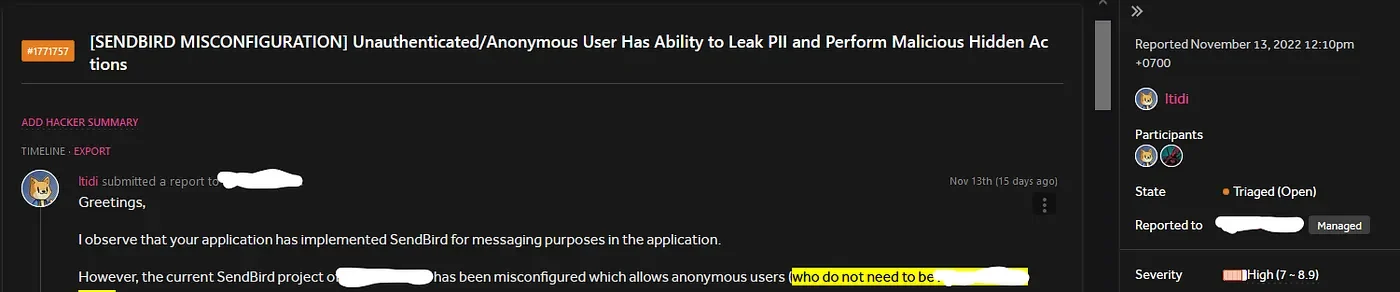
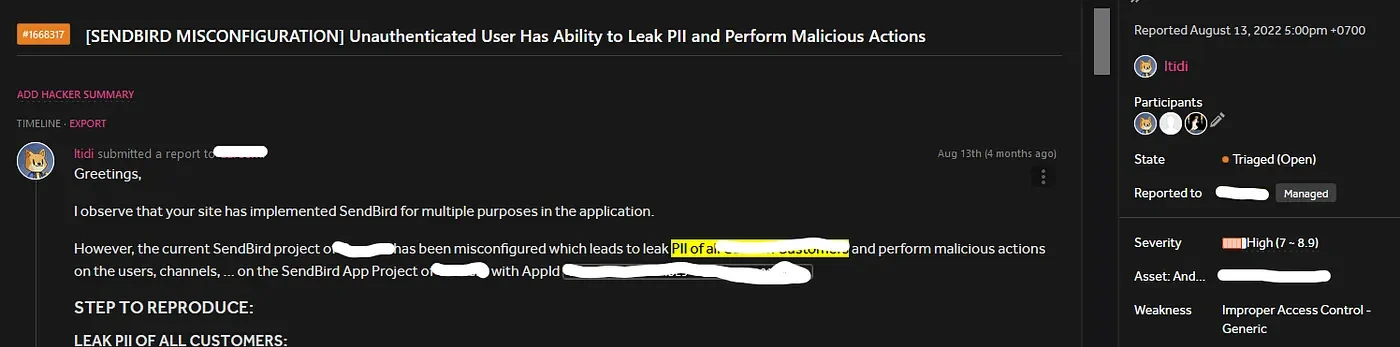
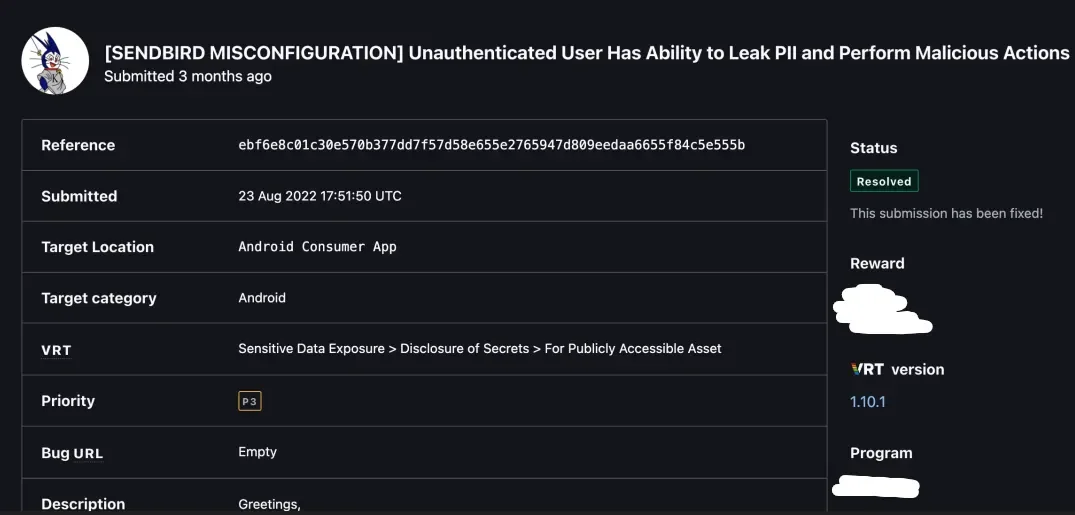
Great collaborations with thaivu, lamscun, thefool45 and fergustr4n.

Root cause
The weakness is broken access control caused by ACL misconfiguration. SendBird's default Application Security Settings for "users without access tokens" are "Read & Write" for chat and "Call & Answer" for call, and the server can authenticate a user by a unique user ID alone, creating the account if the ID does not exist. Combined with access_token=null and the hidden login endpoint, an unauthenticated attacker can obtain a session and reach APIs that should be restricted. Customers could not change ACL settings themselves at the time, since only SendBird's Solutions Engineering team could, so the defaults were what most applications ran with.
Impact
On the target we tested, an unauthenticated user could create a SendBird client user, authenticate and call APIs to abuse the broken access control. Across the applications we checked, most were vulnerable, with impact ranging from Medium to Critical depending on the application's business requirements. The concrete effects are the list above: leaking user information, creating and managing channels, updating profiles and channel configuration, chatting with any user, editing or deleting other users' messages as operator of a self-created channel, updating channel details as a member, and exhausting the 2000 group channel limit to cause a denial of service.
Fix
SendBird has since published more documentation about security recommendations, especially about ACLs, and now allows customers to change ACLs themselves. However, the ACLs and the SendBird Application Security Settings for "users without access tokens" are still vulnerable by default.
Variants to test
- Grep crawled content for "sendbird" and the Application ID regex. A positive result is finding the word sendbird and an Application ID in the crawled content.
- Attempt anonymous login or creation with
access_token=nullover the WebSocket upgrade URL. A positive result is a Session-Key delivered in a WebSocket message. - Attempt the hidden login endpoint
POST /v3/users/{user_id}/loginwith{"app_id":"<application_id>"}. - With the resulting session, call
GET /v3/users/. - Sequentially call the other documented APIs with the session to perform actions on users, channels and messages.
- If anonymous login fails, obtain a session the normal way through the target's own client and repeat step 5.
What happened, in plain words
A small team of security researchers was testing a private website (a "target") that belonged to some company. While poking around, one of them noticed that the site had a chat feature, the little message box where users talk to each other. That chat was not built by the company itself. It was rented from another company called SendBird, which sells chat as a service: instead of writing their own chat system, developers plug SendBird into their app and SendBird handles the messages.
SendBird describes itself on its site as "the leading interaction API platform trusted by modern digital apps like Paypal, Yahoo, Reddit, Delivery Hero, and Hinge to easily embed real-time chat, voice, and video into their apps".
The researchers found that an unauthenticated user could create a SendBird user, authenticate, and then call APIs to read the list of every user and do many other things inside the chat system. The cause was a settings problem called a misconfiguration: the ACLs were too open, and the defaults were too open as well. The team then checked other companies that use SendBird and found most of them had the same problem.
This article walks through the whole story from zero. You only need a browser and a computer to follow it. Every technical word is explained the first time it appears, and there is a glossary at the end.
Some words you will need first
Before the story, here are the ideas that come back all the time. Read them once; they will make the rest much easier.
- API: an API (Application Programming Interface) is the set of doors a program offers to other programs. Think of a restaurant: the menu is the API, the kitchen is the server, and you (the other program) order from the menu. You do not walk into the kitchen yourself; you ask for a dish by name and the kitchen sends it back. On the web, an API door is usually a URL plus a method such as
GET(read something) orPOST(send something). - Endpoint: one specific door of an API.
GET /v3/users/is one endpoint;POST /v3/users/{user_id}/loginis another. The{...}parts are placeholders you fill in. - Request and response: your browser (or a tool) sends a request to a server, and the server sends back a response. A request has a method, a path, sometimes a body (extra data), and sometimes headers (small labels attached to the request).
- Session: a short-lived proof that you are logged in. When you log in to a website, the server gives your browser a session so it does not ask for your password on every page. A Session-Key here is exactly that: a string that says "this person is logged in as user X".
- Token: a small piece of text that acts like a key. An access token is a token that proves who you are to an API. If a token is missing, the request is "anonymous".
- Cookie: a small file your browser stores for a website, often holding the session. Cookies and tokens do the same job: carry proof of identity between requests.
- WebSocket: a normal web page request opens a connection, gets an answer, and closes. A WebSocket is a connection that stays open in both directions, like a phone call instead of a letter. Chat apps use it because messages need to arrive instantly.
- Access control: the rules that decide who is allowed to do what. A door with a lock is access control. When those rules are wrong, we call it broken access control: someone can do things they should not be allowed to do.
- ACL: Access Control List, the actual list of rules (who may read, who may write, who may call). A misconfigured ACL is a list that says "everyone may do everything".
- Authentication vs authorisation: authentication is proving who you are (showing your ID card). Authorisation is whether you are allowed to enter a particular room once inside. This story is mostly about authorisation going wrong.
- Application ID: SendBird gives each customer's chat installation a unique identifier, a long code that looks like a serial number. It is not a secret; it appears in the customer's web pages.
- Google dorking: using clever search queries on Google to find pages that reveal something, for example pages that mention a product name.
- Grep: a command that searches text for a word or pattern. "Grep for sendbird" means "search the files you collected for the word sendbird".
- Regex: a pattern language for matching text. A regex can describe "a code that looks like eight hex characters, a dash, four hex characters, and so on".
- Hex characters: the digits 0 to 9 and the letters A to F.
- Denial of service (DoS): making a service unusable for its real users, for example by filling every seat so nobody else can sit down.
- Severity: how bad a bug is, usually from Low to Critical. It depends on what an attacker can actually do.
1st: learn the third party's products and documents
The first step was not hacking at all. It was reading. The researcher went to the SendBird main site and its developer portal, which offers usage guides, sample APIs, notes and recommendations for each product. Reading the manual before touching anything is like reading the rules of a building before trying the doors: you learn which doors exist and which ones are supposed to be locked.
Four points from that reading mattered later (some of it may be outdated now):
- The host of a customer's SendBird Application takes the form
https://api-{application_id}.sendbird.com. - SendBird provides various access control options, and some are turned on by default to avoid unexpected errors when creating sample apps.
- Customers cannot change Access Control List settings themselves. Changing ACL settings is only possible by a member of SendBird's Solutions Engineering team.
- By default, the SendBird Application Security Settings for "users without access tokens" are "Read & Write" for chat and "Call & Answer" for call.
In plain words: every customer's chat lives at a predictable address built from its Application ID. Some safety rules are switched on automatically, but the rule for people with no access token (anonymous people) is set to allow reading and writing chat, and calling and answering calls. And at the time, customers could not change that themselves: only SendBird staff could. So whatever the default was, most customers were living with it.
2nd: understand functions, verify the knowledge and find the vulnerabilities
Back on the target, the researcher checked that the addresses matched the pattern from the documentation: hosts like api-{application_id}.sendbird.com, with paths like the ones in the docs. They did. Then, using the session the target's own chat already had, the researcher tried different APIs from the documentation, one by one, to see what each would answer.
One of them lists the users of a SendBird Application:
GET /v3/users/
Line by line:
GETis the method. It means "read something, do not change anything"./v3/users/is the path. It points at the list of users.- There is no body, because we are only asking to read.
The server answered with all the users listed. That is not supposed to happen for an ordinary chat user: a normal user should see their own profile and the people they chat with, not the full customer list. The researcher told the whole team to check it.
With that session, the team could call many APIs and perform many actions on users, channels and messages inside the target's SendBird Application. That is a clear case of broken access control caused by an ACL misconfiguration: the list of rules was too generous, so a normal chat user could act like an administrator.
One thing puzzled them. They could not see where the "Session-Key" came from or how it was generated, because its value never appeared in any responses.
So they went back to the documentation, and found more facts:
- "By default, Sendbird server can authenticate a user just by a unique user ID"
- "If no matching user ID is found, the server creates a new user account with the user ID"
- "A user authentication can be done with just their own user ID, but also with either an access token or a session token"
- The target, as a client app, could have authenticated to the SendBird server over WebSocket with the upgrade URL format
wss://ws-{application_id}.sendbird.com/?user_id={user_id}&ai={application_id}&access_token={access_token}
What those four lines mean together is important. Normally, logging in requires a password or a token. Here, SendBird's server will accept a bare user ID as proof of identity, and if that user ID does not exist yet, it will simply create the account. That is like a hotel that gives you a room key just because you said a room number out loud, and builds a new room if the number does not exist.
The WebSocket address is the "phone call" version of logging in. Let us read it piece by piece:
wss://means a secure WebSocket connection (thesstands for secure, as inhttps).ws-{application_id}.sendbird.comis the chat server for that customer.?user_id={user_id}says who you claim to be.&ai={application_id}repeats which application you are talking to.&access_token={access_token}is where the token would go. If there is no token, this can benull.
The team then confirmed four things:
- The target's SendBird client authenticated to the SendBird server over WebSocket.
- The "Session-Key" was sent to the client in a WebSocket message after the client called the upgrade WebSocket URL above. That explains the mystery: the key arrives over the open phone call, not in a normal page response, which is why they never saw it before.
- The target's SendBird client could authenticate with only a user ID, using
access_token=null. - They also found a hidden API to authenticate with a user ID only, the same way as the WebSocket, in a JS file:
POST https://api-{application_id}.sendbird.com/v3/users/{user_id}/loginwith body{"app_id":"<application_id>"}.
That last one deserves a line-by-line reading:
POSTmeans "send something and create or change something".https://api-{application_id}.sendbird.comis the customer's chat server./v3/users/{user_id}/loginis the door that logs in a given user.- The body
{"app_id":"<application_id>"}is a small JSON object (a text format for data) that names the application. JSON is just labelled data: a name in quotes, a colon, a value in quotes.
In summary, on this target an unauthenticated user (someone with no account at all) could create a SendBird client user, authenticate successfully, and call APIs to abuse the broken access control caused by the ACL misconfiguration. No password, no invitation, no token: just a made-up user ID.
3rd: how to perform massive checks on other SendBird instances in different targets
Finding one vulnerable target is nice; finding out whether the problem is widespread is what makes a bug class interesting. The team wrote a repeatable recipe.
- Confirm that the target uses SendBird. Crawl the site (follow its pages automatically), perform content discovery (look for files and paths that are not linked in menus), and grep for the word "sendbird" and for the regex of SendBird's Application ID:
[0–9A-F]{8}-[0–9A-F]{4}-[0–9A-F]{4}-[0–9A-F]{4}-[0–9A-F]{12}
Line by line: the square brackets mean "one character from this set". 0–9A–F means any digit or any letter from A to F. {8} means exactly eight of them. Then a literal dash -, then {4} characters, another dash, {4}, another dash, {4}, another dash, and finally {12}. In short: a code shaped like eight characters, dash, four, dash, four, dash, four, dash, twelve. That is the shape of a SendBird Application ID, so finding one in a page tells you the site uses SendBird and gives you the ID you need.
- With the Application ID in hand, check whether the SendBird Application Security Settings for "users without access tokens" are misconfigured, by trying an anonymous login or account creation in either of these two ways:
wss://ws-{application_id}.sendbird.com/?user_id={user_id}&ai={application_id}&access_token={access_token}
This is the WebSocket call described earlier. You fill in the application ID and a user ID you choose, and you put null where the access token goes. If the server accepts you, the setting is open.
POST https://api-{application_id}.sendbird.com/v3/users/{user_id}/login
with body:
{"app_id":"<application_id>"}
The first block is the request line: method POST, the address of the login door for the user ID you chose. The second block is the body: a JSON object naming the application. If the server answers with a success, the same setting is open, and this time without needing a WebSocket.
-
If step 2 succeeds, we get the "Session-Key" for our user session. Now check whether the ACLs are misconfigured by calling all the APIs one after another to perform actions on the SendBird Application, using the SDK user session we obtained. In everyday terms: now that we hold a room key, we walk the corridor and try every door.
-
If step 2 does not succeed, do it the slow way: go through the functions on the target manually, obtain the SDK user session the normal way the target does (by using the chat like a real visitor), and check for ACL misconfiguration as in step 3. Some buildings do not hand out keys at the front desk, but a guest can still leave a window open.
-
Automate all of the above. Doing the same clicks by hand for hundreds of sites is slow and error-prone; a script repeats the recipe exactly.
References for the SendBird APIs to check:
https://www.postman.com/sendbird/workspace/sendbird-platform-api/overviewhttps://sendbird.com/docs
4th: Bird Hunting
After checking different SendBird Applications, most of them were vulnerable to the ACL misconfiguration. Severity has to be judged per application, because business requirements and impacts differ, from Medium to Critical. A chat that only carries public announcements is less sensitive than a chat used for private customer support.
The impacts the team saw were varied:
- Leak users' sensitive information
- Create a chat channel (without creating a new league)
- Manage the chat channel
- Update the user's chat profile
- Update the group channel configuration
- Chat with any users
- Edit or delete messages of any users while being operator of a self-created channel
- Update the details and configurations of a channel while being a member of any channel
- As documented, a single SendBird user can only join a limit of 2000 group channels. An attacker could create 2000 group channels and add all the users in the SendBird Application to them, so that all users could no longer join any SendBird channels, causing a denial of service.
The last one is worth a plain explanation. Imagine a building where each person may belong to at most 2000 clubs. If someone signs everybody up for 2000 useless clubs, nobody has room left to join a real one. The chat stops working for legitimate users, which is a denial of service.
Some example reports:
Great collaborations with thaivu, lamscun, thefool45 and fergustr4n.
Root cause
The weakness is broken access control caused by ACL misconfiguration. SendBird's default Application Security Settings for "users without access tokens" are "Read & Write" for chat and "Call & Answer" for call, and the server can authenticate a user by a unique user ID alone, creating the account if the ID does not exist. Combined with access_token=null and the hidden login endpoint, an unauthenticated attacker can obtain a session and reach APIs that should be restricted. Customers could not change ACL settings themselves at the time, since only SendBird's Solutions Engineering team could, so the defaults were what most applications ran with.
In one sentence: the front door accepted a name as proof of identity, and the rooms inside were unlocked by default.
Impact
On the target we tested, an unauthenticated user could create a SendBird client user, authenticate and call APIs to abuse the broken access control. Across the applications we checked, most were vulnerable, with impact ranging from Medium to Critical depending on the application's business requirements. The concrete effects are the list above: leaking user information, creating and managing channels, updating profiles and channel configuration, chatting with any user, editing or deleting other users' messages as operator of a self-created channel, updating channel details as a member, and exhausting the 2000 group channel limit to cause a denial of service.
Fix
SendBird has since published more documentation about security recommendations, especially about ACLs, and now allows customers to change ACLs themselves. However, the ACLs and the SendBird Application Security Settings for "users without access tokens" are still vulnerable by default.
Variants to test
If you want to reproduce the checks on a site you are allowed to test, here is the same recipe as a checklist. Each line says what to look for as a positive result.
- Grep crawled content for "sendbird" and the Application ID regex. A positive result is finding the word sendbird and an Application ID in the crawled content.
- Attempt anonymous login or creation with
access_token=nullover the WebSocket upgrade URL. A positive result is a Session-Key delivered in a WebSocket message. - Attempt the hidden login endpoint
POST /v3/users/{user_id}/loginwith{"app_id":"<application_id>"}. - With the resulting session, call
GET /v3/users/. - Sequentially call the other documented APIs with the session to perform actions on users, channels and messages.
- If anonymous login fails, obtain a session the normal way through the target's own client and repeat step 5.
Glossary
- API: the set of doors a program offers to other programs, each door being a URL and a method.
- Endpoint: one specific door of an API, such as
GET /v3/users/. - Request: the message your browser or tool sends to a server.
- Response: the message the server sends back.
- Method: the verb of a request, such as
GET(read) orPOST(send or create). - Path: the part of a URL after the host, such as
/v3/users/. - Body: the extra data attached to a request, often in JSON.
- Header: a small label attached to a request or response.
- Session-Key: the string that proves a chat session is logged in.
- Token: a small piece of text that acts as a key proving identity.
- Access token: a token that proves who you are to an API;
nullmeans none was supplied. - Cookie: a small file a browser stores for a site, often holding the session.
- WebSocket: a connection that stays open in both directions, used for instant chat.
wss://: the secure version of a WebSocket address, likehttpsis tohttp.- JSON: a text format for labelled data, written with quotes, colons and braces.
- Access control: the rules deciding who may do what.
- Broken access control: when those rules are wrong and someone can do more than they should.
- ACL: Access Control List, the concrete list of who may read, write or call.
- Misconfiguration: a setting left in a state that is too open or otherwise unsafe.
- Authentication: proving who you are.
- Authorisation: being allowed to do a particular thing once you are known.
- Unauthenticated: not logged in at all.
- Application ID: the unique code identifying one customer's SendBird installation.
- Host: the domain part of a URL, such as
api-{application_id}.sendbird.com. - Google dorking: using search queries to find pages that reveal information.
- Crawl: automatically follow a site's pages to collect them.
- Content discovery: looking for files and paths that are not linked in menus.
- Grep: searching text for a word or pattern.
- Hex: the characters 0 to 9 and A to F.
- SDK: a ready-made library a developer adds to an app to use a service.
- Client: the program on the user's side, such as the chat widget in a browser.
- Server: the program that answers requests.
- Severity: how bad a bug is, from Low to Critical.
- Denial of service (DoS): making a service unusable for its real users.
- Operator: a role in a chat channel with extra powers, such as moderating messages.
- Group channel: a chat room in SendBird that several users can join.

