Limited Privilege User Can Create Unauthorized Referrals on partners.shopify.com
A user with limited privileges could access the POS lead creation URL directly and submit a referral, even though the referrals page was blocked for them. The backend did not enforce the missing permission, allowing unauthorised creation of referrals.

- Triaged in 4 days
- Fixed in 7 days
- Paid in 11 days
- Disclosed after 3.2 years
Summary by the program
A privilege escalation issue in Shopify's Partner Portal (partners.shopify.com) allowed users without View referrals permission to create POS leads by directly accessing the lead creation URL. While the interface blocked unauthorized users from the referrals page, the backend API lacked proper authorization checks, enabling users to bypass restrictions and submit referrals without proper permissions.
The report
###Summary
I have been working on the partner web portal and have noticed the referrals feature contains an issue where a user with limited privileges can create referrals in an unauthorized manner.
###Steps to Reproduce
First you must authenticate with an administrator user and then invite another with limited privileges
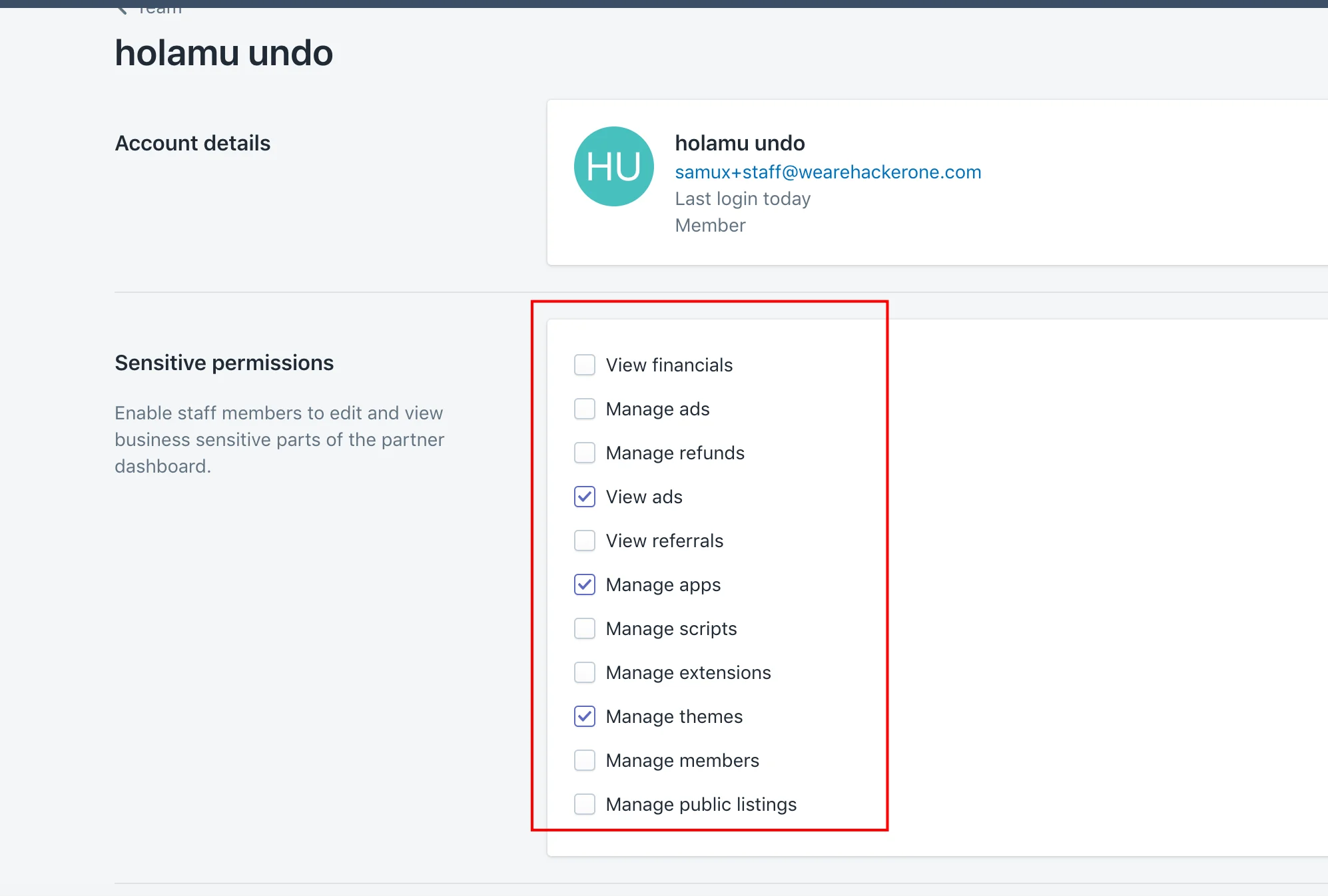
You may notice that the invited user does not have any privileges on the referral functionality.
When you authenticate with the user with limited privileges and then go to the referral functionality
https://partners.shopify.com/partner_id/referrals/
███████
You may notice that the user does not have the appropriate privileges to access this functionality.
Now, when the administrator accesses this same functionality.
███
It can be seen that the administrator can do several things, including Submit a POS Lead. Entering this url generates the following endpoint:
https://partners.shopify.com/partner_id/partner_leads/pos
In this way if the user with limited privileges accesses this URL.
█████
Instead of getting an error, the user can create a new POS Lead within the referrals. By completing the information.
████
It is observed that he was able to complete it with success.
Thanks.
Impact
Through this vulnerability, an attacker can bypass the implemented restriction in order to perform an action without authorization.
Not written yet. The AI write-up for this report has not been written yet. The Original tab links to the source.
How it worked
Root cause
Likely the server-side endpoint for creating POS leads did not verify that the user had the 'View referrals' permission, relying only on the UI hiding the page.
Impact
An attacker with a low-privilege account could bypass the intended restriction and create referrals without authorisation.
What the attacker needed
A partner account with limited privileges; knowledge of the POS lead creation URL
How it was found
- Log in as an administrator and invite a user with limited privileges.
- Log in as the limited-privilege user and try to access the referrals page; access is denied.
- As administrator, access the referrals page and note the POS lead creation URL.
- As the limited-privilege user, navigate directly to the POS lead creation URL.
- Fill in the form and submit; the lead is created successfully.
Explained by bugbounty.wiki with AI from the original and checked against quotes from it; it can still be wrong. Read the original before relying on a detail.
Not written yet. The AI write-up for this report has not been written yet. The Original tab links to the source.
In many web apps, some pages are hidden from users who lack permission, but the server must also check permission when the action is performed. Here, the page was hidden but the server still accepted the action, so a low-privilege user could create referrals they should not be able to.
What is Access control?
A user can do something their role should not allow: reach an admin function, act on a feature they have not paid for, or skip a permission check. IDOR is the special case where the object belongs to someone else.


