HTTP Request Smuggling on my.stripo.email
The web server and back-end disagreed on how to parse the length of a chunked HTTP request, allowing the attacker to smuggle a second request. This could let an attacker poison the back-end connection, bypass front-end rules, or attack other users.
 Originally disclosed on HackerOne
- Triaged in 40 hours
- Fixed in 2 months
- Disclosed after 3 months
Summary by the program
HTTP request smuggling vulnerabilities arise when websites route HTTP requests through webservers with inconsistent HTTP parsing. By supplying a request that gets interpreted as being different lengths by different servers, an attacker can poison the back-end TCP/TLS socket and prepend arbitrary data to the next request. Depending on the website's functionality, this can be used to bypass front-end security rules, access internal systems, poison web caches, and launch assorted attacks on users who are actively browsing the site.
The report
Summary:
HTTP request smuggling vulnerabilities arise when websites route HTTP requests through webservers with inconsistent HTTP parsing. By supplying a request that gets interpreted as being different lengths by different servers, an attacker can poison the back-end TCP/TLS socket and prepend arbitrary data to the next request. Depending on the website's functionality, this can be used to bypass front-end security rules, access internal systems, poison web caches, and launch assorted attacks on users who are actively browsing the site.
Steps To Reproduce:
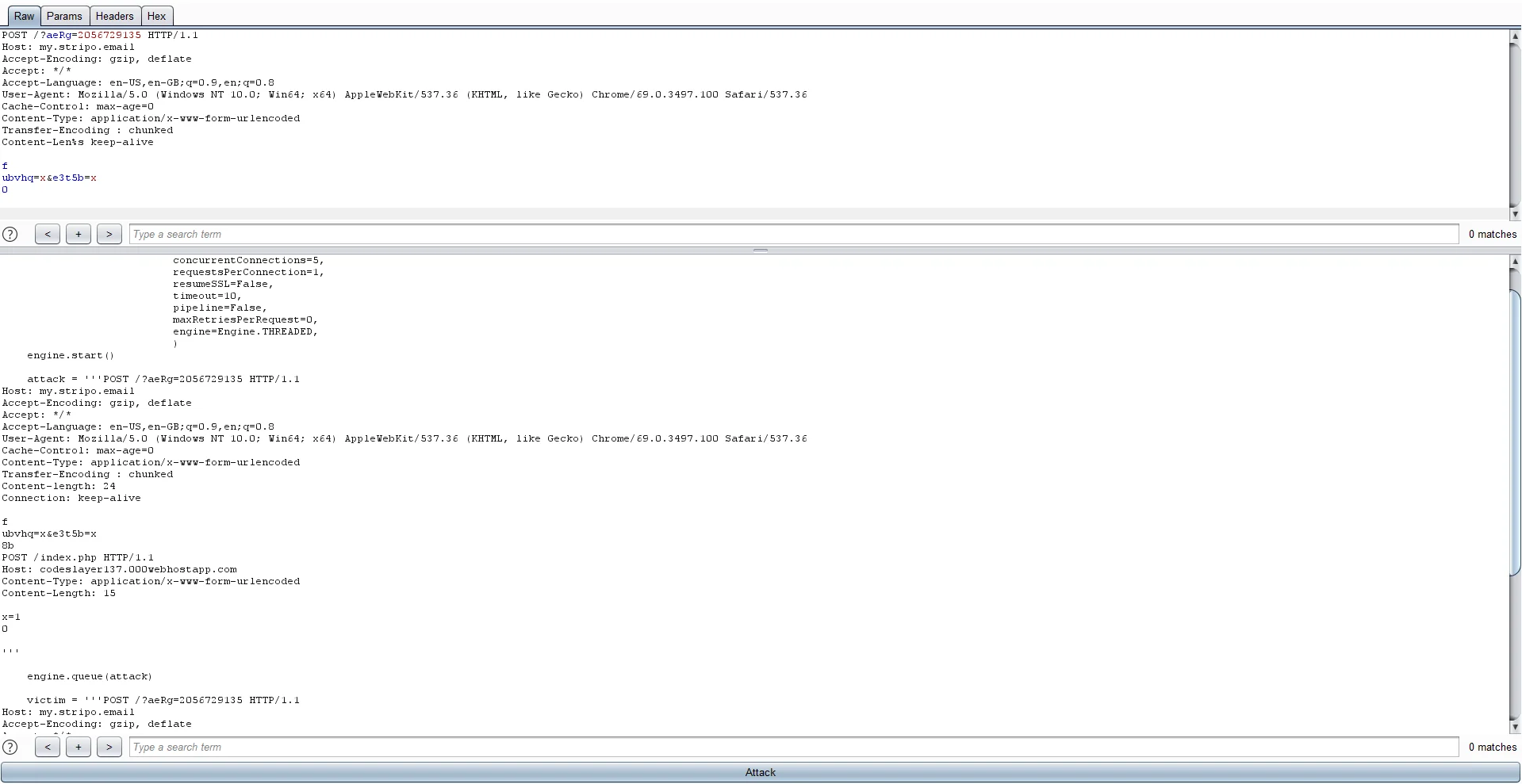
I use BurpSuite with the help of the HTTP Smuggler Request plugin to provide POC 1.Run the burp suite turbo intruder on the following request POST /?aeRg=2056729135 HTTP/1.1 Host: my.stripo.email Accept-Encoding: gzip, deflate Accept: / Accept-Language: en-US,en-GB;q=0.9,en;q=0.8 User-Agent: Mozilla/5.0 (Windows NT 10.0; Win64; x64) AppleWebKit/537.36 (KHTML, like Gecko) Chrome/69.0.3497.100 Safari/537.36 Cache-Control: max-age=0 Content-Type: application/x-www-form-urlencoded Transfer-Encoding : chunked Content-Len%s keep-alive
f ubvhq=x&e3t5b=x 0
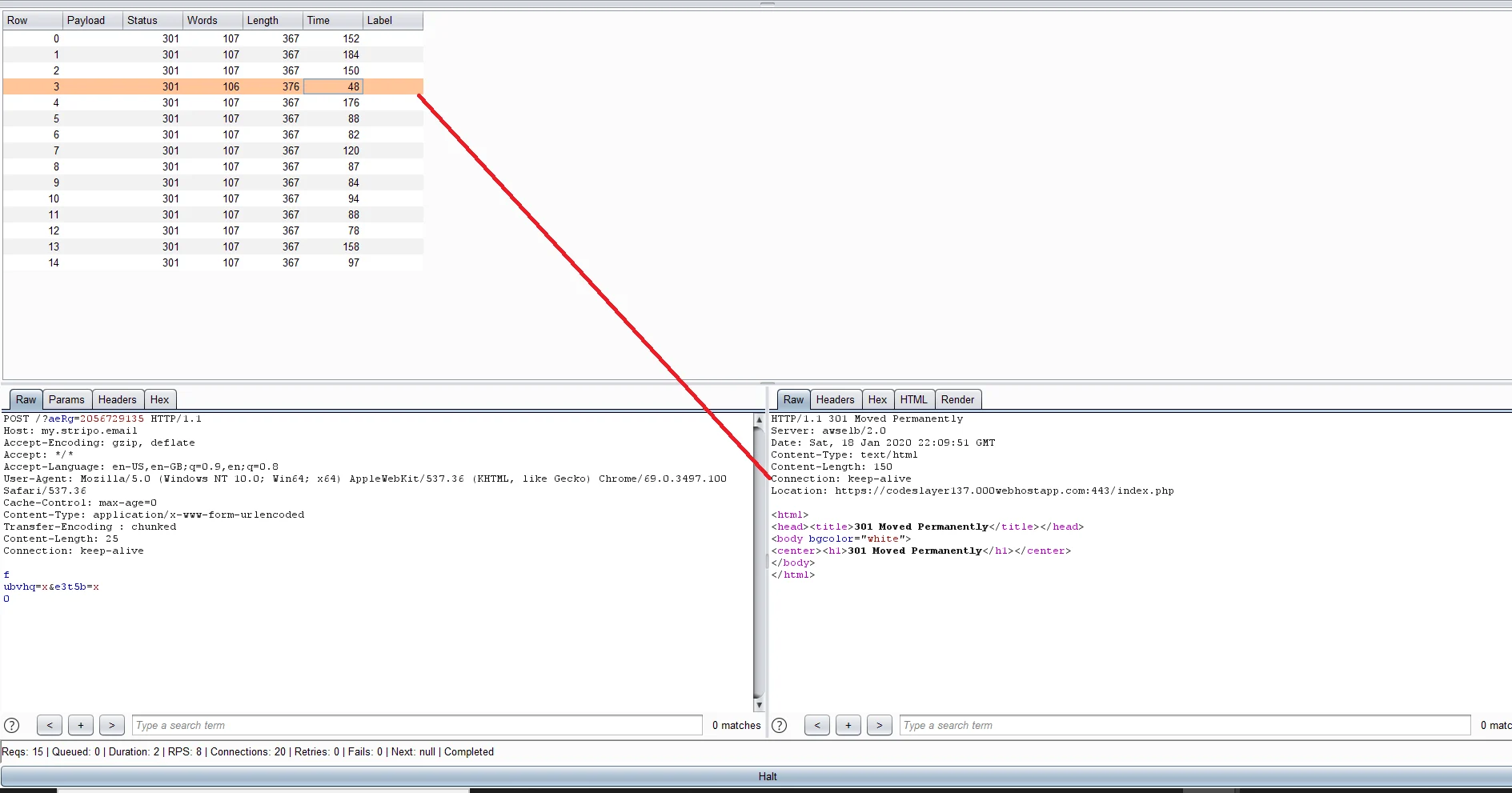
2.The script for the turbo intruder is attached with the name poc.txt 3.301 object responses OK for the post request needed to provide a header response to Location: https://codeslayer137.000webhostapp.com/indeks. php Please see the attached screenshot. (2.png).
Impact
Impact an attacker can poison the TCP / TLS socket and add arbitrary data to the next request. Depending on the functionality of the website, this can be used to bypass front-end security rules, internal system access, poison the web cache, and launch various attacks on users who actively activate the site.
Reference: https://portswigger.net/research/http-desync-attacks-request-smuggling-reborn
Best regards
CodeSlayer13
Attachments
Not written yet. The AI write-up for this report has not been written yet. The Original tab links to the source.
How it worked
Root cause
Likely the front-end and back-end servers parsed the Transfer-Encoding and Content-Length headers inconsistently, so a malformed chunked request was interpreted as having a different length by each server.
Impact
An attacker could poison the back-end TCP/TLS socket and prepend arbitrary data to the next request, potentially bypassing front-end security rules, accessing internal systems, poisoning web caches, or attacking users.
What the attacker needed
Ability to send crafted HTTP requests; front-end and back-end parse headers differently
How it was found
- Send a POST request with a malformed Transfer-Encoding header and a chunked body using Burp Suite's Turbo Intruder.
- Observe a 301 response with a Location header pointing to an external site.
Explained by bugbounty.wiki with AI from the original and checked against quotes from it; it can still be wrong. Read the original before relying on a detail.
Not written yet. The AI write-up for this report has not been written yet. The Original tab links to the source.
When a website sits behind a front-end server, both servers must agree on where one HTTP request ends and the next begins. Here they disagreed because of a malformed length header, so the attacker could sneak in extra data that the back-end treated as the start of the next request.
What is Smuggling / CRLF?
A front end and a back end split one connection's bytes into requests differently, letting an attacker hide a request inside another user's.








