About a Sucuri RCE…and How Not to Handle Bug Bounty Reports
Sucuri's server-side scanner disabled SSL certificate validation when fetching code from Sucuri's API, allowing a man-in-the-middle attacker to replace the base64-encoded PHP payload with arbitrary code that the scanner then executed via eval().
 Published on rcesecurity.com
Sucuri is a self-proclaimed “most recommended website security service among web professionals” offering protection, monitoring and malware removal services. They ran a Bug Bounty program on HackerOne and also blogged about how important security reports are .
The full write-up lives on its author's site
It belongs to its author, so we link to it rather than copy it. The other two tabs are our own rewrites, checked against it.
Context
Sucuri offers website protection, monitoring and malware removal services. One of those services is a server-side scanner: a PHP script that a customer places on their own web server, which runs periodic scans to detect integrity failures and compromises. The script has a random looking filename such as sucuri-[md5].php and is triggered remotely by Sucuri's infrastructure.
The report concerns that server-side scanner. The researcher found that the script disables TLS certificate verification on the callback it makes to Sucuri's monitoring endpoint, and that the response to that callback is passed to eval(). Together those two facts let an attacker who can intercept the callback run arbitrary PHP on the customer's server.
Setup
No special tooling is described. The preconditions are:
- A Sucuri account, from which the server-side scanner script can be downloaded.
- The script placed in the web root of a web server.
- The Sucuri account configured to perform server-side scans, so that the script is triggered.
The researcher notes that the full scanner script cannot be reproduced because of a copyright notice in it, so the logic is shown as pseudo-code instead.
Finding it
The pseudo-code of the scanner, as given in the report, is:
<?php
$endpoint = "monitor2";
$pwd = "random-md5";
if(!isset($_GET['run']))
{
exit(0);
}
if(!isset($_POST['secret']))
{
exit(0);
}
$c = curl_init();
curl_setopt($c, CURLOPT_URL, "https://$endpoint.sucuri.net/imonitor");
curl_setopt($c, CURLOPT_POSTFIELDS, "p=$pwd&q=".$_POST['secret']);
curl_setopt($c, CURLOPT_SSL_VERIFYPEER, false);
$result = curl_exec($c);
$b64 = base64_decode($result);
eval($b64);
?>
The script exits unless a run GET parameter and a secret POST parameter are present. It then posts the secret to https://monitor2.sucuri.net/imonitor, base64-decodes the response and evaluates it as PHP.
The line that stood out is:
curl_setopt($c, CURLOPT_SSL_VERIFYPEER, false);
Certificate verification is explicitly turned off. The report quotes the curl project's own warning on this option: disabling verification allows a man-in-the-middle to intercept the communication without the client knowing, and encryption alone is not enough because the client cannot be sure it is talking to the correct endpoint.
Exploitation
Step 1: the scanner is triggered
Once the script is in the web root and server-side scans are configured, the script is hit by the Sucuri Integrity Monitor with an HTTP POST request targeting the run method:

The request also carries the secret parameter used by the pseudo-code. The report mentions that the script performs a number of IP validations intended to ensure only Sucuri can trigger it, and that this part is flawed, citing:
$_SERVER['REMOTE_ADDR'] = $_SERVER['HTTP_X_FORWARDED_FOR']
The researcher explicitly leaves that topic out of this post.
Step 2: the callback
The script then makes a curl request back to the Sucuri monitoring system. The callback contains nothing beyond the previously mentioned secret:

Step 3: the response carries PHP
The response to the callback contains a large base64 string prefixed with WORKED::
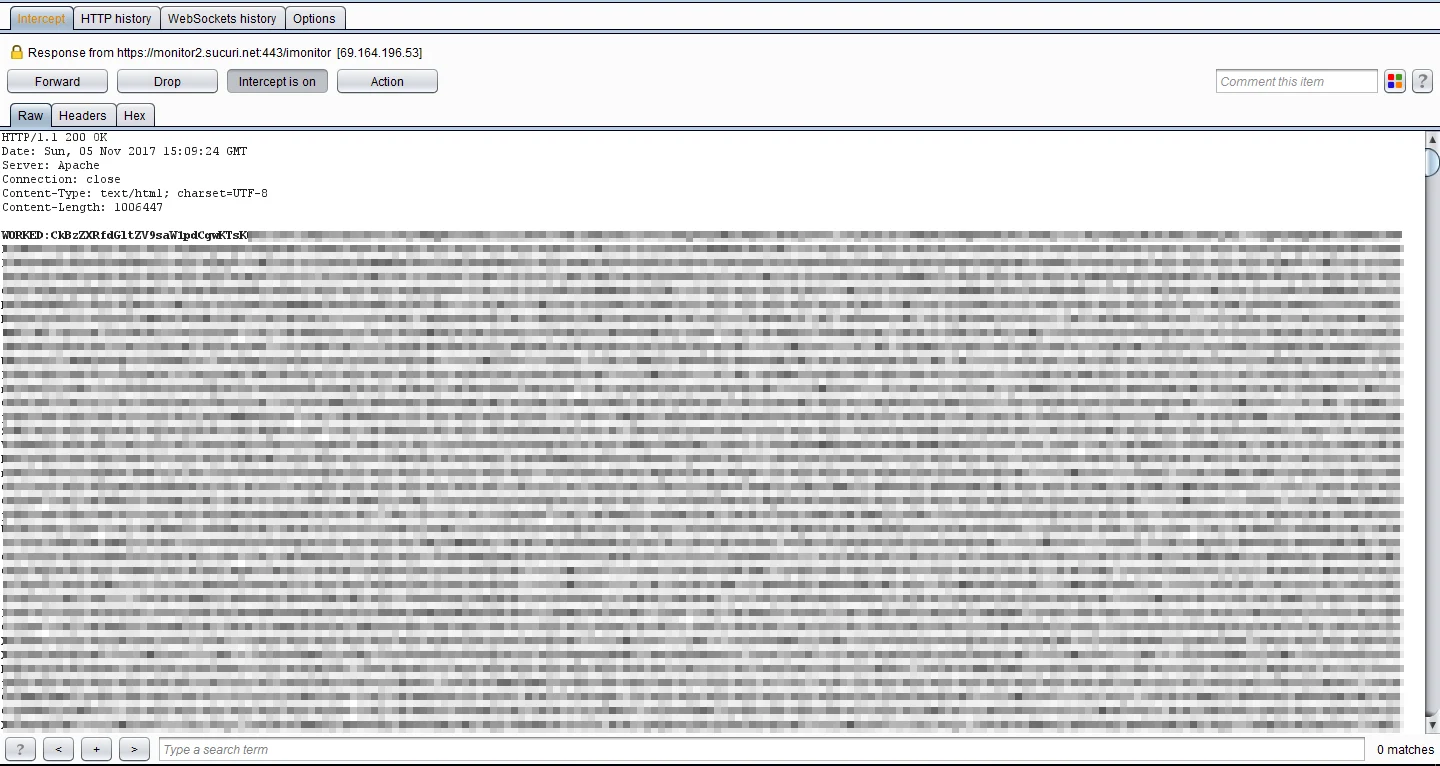
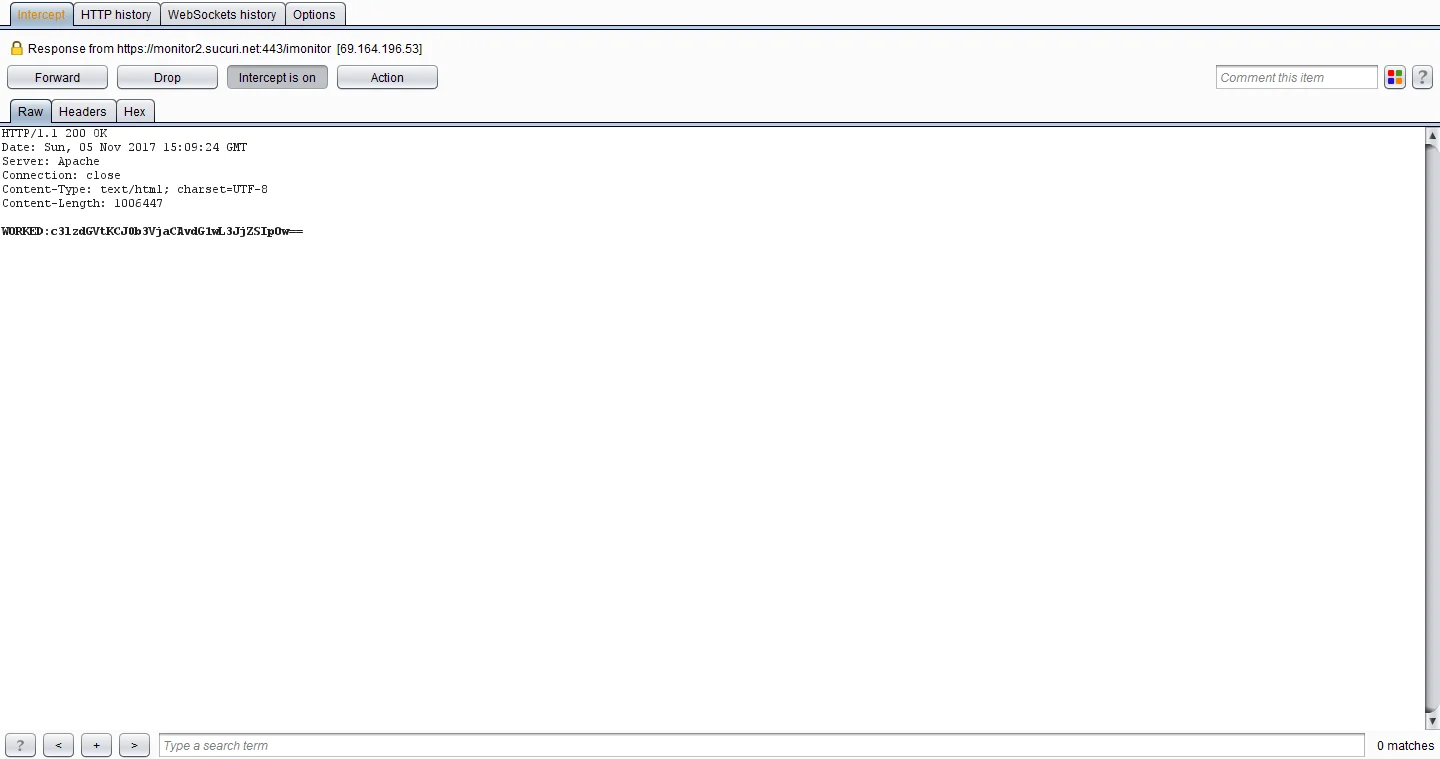
After decoding, the researcher found PHP code generated on the Sucuri infrastructure to perform the actual server-side scanning. Because the client does not verify the server certificate, an attacker with man-in-the-middle capability can replace that base64 string with their own PHP. The report gives this payload:
[redacted]==
which is equal to:
system("touch /tmp/rce");
Step 4: code execution
The replaced payload is decoded and passed to eval(), so the attacker's PHP runs on the customer's server:

Root cause
Two design decisions combine:
CURLOPT_SSL_VERIFYPEERis set tofalse, so the scanner accepts any certificate when it connects tomonitor2.sucuri.net. An attacker positioned between the customer's server and Sucuri can present their own certificate and answer the callback.- The response body is base64-decoded and passed straight to
eval(), with no signature or other integrity check. Whatever the endpoint returns is executed.
The IP validation in the script does not help against this: the attack happens on the outbound callback, not on the inbound trigger. The report also notes the X-Forwarded-For handling as a separate weakness in that validation.
Impact
An attacker with man-in-the-middle capability against the customer's server, or any intermediary hop to it, can execute arbitrary code on that server. The report frames this as an RCE affecting potentially all Sucuri customers who use the server-side scanner.
The report records Sucuri's own position on severity: exploitation requires network-level attacks to impersonate the API, which they considered a lot of effort for little result, and the scanner file contains a unique hash per site that an attacker would also need. The researcher's view is that MiTM is achievable in practice and that compliance requirements such as PCI DSS make it relevant.
Fix
Sucuri told the researcher on 2018-06-07 that a fix was ready for testing, and the report states the issue was fixed. The report does not describe the code change itself. The researcher had earlier proposed three alternatives to cope with hosters that do not offer the proper libraries:
- Deliver the certificate chain (CA, intermediates and server certificate) to the customer, separately or as part of the PHP file, and verify the server certificate within PHP, for example with
openssl_x509_parse(). - Add a customer-side method that verifies a signature delivered with the payload from
monitor2, discarding the payload beforeeval()if the signature does not match. The signature must be cryptographically secure by design. - Encrypt the payload with public-private key cryptography on the Sucuri side and decrypt it on the client side instead of base64-encoding it, which the researcher says should be doable in pure PHP.
Variants to test
- Other server-side agents that call home. Look for scripts a vendor asks you to place on your own server that make outbound HTTPS requests. A positive result is a request whose response is executed, parsed as a command, or otherwise trusted, combined with disabled certificate verification.
- Certificate verification flags in client code. Search downloaded agents and SDKs for options that turn verification off, such as
CURLOPT_SSL_VERIFYPEERset tofalse. A positive result is such a flag on a channel that carries executable or security-relevant data. - Response integrity. For any agent that receives code or configuration from a vendor endpoint, check whether the response is signed or otherwise authenticated before use. A positive result is unsigned content reaching
eval(), an interpreter, or a privileged configuration path. - Trigger validation. Test whether the inbound trigger can be replayed or spoofed, for example through
X-Forwarded-Forhandling as in the snippet above. A positive result is the agent running its callback logic when triggered from an address it should reject.
What happened, in plain words
Sucuri is a company that sells website security: it watches websites for signs of tampering, cleans up infected sites and generally acts as a guard for its customers. One of its products is a small program, written in a language called PHP, that a customer copies onto their own web server. That little program is called the server-side scanner. Every so often it wakes up, contacts Sucuri's computers, and asks them for instructions. Sucuri's computers reply with a piece of PHP code, and the scanner runs that code on the customer's server. This is how Sucuri checks whether the customer's website files have been changed or infected.
A security researcher, Julien Ahrens, looked at that scanner and found two problems that, combined, are serious. First, when the scanner talks to Sucuri's computers, it does not check that it is really talking to Sucuri. Second, whatever answer comes back is run as code on the customer's server, without any check that the answer really came from Sucuri. Put together, anyone who can sit between the customer's server and Sucuri's computers, and pretend to be Sucuri, can make the customer's server run any code they like. That is called remote code execution, or RCE.
The researcher reported this through Sucuri's bug bounty programme on HackerOne. A bug bounty programme is a scheme where a company invites outsiders to look for security problems and pays them for good reports. Sucuri paid 250 US dollars at first, then added another 500, out of an announced maximum of 5000. They fixed the problem, marked the report as informative, and then stopped answering. After a long back and forth, and after HackerOne's rules allowed it, the researcher published the whole story himself.
Some words you will need
Before going further, a few everyday explanations of things that come up constantly in this story.
- A server is a computer somewhere on the internet that answers requests from other computers. When you open a website, your browser asks a server for a page and the server sends it back.
- A web server here means the machine a customer rents or owns, on which their website lives.
- PHP is a programming language used to build websites. A file ending in
.phpis a text file containing PHP instructions; when a web server is asked for it, it runs those instructions and sends back the result. - An API (application programming interface) is a way for two programs to talk to each other, as opposed to a way for a person to talk to a program. Think of a restaurant: the menu and the waiter are the API between you and the kitchen. You do not walk into the kitchen yourself; you ask the waiter, and food comes back. Here, the scanner is the customer at the table and Sucuri's monitoring system is the kitchen.
- A callback is a request that a program makes back to its maker. The scanner does not wait for Sucuri to knock on its door; it phones home and asks for instructions. That outgoing call is the callback.
- HTTPS is the encrypted version of the web's usual language, HTTP. The padlock in your browser address bar means your browser and the website agreed on a secret code so nobody in between can read or change what is sent.
- A TLS certificate is the digital equivalent of an ID card that a server shows to prove it is who it claims to be. When your browser connects to a bank, the bank's server shows a certificate, and the browser checks it was issued by someone it trusts. If the check fails, the browser warns you.
- A man in the middle (MiTM) is someone who can sit on the network path between two computers and quietly relay, read or alter their conversation. Imagine posting a letter and the postal worker opening it, rewriting it, and sealing it again before delivery. Neither the sender nor the recipient notices unless they have a way to detect tampering.
- curl is a widely used piece of software, available inside many programming languages, for making web requests from code. The scanner uses it to call home.
- base64 is a way of writing arbitrary data using only ordinary letters, digits and a couple of symbols, so it can travel safely inside text. It is not encryption: anyone can turn it back into the original with a single command. Think of it as a standard way of packing a parcel, not a lock on the parcel.
- eval() is a PHP function that takes a piece of text and runs it as PHP code. It is the programming equivalent of a person who follows any instruction written on a note handed to them, without asking who wrote it.
- Remote code execution (RCE) is the name for the situation where an attacker can make someone else's computer run code of the attacker's choosing. It is usually the most serious kind of web security bug, because from there the attacker can do anything the server is allowed to do.
- A bug bounty programme is a company's public offer to pay researchers for finding and reporting security problems responsibly.
- HackerOne is a company that runs bug bounty programmes on behalf of other companies, including the reporting platform and the rules around disclosure.
- Disclosure means making a security problem public. Responsible disclosure usually means telling the vendor first, giving them time to fix it, and publishing later.
- PCI DSS is a set of security rules that organisations handling payment card data must follow. It is a compliance requirement, meaning a legal or contractual obligation rather than a technical one.
What the scanner does
The report cannot reproduce the full scanner file because it carries a copyright notice, so the researcher shows its logic as pseudo-code: a simplified sketch that behaves like the real thing without being the real file. Here it is:
<?php
$endpoint = "monitor2";
$pwd = "random-md5";
if(!isset($_GET['run']))
{
exit(0);
}
if(!isset($_POST['secret']))
{
exit(0);
}
$c = curl_init();
curl_setopt($c, CURLOPT_URL, "https://$endpoint.sucuri.net/imonitor");
curl_setopt($c, CURLOPT_POSTFIELDS, "p=$pwd&q=".$_POST['secret']);
curl_setopt($c, CURLOPT_SSL_VERIFYPEER, false);
$result = curl_exec($c);
$b64 = base64_decode($result);
eval($b64);
?>
Line by line, in plain words:
<?phpmarks the start of a PHP file. The web server knows everything after this is instructions, not text to display.$endpoint = "monitor2";stores the name of the Sucuri computer the script will talk to.$endpointis just a labelled box holding a value, like a sticky note with a word on it.$pwd = "random-md5";stores a password-like value. An MD5 is a kind of fingerprint computed from data; here it stands in for a random-looking string that identifies this particular installation.if(!isset($_GET['run']))checks whether the request that arrived contains a parameter calledrun. A parameter is a named value attached to a web request, the same way a search box sends what you typed.$_GETholds parameters that arrive in the address bar part of the request.exit(0);means: ifrunis missing, stop immediately and do nothing. This is a simple gate so the script only acts when asked in the right way.if(!isset($_POST['secret']))does the same check for a parameter calledsecret, this time in the body of the request rather than the address.$_POSTholds values sent in the body, which is where forms usually put their data.exit(0);again stops the script if the secret is missing.$c = curl_init();prepares a new outgoing web request. Think of it as picking up the phone and getting ready to dial.curl_setopt($c, CURLOPT_URL, "https://$endpoint.sucuri.net/imonitor");sets the address to call: the Sucuri monitoring endpoint, over HTTPS. The$endpointbox from earlier is dropped into the address.curl_setopt($c, CURLOPT_POSTFIELDS, "p=$pwd&q=".$_POST['secret']);attaches the data to send: the installation's password and the secret that arrived in the request.curl_setopt($c, CURLOPT_SSL_VERIFYPEER, false);is the line that matters. It tells curl not to check the certificate of the server it is calling. In everyday terms: the scanner is told not to look at the ID card of whoever answers the phone.$result = curl_exec($c);actually makes the call and stores whatever comes back in$result.$b64 = base64_decode($result);unpacks the answer from its base64 wrapping back into the original data.eval($b64);runs that unpacked data as PHP code. Whatever Sucuri sent is now instructions being executed on the customer's server.?>marks the end of the PHP file.
So the whole design is: someone knocks with the right two values, the scanner phones Sucuri, and whatever Sucuri says is executed. That is a deliberate design, and it is how the product is meant to work. The problem is in how carefully the scanner checks who it is talking to.
The line that stood out
The researcher's attention went to this single setting:
curl_setopt($c, CURLOPT_SSL_VERIFYPEER, false);
CURLOPT_SSL_VERIFYPEER is the switch that tells curl whether to verify the certificate of the server it connects to. Setting it to false turns verification off. The scanner will therefore accept a certificate from anyone, including someone pretending to be Sucuri.
This matters because HTTPS gives you two things, and people often confuse them. One is encryption: nobody in the middle can read the conversation. The other is authentication: you know who you are talking to. Turning off certificate verification keeps the encryption but throws away the authentication. You are whispering, but to a stranger who may be wearing your friend's coat.
The curl project itself, which makes the software, warns about exactly this. The report quotes its documentation:
WARNING: disabling verification of the certificate allows bad guys to man-in-the-middle the communication without you knowing it. Disabling verification makes the communication insecure. Just having encryption on a transfer is not enough as you cannot be sure that you are communicating with the correct end-point.
In other words, the scanner's phone call is encrypted, but it has no way of knowing whether the voice on the other end is Sucuri or an impostor.
How the attack works, step by step
Step 1: the scanner is triggered
Once the script sits in the web root (the folder on a web server where the public website files live) and the Sucuri account is set up to run server-side scans, the script is contacted by something the report calls the Sucuri Integrity Monitor. It arrives as an HTTP POST request, which is the kind of request a browser sends when you submit a form, aimed at the run method:
The report shows the incoming request from the Sucuri Integrity Monitor.
The report also mentions that the script performs a number of IP validations, meaning checks on the address the request came from, intended to make sure only Sucuri can trigger it. The researcher says this part is flawed and gives this snippet as an example:
$_SERVER['REMOTE_ADDR'] = $_SERVER['HTTP_X_FORWARDED_FOR']
REMOTE_ADDR is the address the web server actually saw the connection come from. HTTP_X_FORWARDED_FOR is a header, a labelled line in the request, in which the sender can claim to be coming via some other address. This line copies the claim over the real address, so anyone can state where they appear to come from. The researcher explicitly leaves that topic out of this post, so we will too, but it is worth knowing it exists.
Step 2: the scanner calls home
The script then makes its curl request back to the Sucuri monitoring system. The report shows the outgoing call:
This callback contains nothing beyond the secret mentioned earlier.
Step 3: the answer contains PHP code
The response to that callback is the interesting part. It contains a large base64 string, prefixed with the word WORKED::
After decoding the base64, the researcher found PHP code that had been generated on Sucuri's own infrastructure to carry out the actual scanning. That is the normal, intended behaviour: Sucuri decides what the scanner should do and sends it as code.
Now recall the missing certificate check. Because the scanner does not verify who it is talking to, an attacker who can intercept the connection can answer the call themselves. They do not need to break any encryption; they simply present their own certificate, which the scanner accepts without question, and send their own reply. Instead of Sucuri's base64 string, they send a base64 string of their own choosing. The report gives this payload:
[redacted]==
which is equal to:
system("touch /tmp/rce");
What these two blocks mean:
- The first block is the base64 packing of a short PHP instruction. It looks like gibberish because base64 uses only ordinary characters to represent arbitrary data. Anyone can unpack it; it is not a secret code.
- The second block is what you get after unpacking.
system(...)is a PHP function that runs a command on the operating system, as if someone had typed it into a terminal.touchis a standard command that creates an empty file if it does not exist, or updates its timestamp if it does./tmp/rceis the path of the file to create, in the temporary folder. - So the payload's effect is simply to create a file called
rcein/tmp. That is a harmless demonstration: it proves code ran, without doing damage. An attacker would of course put something else there.
The report shows the tampered response:
Step 4: the code runs
Back in the scanner, the reply is base64-decoded and handed to eval(). Since the reply is now the attacker's payload rather than Sucuri's, the attacker's PHP runs on the customer's server:
The report shows the execution of the arbitrary code on the customer's server. That is the whole attack. No password was guessed, no encryption was broken. The scanner was simply willing to take instructions from anyone who answered the phone.
Why it works: the root cause
Two design decisions combine into the vulnerability:
CURLOPT_SSL_VERIFYPEERis set tofalse, so the scanner accepts any certificate when it connects tomonitor2.sucuri.net. An attacker positioned between the customer's server and Sucuri can present their own certificate and answer the callback.- The response body is base64-decoded and passed straight to
eval(), with no signature or other integrity check. Whatever the endpoint returns is executed.
A signature here would mean a cryptographic stamp attached to the message, proving it came from Sucuri and was not altered. The scanner has none, so it cannot tell Sucuri's instructions from an impostor's.
The IP validation in the script does not help against this. That validation guards the incoming knock on the door; the attack happens on the outgoing phone call. The report also notes the X-Forwarded-For handling as a separate weakness in that validation.
Who is affected
An attacker with man-in-the-middle capability against the customer's server, or against any of the intermediate computers the traffic passes through on the way, can execute arbitrary code on that server. The report frames this as an RCE affecting potentially all Sucuri customers who use the server-side scanner.
The report also records Sucuri's own position on severity. They argued that a successful attack requires network-level attacks to impersonate their API, which they considered a lot of effort for very little result, and that the scanner file contains a unique hash for every site, which an attacker would also need. The researcher's view is that man-in-the-middle attacks are achievable in practice, and that compliance requirements such as PCI DSS make the issue relevant regardless.
The fix
Sucuri told the researcher on 2018-06-07 that a fix was ready for testing, and the report states the issue was fixed. The report does not describe the code change itself. The researcher had earlier proposed three alternatives, aimed at the objection that many hosting companies do not offer the proper libraries for certificate checking:
- Deliver the certificate chain (the certificate authority, the intermediate certificates and the server certificate) to the customer, separately or as part of the PHP file, and verify the server certificate within PHP, for example with
openssl_x509_parse(). In plain terms: ship the expected ID card along with the scanner, and have the scanner compare the card it is shown against the copy it was given. - Add a customer-side method that verifies a signature delivered with the payload from
monitor2, discarding the payload beforeeval()if the signature does not match. The signature must be cryptographically secure by design. In plain terms: Sucuri stamps every instruction with a seal only it can produce, and the scanner refuses anything without a valid seal. - Encrypt the payload with public-private key cryptography on the Sucuri side and decrypt it on the client side instead of base64-encoding it, which the researcher says should be doable in pure PHP. In plain terms: Sucuri locks the instructions in a box that only the scanner can open, so an impostor cannot substitute their own.
How the report was handled
The communication side of this story is, in the researcher's words, the most interesting part. Here is the timeline as the report gives it.
| Date | What happened |
|---|---|
| 2017-11-05 | Initial report sent to Sucuri via HackerOne (report #287580). |
| 2017-11-16 | Sucuri says they are aware of the issue but cannot enable CURLOPT_SSL_VERIFYPEER because many hosters do not offer the proper libraries, and the attack would require an attacker with MiTM on the hoster. |
| 2017-11-17 | Sucuri says they do not think a MiTM is doable, arguing that if it were, attackers could hijack email from almost any provider and redirect traffic by hijacking Google's [redacted] DNS. |
| 2017-11-17 | The researcher proposes three alternative fixes (the ones listed above). |
| 2017-11-29 to 2018-05-16 | Sucuri goes silent for half a year. The researcher tries HackerOne and email, and requests mediation through HackerOne. |
| 2018-06-07 | Sucuri says a fix is ready for testing. |
| 2018-06-21 | Sucuri pays the minimum bounty of 250 USD, citing the effort required for a network-level attack and the unique hash in the scanner file. |
| 2018-07-18 | Sucuri adds 500 USD because they apparently misunderstood the signature validation point. |
| 2018-09-15 | The researcher requests public disclosure, arguing that if the issue is so low severity for Sucuri, they should not mind. |
| 2018-10-12 | Shortly before the scheduled disclosure date, Sucuri reopens the report and changes its status to Informative without further clarification, then goes silent again. |
| 2018-11-23 | The researcher follows up with HackerOne, which contacts Sucuri. HackerOne says Sucuri will close their programme and that the status change was to address information they consider sensitive. |
| 2018-12-15 | HackerOne closes the programme at Sucuri's request. HackerOne points out tools to censor the report; Sucuri does not react. |
| 2019-01-02 | The researcher agrees with HackerOne on the last resort disclosure option, giving Sucuri another 180 days. No response. |
| 2019-06-13 to 2019-06-19 | The researcher emails Sucuri directly to warn them about the blog post. No answer. |
| 2019-06-20 | Public disclosure under HackerOne's last resort option. |
A few of these deserve a plain explanation.
When Sucuri argued that a MiTM cannot be doable because otherwise email and DNS could be hijacked, the researcher's reply was essentially: that is exactly why the world moved to TLS and why companies such as Google push for it everywhere. The existence of other insecure systems is not a reason to leave one more insecure.
When Sucuri paid the minimum bounty, they gave two reasons. The first was that exploitation requires network-level attacks against the hosting server or any intermediary hop, which they saw as a lot of effort for little result, and that their use of anycast does not guarantee a BGP hijacking attack would succeed. Anycast is a technique where the same address is served from many locations; BGP is the routing system that decides which path traffic takes across the internet. The second reason was that the scanner file contains a unique hash for every site, which an attacker would also need. The researcher's counterpoint on the first is that MiTM is achievable in practice and that compliance requirements such as PCI DSS make it relevant.
Marking a report as informative is a status meaning the report was treated as useful information rather than as a confirmed vulnerability. Changing the status shortly before a scheduled disclosure, and then not answering, is what the researcher describes as going silent for the second time.
About HackerOne's last resort option
The researcher tried several times to disclose the issue through HackerOne, but Sucuri was not willing to provide any disclosure timeline, and in the end did not respond at all, not even by email. That is why he took the last resort option after consulting with HackerOne, under their guidelines:
If 180 days have elapsed with the Security Team being unable or unwilling to provide a vulnerability disclosure timeline, the contents of the Report may be publicly disclosed by the Finder. We believe transparency is in the public's best interest in these extreme cases.
In plain words: the normal deal is that a researcher tells the vendor, the vendor fixes the problem, and then everyone agrees when to tell the world. If the vendor will not even say when, and enough time has passed, the researcher may publish. The researcher's stated reason for publishing is that this is an RCE affecting potentially all of Sucuri's customers who use the server-side scanner, and that there was no public or customer statement by Sucuri that he was aware of, so the general public deserves to know.
Things to look for in other products
These are the patterns from this report, written so that someone new to security can recognise them elsewhere.
- Other server-side agents that call home. Look for scripts a vendor asks you to place on your own server that make outbound HTTPS requests. A positive result is a request whose response is executed, parsed as a command, or otherwise trusted, combined with disabled certificate verification.
- Certificate verification flags in client code. Search downloaded agents and SDKs for options that turn verification off, such as
CURLOPT_SSL_VERIFYPEERset tofalse. A positive result is such a flag on a channel that carries executable or security-relevant data. - Response integrity. For any agent that receives code or configuration from a vendor endpoint, check whether the response is signed or otherwise authenticated before use. A positive result is unsigned content reaching
eval(), an interpreter, or a privileged configuration path. - Trigger validation. Test whether the inbound trigger can be replayed or spoofed, for example through
X-Forwarded-Forhandling as in the snippet above. A positive result is the agent running its callback logic when triggered from an address it should reject.
Glossary
- API: a way for two programs to talk to each other, rather than for a person to talk to a program.
- Anycast: a technique where the same network address is served from many locations at once.
- Base64: a way of writing arbitrary data using ordinary characters so it can travel inside text; it is packing, not encryption.
- BGP: the routing system that decides which path traffic takes across the internet.
- Bug bounty programme: a company's public offer to pay researchers for finding and reporting security problems.
- Callback: a request a program makes back to its maker, here the scanner phoning home to Sucuri.
- Certificate: a digital ID card a server shows to prove who it is.
- Certificate verification: checking that a server's certificate was issued by someone trusted and belongs to the right server.
- Compliance requirement: a legal or contractual obligation, such as PCI DSS, rather than a technical one.
- curl: software, available inside many programming languages, for making web requests from code.
- Disclosure: making a security problem public, usually after telling the vendor and giving them time to fix it.
- eval(): a PHP function that runs a piece of text as PHP code.
- HackerOne: a company that runs bug bounty programmes on behalf of other companies, including the reporting platform and disclosure rules.
- Header: a labelled line in a web request or response carrying extra information, such as where the sender claims to come from.
- HTTPS: the encrypted version of HTTP, the web's usual language.
- Informative: a report status meaning the report was treated as useful information rather than a confirmed vulnerability.
- Man in the middle (MiTM): someone who can sit on the network path between two computers and relay, read or alter their conversation.
- MD5: a kind of fingerprint computed from data, used here as a random-looking identifier.
- Parameter: a named value attached to a web request, like a search box sends what you typed.
- PCI DSS: a set of security rules for organisations that handle payment card data.
- PHP: a programming language used to build websites.
- Pseudo-code: a simplified sketch of a program that shows its logic without being the real file.
- Remote code execution (RCE): a situation where an attacker can make someone else's computer run code of the attacker's choosing.
- Server: a computer on the internet that answers requests from other computers.
- Signature: a cryptographic stamp attached to a message, proving who sent it and that it was not altered.
- TLS: the encryption technology behind HTTPS.
- Web root: the folder on a web server where the public website files live.
- X-Forwarded-For: a request header in which the sender can claim to be coming via some other address.







