Clickjacking in love.uber.com
The domain love.uber.com could be loaded inside an iframe, meaning it lacked framing protections. An attacker could overlay their own content on top of the framed page to trick a user into clicking something unintended, such as entering credentials into attacker-controlled fields.

- Disclosed after 2 months
Hi ,
Your domain love.uber.com is vulnerable to Clickjacking.
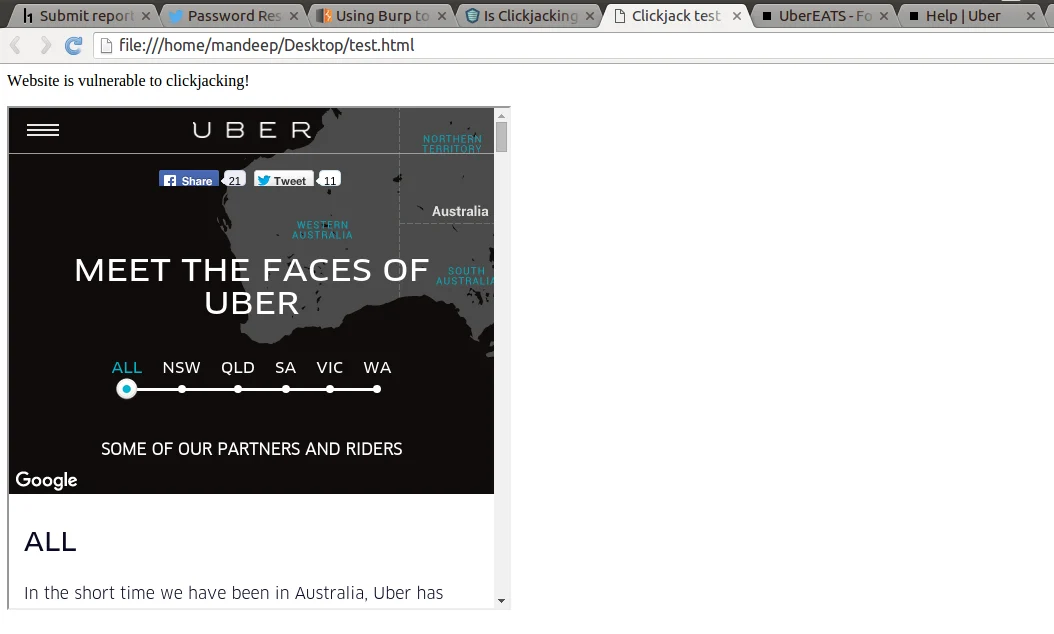
I'm able to load the domain love.uber.com in an iframe , so an attacker can certainly take advantage of this clickjacking bug in love.uber.com
Click-jacking is a process of “stealing” clicks on your site, redirecting them to other places, by putting your page in an iframe and placing the attacker’s content over yours. The idea is to make this look as seamless as possible, so the user can’t tell right away that something is wrong.
if someone frames your site and puts login controls directly over yours, then even tools like SiteKey , won’t prevent them from collecting username and password data.
POC Screenshot Attached !
Attachments
Not written yet. The AI write-up for this report has not been written yet. The Original tab links to the source.
How it worked
Root cause
Likely the application did not send headers such as X-Frame-Options or Content-Security-Policy frame-ancestors to stop other sites from embedding it.
Impact
An attacker could trick a user into interacting with the framed site, potentially capturing login credentials, though the report only demonstrates that framing was possible.
What the attacker needed
Victim visits attacker page; target page can be framed
Explained by bugbounty.wiki with AI from the original and checked against quotes from it; it can still be wrong. Read the original before relying on a detail.
Not written yet. The AI write-up for this report has not been written yet. The Original tab links to the source.
Clickjacking is when a malicious site loads a real site inside an invisible frame and puts fake buttons or login boxes on top. The user thinks they are clicking the real site, but their clicks go to the attacker. This report says the site could be framed, so that trick was possible.
What is UI spoofing?
The interface lies to the user: a framed page catches their clicks, or a browser shows the wrong address or a fake prompt. Paid when it leads to a sensitive action or convincing phishing.




