Subdomain takeover on rider.uber.com due to non-existent distribution on Cloudfront
The domain rider.uber.com was configured with a DNS record pointing to a CloudFront distribution that did not exist, allowing an attacker to claim the distribution and serve content under the Uber domain. The attacker demonstrated this by hosting a proof-of-concept page at a subpath of the domain.
 Originally disclosed on HackerOne
- Triaged in under an hour
- Fixed in 16 hours
- Paid in 15 days
- Disclosed after 2 months
Hi,
3 hours ago, rider.uber.com was responding like this:
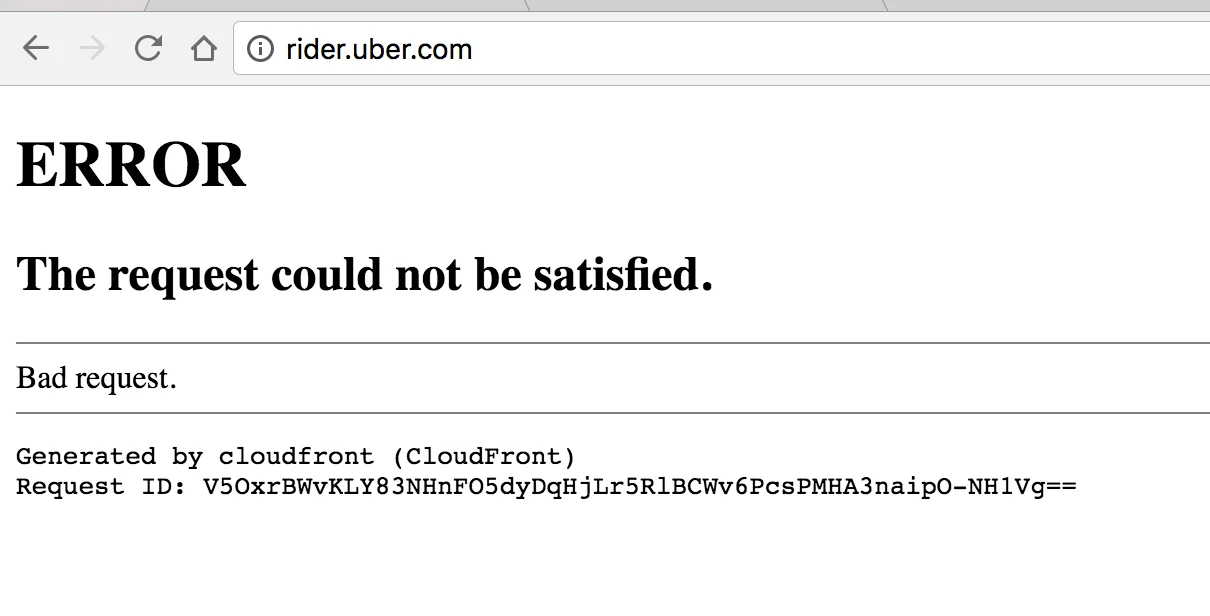
This happened on both HTTP and HTTPS. Now, as our blog post from last week says: https://labs.detectify.com/2016/10/05/the-story-of-ev-ssl-aws-and-trailing-dot-domains/
This means that there's a high chance this domain does not have any distribution at all, and that anyone can now claim it.
I've done this as a PoC now, I haven't placed anything on the apex level, howevel if you use this URL: http://rider.uber.com/login-poc
There's a PoC there:
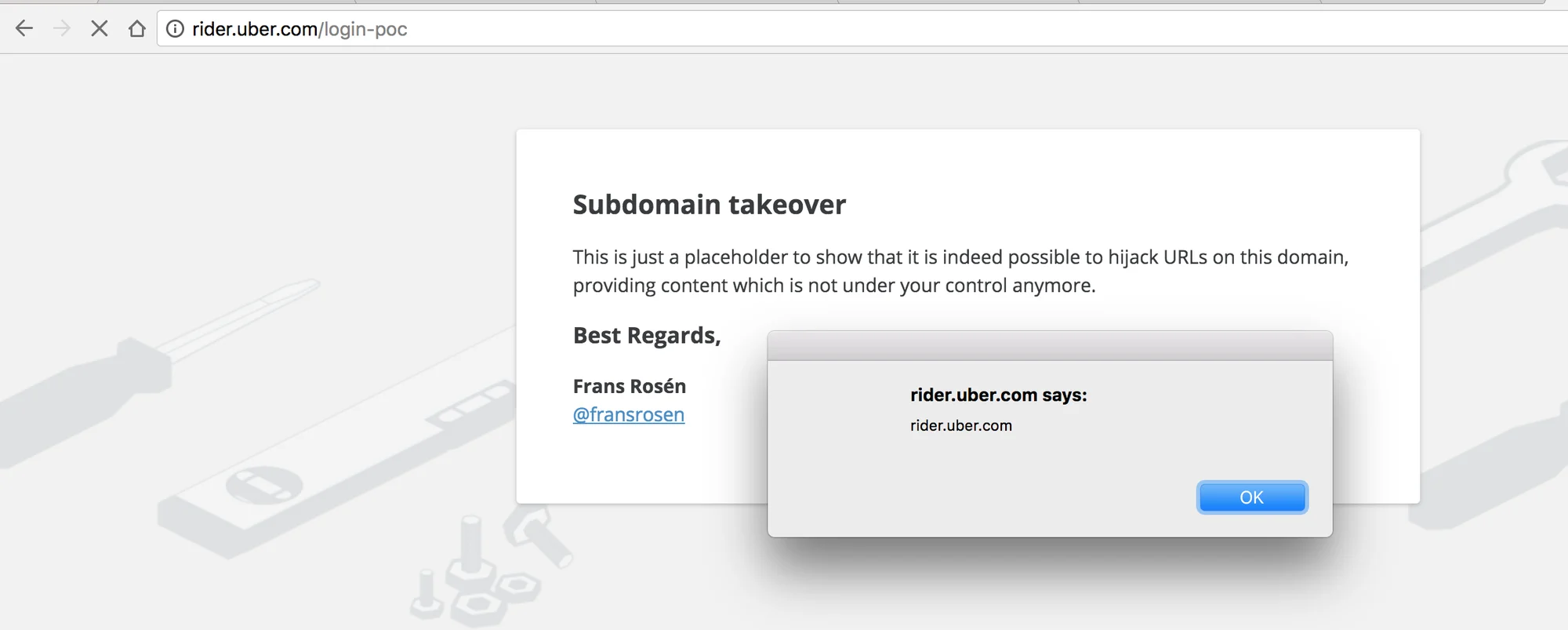
You should immediately remove the DNS RR, or point it elsewhere, or tell me and I'll remove the Alternate CNAME again on my PoC-distribution.
Regards, Frans
Attachments

What the report shows
The target is rider.uber.com, a hostname in the Uber program. The researcher noticed that the host had started returning an error on both HTTP and HTTPS, and the screenshot he attached shows the response the domain was serving at that point.
He connected that behaviour to a blog post his team had published the week before, which described how a domain can end up with no distribution behind it in AWS and therefore be claimable by anyone. On that basis he judged there was a high chance this hostname had no CloudFront distribution at all.
He then tested the theory. He created a distribution of his own and added an Alternate CNAME to it, which he later offered to remove. and he reports that he did not place anything on the apex level. The proof of concept was reachable at:
http://rider.uber.com/login-poc
In his closing lines he asks the team to remove the DNS record, point it elsewhere, or tell him so that he can remove the Alternate CNAME again on his PoC distribution. The report gives no bounty amount, no severity rating and no confirmation of a fix; it ends with that request.
Root cause
The report suggests a dangling DNS record: a hostname whose CloudFront distribution may no longer exist, leaving the name free to claim. Because the distribution is gone, the name it was pointing at is free, and a new distribution can be created that claims it.
Impact
The researcher's own framing is careful: there is a high chance the domain has no distribution, and his PoC shows a distribution he created serving content on the hostname. What that means in practice is that content served from the Uber hostname can be controlled by whoever holds the distribution. The report does not go further than the PoC page and does not describe any credential theft, cookie access or user impact, so the demonstrated impact stops at content injection on a trusted hostname.
How this kind of bug works
Subdomain takeover is a delegation problem. A hostname is pointed at a third-party service, usually with a CNAME, and the service decides what to serve based on a name or identifier carried in that record. When the customer deletes the resource at the provider but leaves the DNS record behind, the pointer remains and the resource name becomes available. The next person to create a resource with that same name inherits all traffic to the hostname.
The reason this matters is trust: browsers, cookies scoped to the parent domain, allowlists, email and OAuth redirect rules all treat the hostname as belonging to the organisation. Serving attacker content from it can enable phishing on a legitimate-looking URL, cookie theft where cookies are scoped broadly, bypass of redirect allowlists, and in some setups interception of traffic intended for the original service.
The defences are process and verification rather than a single control: delete the DNS record as part of decommissioning the resource, keep an inventory that ties every external CNAME to a live resource, monitor for records whose target no longer resolves or whose provider reports the name as unclaimed, and use provider features that reserve the name after deletion where they exist.
How to test for it
- Enumerate hostnames for the target through certificate transparency logs, passive DNS, search engine results and the organisation's own published lists.
- Resolve each hostname and record the CNAME chain. Flag anything pointing at a cloud or SaaS provider: object storage, CDN, application hosting, marketing pages, help centres.
- For each flagged record, request the hostname over HTTP and HTTPS and read the response body and status code carefully. Provider-specific error pages are the strongest signal: a storage bucket that does not exist, a CDN distribution that is not configured, an application host that reports an unknown app.
- Confirm the resource name is genuinely unclaimed by attempting to create a resource with that exact name in your own account at the provider. A successful creation plus content served through the target hostname is the proof.
- Keep the PoC minimal: a static page with a unique marker, no collection of visitor data, and no interaction with real users. Remove the claim once the report is acknowledged.
Common false positives: the hostname resolves to a live resource that simply returns an error for other reasons; the provider serves a generic error page for every unknown name but does not allow claiming; the record points to a service where the name is still reserved by the owner; or the hostname is not actually reachable from the internet. A response that looks like a takeover page but cannot be reproduced by creating the resource is not a finding.
How it is fixed
Remove the dangling DNS record, or repoint it at a resource the organisation controls. Where the provider supports it, reserve the resource name so it cannot be claimed by another account. Add decommissioning checks that delete DNS entries together with the resource, and monitor external CNAMEs for targets that stop resolving or start returning unclaimed-resource errors.
Hunting notes
These bugs cluster around forgotten infrastructure: marketing microsites, campaign landing pages, status and help pages, staging hostnames, and anything created quickly and retired quietly. Old certificate transparency entries and historical DNS data are good sources because they surface names that no longer appear in current documentation.
Useful recon signals are CNAMEs to CDN and storage providers, hostnames whose responses changed recently, and error pages that name the provider. When you report, show the chain from DNS record to provider error to your claimed resource to content served on the target hostname, and keep the claim benign. Programs accept these reports when the proof is reproducible and the impact is framed honestly: control of content on a trusted hostname, with the specific consequences that follow from how that hostname is used.
What happened, in plain words
A security researcher was looking at rider.uber.com, a hostname belonging to Uber. A hostname is the part of a web address you type into a browser, like rider.uber.com. He noticed that the site had stopped working: it returned an error page on both HTTP and HTTPS. HTTP and HTTPS are the two ways a browser can talk to a website; HTTPS is the encrypted version, the one with the padlock.
The screenshot shows the error the domain was serving at that moment. The researcher connected this to a blog post his team had published the week before, which explained how a domain can end up with nothing behind it in Amazon Web Services (AWS) and therefore be claimable by anyone. AWS is a large cloud provider: companies rent computers and services from it instead of running their own. One of those services is CloudFront, a content delivery network (CDN), which stores copies of a site on servers around the world so pages load faster. On that basis he judged there was a high chance this hostname had no CloudFront distribution at all. A distribution is the CloudFront setup that actually serves a site; if it is deleted, nothing is left to answer.
He then tested the theory. He created a distribution of his own and added an Alternate CNAME to it. He says he did not place anything on the apex level, meaning the bare domain itself was left untouched. The proof of concept (PoC), a small demonstration that proves the problem is real, was reachable at:
http://rider.uber.com/login-poc
In other words, a page the researcher controlled appeared under a genuine Uber address. That is the whole point: visitors would see the Uber name in their browser bar while the content came from someone else.
In his closing lines he asks the team to remove the DNS record, point it elsewhere, or tell him so that he can remove the Alternate CNAME again on his PoC distribution. DNS, the Domain Name System, is the internet's address book: it maps a name like rider.uber.com to the server that should answer. A CNAME is a DNS entry that says "this name is really another name, go look there instead". An Alternate CNAME is the extra name CloudFront gives a distribution so it can be reached under a custom hostname. The report gives no bounty amount, no severity rating and no confirmation of a fix; it ends with that request.
Root cause
The report suggests a dangling DNS record: a hostname whose CloudFront distribution may no longer exist, leaving the name free to claim. Because the distribution is gone, the name it was pointing at is free, and a new distribution can be created that claims it.
Impact
The researcher's own framing is careful: there is a high chance the domain has no distribution, and his PoC shows a distribution he created serving content on the hostname. What that means in practice is that content served from the Uber hostname can be controlled by whoever holds the distribution. The report does not go further than the PoC page and does not describe any credential theft, cookie access or user impact, so the demonstrated impact stops at content injection on a trusted hostname.
In general, how this kind of bug works
This class of bug is called subdomain takeover. It is a delegation problem, and a simple comparison helps: imagine you tell the post office that all letters for your old office should be forwarded to a new address. If you close the new office but forget to cancel the forwarding, anyone who moves into that address starts receiving your mail.
A hostname is pointed at a third-party service, usually with a CNAME, and the service decides what to serve based on a name or identifier carried in that record. When the customer deletes the resource at the provider but leaves the DNS record behind, the pointer remains and the resource name becomes available. The next person to create a resource with that same name inherits all traffic to the hostname.
The reason this matters is trust: browsers, cookies scoped to the parent domain, allowlists, email and OAuth redirect rules all treat the hostname as belonging to the organisation. A cookie is a small piece of data a site stores in your browser, often to keep you logged in; if it is scoped broadly, it can be sent to any subdomain. An allowlist is a list of addresses a system is permitted to trust. OAuth is the "log in with another service" mechanism, and its redirect rules decide where a login may send you afterwards. Serving attacker content from a trusted hostname can enable phishing on a legitimate-looking URL, cookie theft where cookies are scoped broadly, bypass of redirect allowlists, and in some setups interception of traffic intended for the original service. Phishing is a fake page that looks real in order to trick you into typing a password.
The defences are process and verification rather than a single control: delete the DNS record as part of decommissioning the resource, keep an inventory that ties every external CNAME to a live resource, monitor for records whose target no longer resolves or whose provider reports the name as unclaimed, and use provider features that reserve the name after deletion where they exist.
In general, how to test for it
- Enumerate hostnames for the target through certificate transparency logs, passive DNS, search engine results and the organisation's own published lists. Certificate transparency logs are public records of every certificate issued for a domain, so they reveal names that may no longer be advertised.
- Resolve each hostname and record the CNAME chain. Flag anything pointing at a cloud or SaaS provider: object storage, CDN, application hosting, marketing pages, help centres. SaaS means software sold as a service, run by someone else.
- For each flagged record, request the hostname over HTTP and HTTPS and read the response body and status code carefully. Provider-specific error pages are the strongest signal: a storage bucket that does not exist, a CDN distribution that is not configured, an application host that reports an unknown app.
- Confirm the resource name is genuinely unclaimed by attempting to create a resource with that exact name in your own account at the provider. A successful creation plus content served through the target hostname is the proof.
- Keep the PoC minimal: a static page with a unique marker, no collection of visitor data, and no interaction with real users. Remove the claim once the report is acknowledged.
Common false positives: the hostname resolves to a live resource that simply returns an error for other reasons; the provider serves a generic error page for every unknown name but does not allow claiming; the record points to a service where the name is still reserved by the owner; or the hostname is not actually reachable from the internet. A false positive is a result that looks like a problem but is not one. A response that looks like a takeover page but cannot be reproduced by creating the resource is not a finding.
In general, how it is fixed
Remove the dangling DNS record, or repoint it at a resource the organisation controls. Where the provider supports it, reserve the resource name so it cannot be claimed by another account. Add decommissioning checks that delete DNS entries together with the resource, and monitor external CNAMEs for targets that stop resolving or start returning unclaimed-resource errors.
In general, where to look
These bugs cluster around forgotten infrastructure: marketing microsites, campaign landing pages, status and help pages, staging hostnames, and anything created quickly and retired quietly. Old certificate transparency entries and historical DNS data are good sources because they surface names that no longer appear in current documentation.
Useful recon signals are CNAMEs to CDN and storage providers, hostnames whose responses changed recently, and error pages that name the provider. Recon means the information-gathering phase before testing. When you report, show the chain from DNS record to provider error to your claimed resource to content served on the target hostname, and keep the claim benign. Programs accept these reports when the proof is reproducible and the impact is framed honestly: control of content on a trusted hostname, with the specific consequences that follow from how that hostname is used.
Glossary
- Hostname: the name part of a web address, such as
rider.uber.com. - HTTP / HTTPS: the two ways a browser talks to a website; HTTPS is the encrypted version.
- AWS: Amazon Web Services, a cloud provider that rents computing and hosting services.
- CloudFront: AWS's content delivery network, which serves copies of a site from many locations.
- Distribution: a CloudFront configuration that serves a particular site.
- CDN: content delivery network, a service that caches and serves content close to users.
- PoC: proof of concept, a small demonstration that shows a vulnerability is real.
- DNS: the internet's address book, mapping names to the servers that answer for them.
- CNAME: a DNS entry that points one name at another name.
- Alternate CNAME: the extra name CloudFront gives a distribution so it can answer under a custom hostname.
- Dangling DNS record: a DNS entry still pointing at a resource that has been deleted.
- Subdomain takeover: claiming a hostname by registering the abandoned resource it points to.
- Cookie: a small piece of data a site stores in your browser, often used to keep you logged in.
- Allowlist: a list of addresses or names a system is permitted to trust.
- OAuth: a mechanism for logging in to one service using another service's account.
- Phishing: a fake page that imitates a real one to trick people into giving up credentials.
- SaaS: software provided as a service and run by a third party.
- Certificate transparency logs: public records of certificates issued for domains, useful for finding hostnames.
- Recon: the information-gathering phase of security testing.
- False positive: a result that looks like a vulnerability but is not one.









