Text Only Content Spoofing on ubermovement.com Community Page
The community page reflected the 'tag' parameter into the page without sanitisation, allowing an attacker to inject misleading text and a link to an external site. A victim could be tricked into believing the falsified content is legitimate and visit the attacker's site.

- Disclosed after 4 days
Text Only Content Spoofing on ubermovement.com Community Page
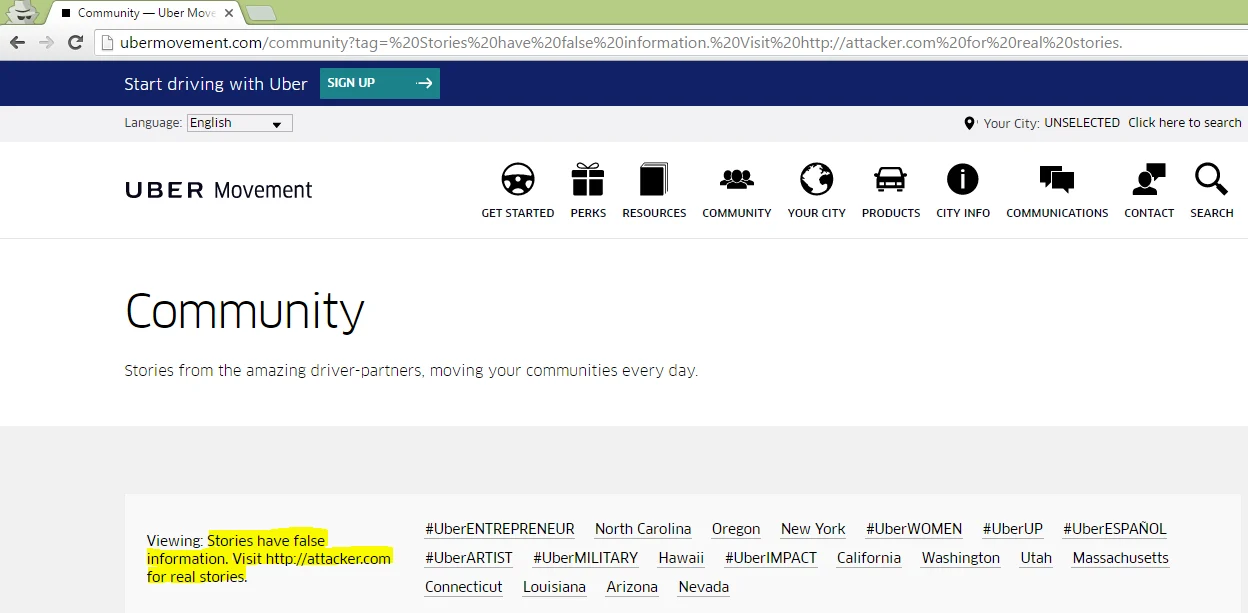
Vulnerable URL: http://ubermovement.com/community?tag=%20Stories%20have%20false%20information.%20Visit%20http://attacker.com%20for%20real%20stories.
Content Spoofing is an attack technique that allows an attacker to inject a malicious payload that is later misrepresented as legitimate content of a web application. This approach is common on error pages, or sites providing story or news entries. The content specified in this parameter is later reflected into the page to provide the content for the page. If an attacker where to replace this content with something more sinister they might be able to falsify statements on the destination website. Upon visiting this link the user would believe the content being displayed as legitimate . This attack exploits the trust relationship established between the user and the web site.
The community page says about the stories from driver-partner. An attacker can specify misleading/falsified information about the stories through ‘tag’ parameter and trick the user into clicking the URL via email. This falsified information is reflected back on to the browser by the application and user consider it as a legitimate content, thereby follow the information provided by the attacker. In this example the falsified content is directly reflected back on the same page. Please refer the attachment.
Valid Page: http://ubermovement.com/community?tag=Washington Modified Page: http://ubermovement.com/community?tag=%20Stories%20have%20false%20information.%20Visit%20http://attacker.com%20for%20real%20stories.
It is recommended to allow the user to supply only trusted input using white-listing technique in order to maintain the trust between the user and web site.
Attachments
Not written yet. The AI write-up for this report has not been written yet. The Original tab links to the source.
How it worked
Root cause
Likely the application reflected user-supplied input from the 'tag' parameter into the page without validating or encoding it.
Impact
An attacker could trick users into believing falsified information is legitimate content from the site and follow a link to an attacker-controlled site.
What the attacker needed
Victim clicks a crafted link
The fix
The application should only allow trusted input using a whitelisting technique.
How it was found
- Visit the community page with a normal tag value to see the valid page.
- Modify the 'tag' parameter to contain misleading text and a link to an attacker-controlled site.
- Send the modified URL to a victim (e.g., via email) so they see the falsified content as part of the legitimate page.
Explained by bugbounty.wiki with AI from the original and checked against quotes from it; it can still be wrong. Read the original before relying on a detail.
Not written yet. The AI write-up for this report has not been written yet. The Original tab links to the source.
When you type something into a website's address bar, the site sometimes shows it back on the page. Here, the site showed whatever was in the 'tag' part of the link without checking it. An attacker could put a fake message and a link to their own site, making it look like the real site was saying it.
What is UI spoofing?
The interface lies to the user: a framed page catches their clicks, or a browser shows the wrong address or a fake prompt. Paid when it leads to a sensitive action or convincing phishing.





